
Edible
Chinese Artichoke
Stachys affinis
Also known as Crosne, Japanese artichoke, Knotroot
How to grow Chinese artichokes, Stachys affinis. The little spiral tubers, keeping them contained, lifting every one, and why they shrivel within a day.
At a glance
- Difficulty
- Easy
- Water
- Weekly through summer and autumn
- Light
- Full sun to light shade
- Temperature
- Fully hardy to about -20 deg C, dying back each winter
- Hardiness
- USDA 5-9, RHS H6, hardy to -20 C
- Type
- Hardy herbaceous perennial grown as an annual
- Height
- 30-45 cm
- Native to
- Northern China
- Best month
- November in the Northern Hemisphere, May in the Southern Hemisphere
Tubers survive in frozen ground and are lifted as needed through winter, so cold is an asset rather than a limit. The catch is the season, since the tubers bulk only in the last few weeks before the tops die down. Every fragment left behind grows again, which makes a bed close to permanent.
Hardiness zones describe winter cold alone. Summer heat, humidity, rainfall and the length of the growing season decide as much, so treat the range as the outer limit rather than as a recommendation.
Every month named in this guide is for the temperate Northern Hemisphere. If you garden in the Southern Hemisphere, shift each one by six months, so November becomes May. Closer to the equator the wet and dry seasons matter more than the calendar, and the shift stops being a useful guide.
Not known to be toxic
- Safe to eat
- The tubers, raw or cooked, skin and all
Chinese artichoke is a food crop and carries no toxicity concern. Neither the RHS nor the ASPCA lists Stachys affinis, which reflects how little it is grown in either country rather than any assessment. The tubers are eaten raw, cooked or pickled with the skin on and need no peeling or special preparation. Like Jerusalem artichoke and yacon it stores its carbohydrate largely as stachyose, an oligosaccharide humans cannot digest, so gut bacteria ferment it and a large portion causes wind in some people. The effect is considerably milder than Jerusalem artichoke. The genus Stachys includes hedge woundwort and betony, both long used in folk medicine, and this species has no such history in Britain. The leaves are not eaten.
Sources: RHS potentially harmful garden plants, ASPCA toxic and non-toxic plants
About
Chinese artichokes are small white spiral tubers that look like fat grubs and taste of water chestnut and artichoke heart. They are crisp raw, stay crisp cooked, and need no peeling, which is fortunate because peeling something 4 cm long with six constrictions would be intolerable.
French cooking took them up in the 1880s at Crosne in Essonne, which is why British catalogues sell them as crosnes, and they became a brief fashionable vegetable before disappearing again.
Two practical facts shape how the crop is handled. The tubers shrivel within a day of lifting, so they are dug as needed rather than stored. And every one left in the ground grows next year, so a bed becomes permanent unless you sieve it.
Appearance and character
A low, spreading clump of square stems 30 to 45 cm tall, in the manner of every member of the mint family.
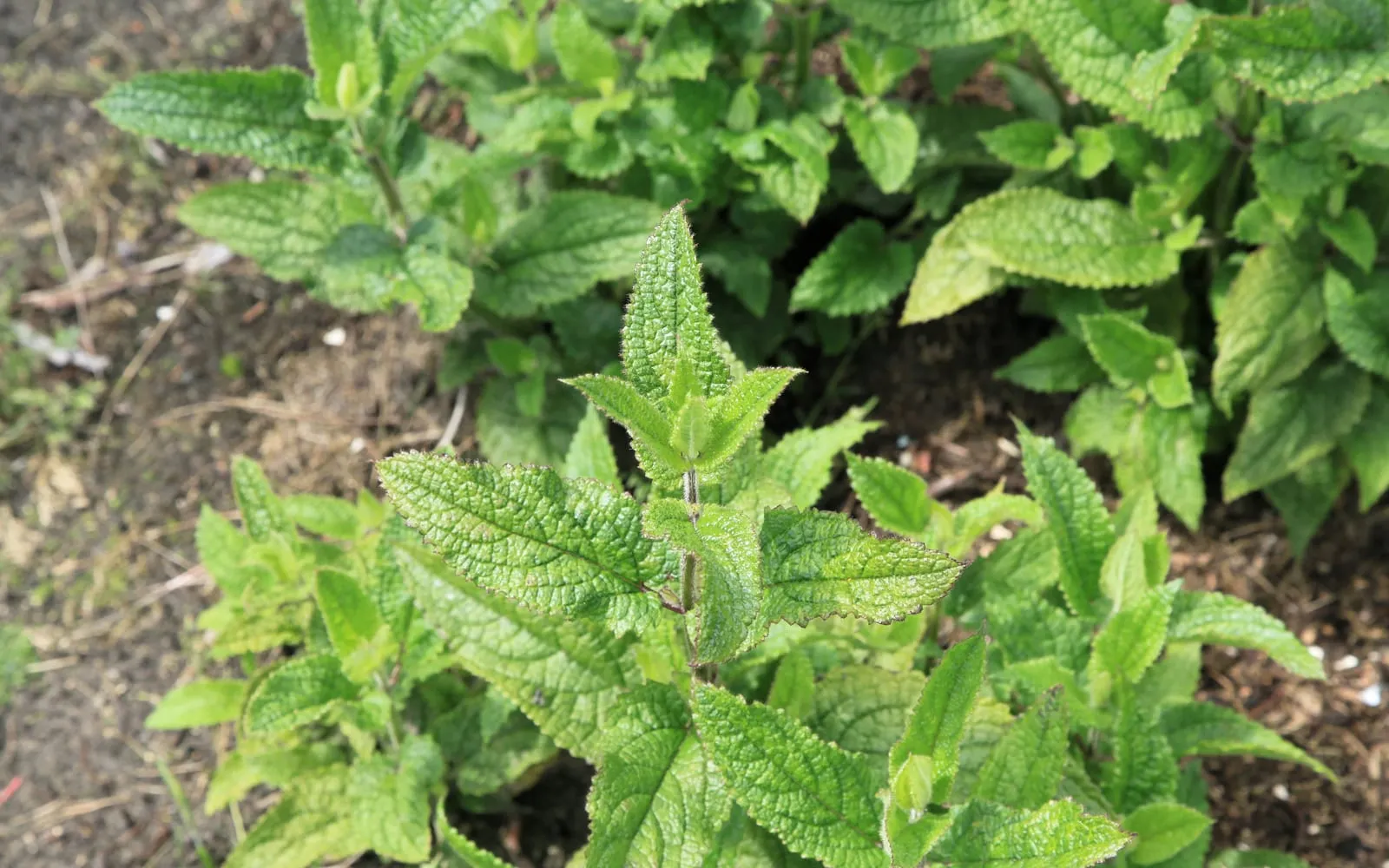
Leaves are oval, toothed, softly hairy and mid-green, held in opposite pairs. The whole plant looks like a coarse and rather dull mint and has no scent worth mentioning.
Small pinkish-white flowers appear on short spikes in late summer, and plants in a cool climate often do not flower at all.
Tubers are the crop and are unmistakable. Small, 3 to 6 cm long, pearly white, and formed of a series of swollen segments in a spiral, like a string of beads or a fat maggot.
Flesh is white, crisp and sweet, tasting of water chestnut with a hint of globe artichoke, and it keeps its crunch through cooking.
Where it is from
Chinese artichoke is native to northern China, where it has been grown for centuries and is eaten fresh and pickled.
Japan adopted it, and it appears in New Year cooking dyed red with shiso leaves, under the name chorogi.
It reached Europe in 1882, sent to the French agronomist Auguste Paillieux, who grew it at Crosne in Essonne. The village name became the French name for the vegetable and reached British catalogues unchanged.
It was briefly fashionable in Paris restaurants in the 1890s and in Britain in the Edwardian period, then fell away, largely because a tuber that shrivels in a day cannot be sold through a distribution chain.
The revival has come from restaurant kitchen gardens for exactly the same reason, since a grower who can dig them an hour before service has something nobody can buy.
How it grows
Plant tubers in March or April at 5 to 8 cm deep and 30 cm apart in rows 45 cm apart.
Contain the bed. A sunk barrier, a raised bed with solid sides or a large container all stop it spreading through the plot.
Earth up lightly in July, or mulch, since the tubers form close to the surface.
Cut the stems down in October once the foliage yellows.
Lift from November onwards, and dig only what you need. The tubers keep far better in the ground than out of it, and they stand hard frost.
Sieve the soil when you clear the bed in March, because anything left regrows. Save two dozen of the best tubers to replant straight away.
Wash them in a bag with coarse salt and rub, which is the traditional way to clean the spirals without scrubbing each one.
Through the seasons
Early spring is for planting, in March or April, into light soil in a contained bed.
Late spring brings the shoots up. Slugs take the young growth and the plant grows away from them.
Summer needs watering in dry weather and little else. Earth up or mulch in July to cover the developing tubers.
Autumn fills the tubers, from September into November. Keep watering through September. Cut the stems down when the foliage yellows in October.
Winter is the harvest. Dig as needed from November through to March. The tubers are fully hardy and shrivel within a day once lifted, so leave them where they are until the moment you want them.
Care difficulty
Easy. The plant asks for nothing through the season and crops reliably.
Containment is the decision to make before planting. Every tuber left behind grows, and a clump left alone spreads a foot a year.
Complete lifting is the corresponding job. Sieve the soil when clearing the bed.
Drainage matters over winter, since the tubers sit shallow in wet soil from November to March. Light sandy ground is what the crop wants.
Yields are modest by weight and the tubers are small, so plant more than seems necessary. A square metre gives perhaps a kilogram.
Slugs are the only pest of consequence and they find the shallow tubers.
Watering
Water weekly through summer and autumn, around 12 litres per square metre in dry weather.
Keep watering through September, which is when the tubers form and fill.
Avoid waterlogging over winter. Chinese artichoke rots on heavy wet ground, which is the one condition it does not tolerate.
Mulch after earthing up to hold moisture and cover the shallow tubers.
Container growing works well and solves both the containment and the drainage problem. Use a pot of 30 litres or more.
Warning signs, diseases and pests
Slugs graze the young shoots in spring and the shallow tubers in autumn. Earth up or mulch, and patrol on damp evenings.
Root and tuber rot follow waterlogging on heavy ground over winter. Grow in a raised bed or a container where the soil is heavy.
Powdery mildew coats the leaves in a dry late summer and does little harm at that stage.
Spreading is the main problem and is not a pest. Contain the bed and sieve the soil when clearing.
Small tubers usually mean overcrowding in a bed that has not been lifted, or a dry summer.
Shrivelling within a day of lifting is normal rather than a fault. Dig as needed.
Nothing else troubles it. The plant is hardy, unfussy and largely ignored by pests.
Growing environment
Full sun to light shade.
Light, sandy, free-draining soil is what it wants, and it produces cleaner tubers in loose ground that are easier to wash.
Free drainage over winter matters more than fertility.
A contained bed, a raised bed with solid sides, or a large container.
Slightly acid to neutral soil, pH 6 to 7.
Rotate on three years, though the plant shares almost no diseases with anything else in the garden.
Feeding
Chinese artichoke needs very little. Dig compost into the bed before planting and leave it at that.
Avoid nitrogen, which gives a large leafy clump and small tubers.
A dressing of sulphate of potash before planting helps on poor sandy ground.
An old congested clump is better lifted, sieved and replanted with fresh tubers than fed.
Never use fresh manure.
Troubleshooting
They shrivelled within a day of lifting. Normal. The tubers have a thin skin and lose water fast. Dig them as you need them and leave the rest in the ground.
They have spread across the bed. Every tuber left behind grows. Sieve the soil when clearing, and contain the bed with a barrier or grow in a container.
The tubers are tiny. An overcrowded bed, a dry summer, or too much nitrogen. Lift the lot, replant at 30 cm spacing, and water through September.
They rotted over winter. Waterlogging. Grow in a raised bed or a container on heavy ground.
Washing them is impossible. Put them in a bag with a handful of coarse salt and shake and rub. That is the traditional method and it works far better than a brush.
Do I peel them? No. The skin is thin and edible, and peeling a spiral tuber is not a realistic proposition.
A white powdery coating on the leaves. Powdery mildew in a dry late summer. It arrives too late to affect the crop.
How much do I get? Around a kilogram per square metre. Plant more than seems necessary, because the tubers are small.
Chinese Artichoke problem guides
Not sure what is wrong? See the common vegetable pests guide.