
Outdoor plant
Feverfew
Tanacetum parthenium
Also known as Bachelor's buttons
How to grow feverfew in a border or cottage garden. Its small white daisy flowers, pungent foliage, and long history as a traditional migraine remedy.
At a glance
- Difficulty
- Easy
- Water
- Regular watering while establishing, drought-tolerant once mature
- Light
- Full sun to light shade
- Hardiness
- USDA 4-9, RHS H5, hardy to -15 C
- Type
- Short-lived hardy perennial, often grown as a biennial
- Height
- 30-60 cm
- Native to
- Southeastern Europe, Caucasus
Reliably hardy through ordinary temperate winters, though individual plants are relatively short-lived, typically thriving for only two or three years even in good conditions. Reliable self-seeding generally keeps a planting going indefinitely without deliberate resowing, and it tolerates a wide range of soil and light conditions with little fuss.
Hardiness zones describe winter cold alone. Summer heat, humidity, rainfall and the length of the growing season decide as much, so treat the range as the outer limit rather than as a recommendation.
Harmful if eaten
- Do not eat
- The leaves, particularly when fresh
- Harm from
- Eating it and handling it
- Affects
- People, cats, dogs and horses
Feverfew leaves contain parthenolide, a compound that can cause mouth ulcers and digestive upset if chewed or eaten in quantity, and contact with the fresh foliage occasionally causes skin irritation in sensitive individuals, a reaction sometimes called feverfew dermatitis. The ASPCA lists it as mildly toxic to cats, dogs and horses. Despite this, dried feverfew leaf has a long history of use as a traditional herbal remedy for migraine, taken in controlled, prepared doses rather than eaten fresh from the garden, and this entry describes growing the plant rather than any medicinal use.
About
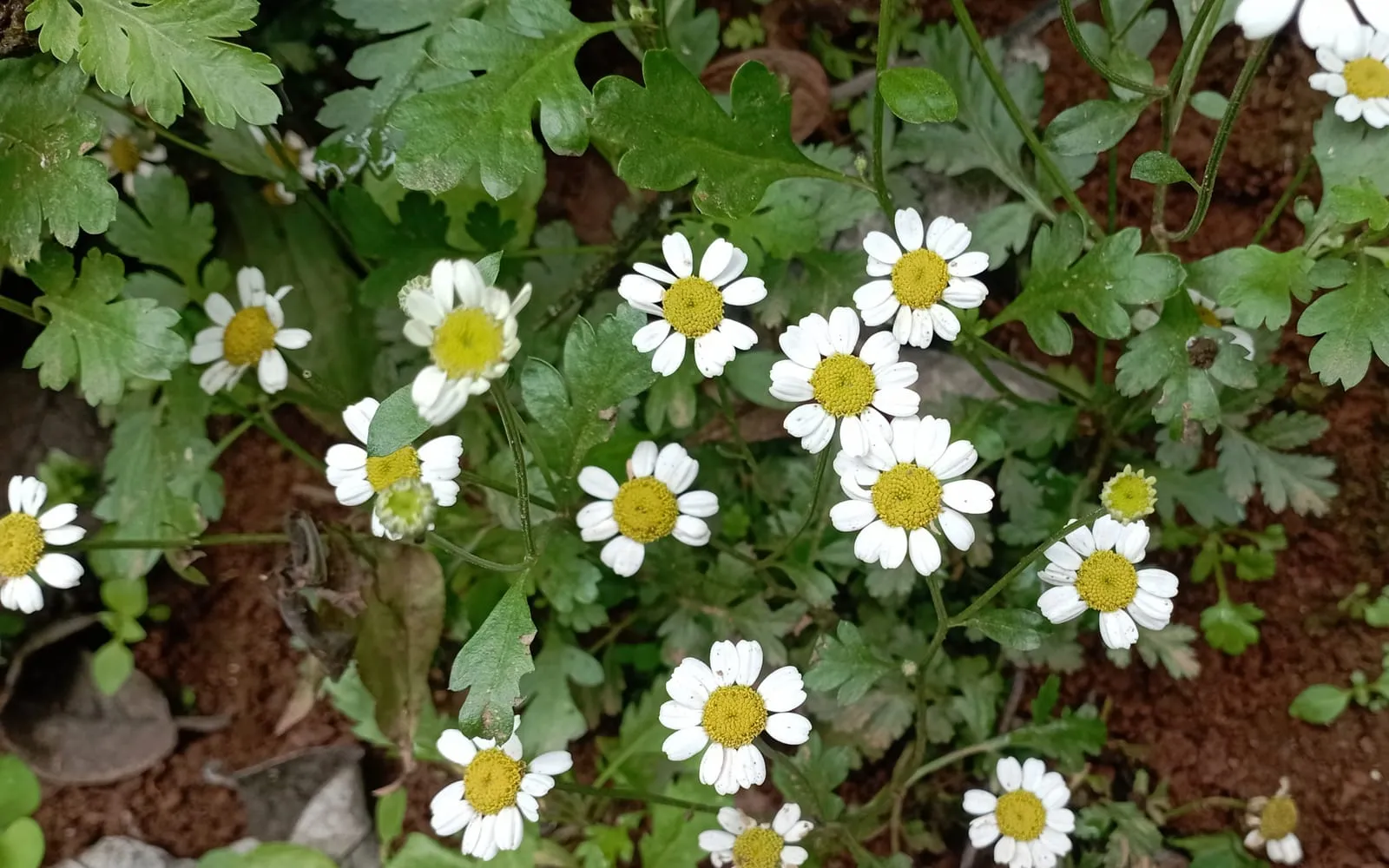
Feverfew is a bushy, short-lived perennial grown for its abundant clusters of small, daisy-like flowers, white with a yellow centre, held above pale green, strongly aromatic foliage with a sharp, distinctive scent that some find pleasant and others find overpowering at close range. It has a long history of traditional use as a herbal remedy for migraine and fever, reflected directly in its common name, and remains one of the more studied traditional herbs in modern research into migraine prevention.
Unlike its close relative tansy, which has flat, petal-less button flowers and a much higher toxicity risk, feverfew’s flowers look like conventional small daisies and the plant is generally considered milder, though its fresh leaves still carry a real, if modest, irritant risk worth respecting.
Appearance and character
Pale to mid-green, deeply lobed leaves, strongly aromatic when brushed or crushed, clothe bushy, branching stems that build into a rounded clump over a season. Small, daisy-like flowers, white with a flat or slightly domed yellow centre, open in loose clusters from early summer, much smaller and more numerous per plant than a typical garden daisy.
Flowering continues over a long season, and the plant self-seeds readily where conditions suit it, often producing volunteer seedlings the following spring that keep an informal planting going without needing deliberate resowing each year.
Where it is from
Rocky, open ground in southeastern Europe and the Caucasus, though the species has been cultivated and has naturalised so widely across Europe and beyond that it is now found well outside this original range in many temperate gardens and waste ground alike.
That long history of cultivation and naturalisation reflects an especially easy, adaptable plant, tolerant of a range of soil types and light conditions, which is part of why it has remained a fixture of cottage gardens for centuries alongside its traditional medicinal use.
How it grows
A short-lived perennial, often behaving more like a biennial in practice, typically flowering strongly for its first two or three years before individual plants decline, though a planting kept going by reliable self-seeding can appear to persist indefinitely as new seedlings replace older, spent plants. Growth is bushy and self-supporting, rarely needing staking even at full height.
Because self-seeding is usually so reliable, most gardeners let nature maintain a planting rather than deliberately propagating replacement plants, though deadheading some flower heads to control excessive self-seeding, while leaving others to set seed, offers a reasonable middle ground.
Through the seasons
Spring fresh growth resumes from established plants, and self-sown seedlings from the previous year become established and grow on.
Summer is the main flowering period, with clusters of small white daisies opening over an extended season.
Autumn flowering tapers as temperatures drop; seed disperses from unremoved flower heads, setting up the following year’s self-sown plants.
Winter established plants persist as low foliage in a mild climate or die back in a colder one, with hardy self-sown seedlings often already present and ready to grow on the following spring.
Care difficulty
Easy. This is an especially low-maintenance plant, tolerating a wide range of conditions and largely maintaining itself through self-seeding once established, with very little active management required beyond occasional deadheading if a tidier appearance or reduced self-seeding is wanted.
Watering
Regular watering supports establishment while young. Once settled, this species tolerates real drought reasonably well, needing supplemental watering mainly during an extended dry spell.
Warning signs, diseases and pests
Aphids occasionally colonise soft new growth and flower buds, and are dislodged easily with a jet of water. Leaf miners can tunnel within the leaves, showing as pale winding trails, generally a cosmetic rather than serious problem that rarely needs direct treatment on an otherwise healthy plant.
A declining, woody-looking plant after a couple of good flowering seasons is a normal part of this species’ relatively short lifespan rather than a sign of disease, and is best replaced by self-sown seedlings rather than treated as a problem to solve.
Growing environment
Full sun to light shade both suit it, and ordinary, free-draining soil gives good results without needing any particular enrichment. This species tolerates poor soil much better than very rich, heavily fed ground.
Feeding
None needed. This species performs well in ordinary garden soil without supplemental feeding, and rich conditions offer little benefit over lean ground for a plant already this easy to grow.
Troubleshooting
An established plant has declined after a couple of good years. This reflects the species’ naturally short lifespan. Allow self-sown seedlings nearby to grow on as replacements rather than treating the decline as a problem.
Too many self-sown seedlings are appearing each spring. Deadhead some flower heads before they set seed to reduce the following year’s self-seeding, while still leaving enough to maintain the planting.
Pale winding trails have appeared on the leaves. This is leaf miner damage, generally cosmetic. Remove affected leaves if the appearance bothers you, though treatment is rarely necessary on an otherwise healthy plant.
Skin irritation developed after handling the fresh foliage. This is a known, if uncommon, reaction to the plant’s natural compounds. Wear gloves when handling large quantities of fresh foliage in future, and wash any affected skin promptly.
You want to keep a particular plant’s colour or form going. Since this species is short-lived and self-seeds fairly freely, the simplest approach is to let a few flower heads set seed near the parent plant each year, allowing a broadly consistent population to persist without needing deliberate propagation.
You want a tidier, more compact plant for the front of a border. Pinch out the growing tips of young plants early in the season to encourage bushier, lower growth, and deadhead regularly through summer to keep the display neat rather than letting spent flower heads accumulate and turn brown on the plant, which quickly makes a bed look tired and unkempt.