
Houseplant
Dwarf Palmetto
Sabal minor
Also known as Sabal minor, Blue Palmetto
How to grow Sabal minor, the dwarf palmetto, a tough trunkless fan palm with stiff blue-green fans, good hardiness and shade tolerance.
At a glance
- Difficulty
- Easy
- Water
- When the top of the soil dries; keep evenly moist in growth
- Light
- Full sun to part shade
- Temperature
- Very hardy; tolerates hard frost
- Humidity
- Average to high
- Hardiness
- USDA 7-11, RHS H6, hardy to -18 C
- Type
- Evergreen usually trunkless fan palm
- Height
- 1 to 2 m
- Native to
- Southeastern United States
A very hardy fan palm from the woodlands, floodplains and swamp margins of the southeastern United States, used to warm, humid summers and cold winters and even seasonal flooding. It tolerates hard frost to around minus 18 deg C and far more shade and moisture than most palms, and needs free-draining but moisture-retentive soil in sun or part shade. It needs no winter protection in most temperate gardens.
Hardiness zones describe winter cold alone. Summer heat, humidity, rainfall and the length of the growing season decide as much, so treat the range as the outer limit rather than as a recommendation.
Not known to be toxic
A safe plant to keep around pets and children. The dwarf palmetto is not listed as toxic by the ASPCA or the RHS, and no harmful compound is recorded in it; its small fruits are eaten by wildlife and were used as food historically. Unlike its spiny relatives it has smooth, unarmed leaf stalks, so it has no known chemical hazard and no spine hazard.
Sources: ASPCA toxic and non-toxic plants, RHS potentially harmful garden plants
About
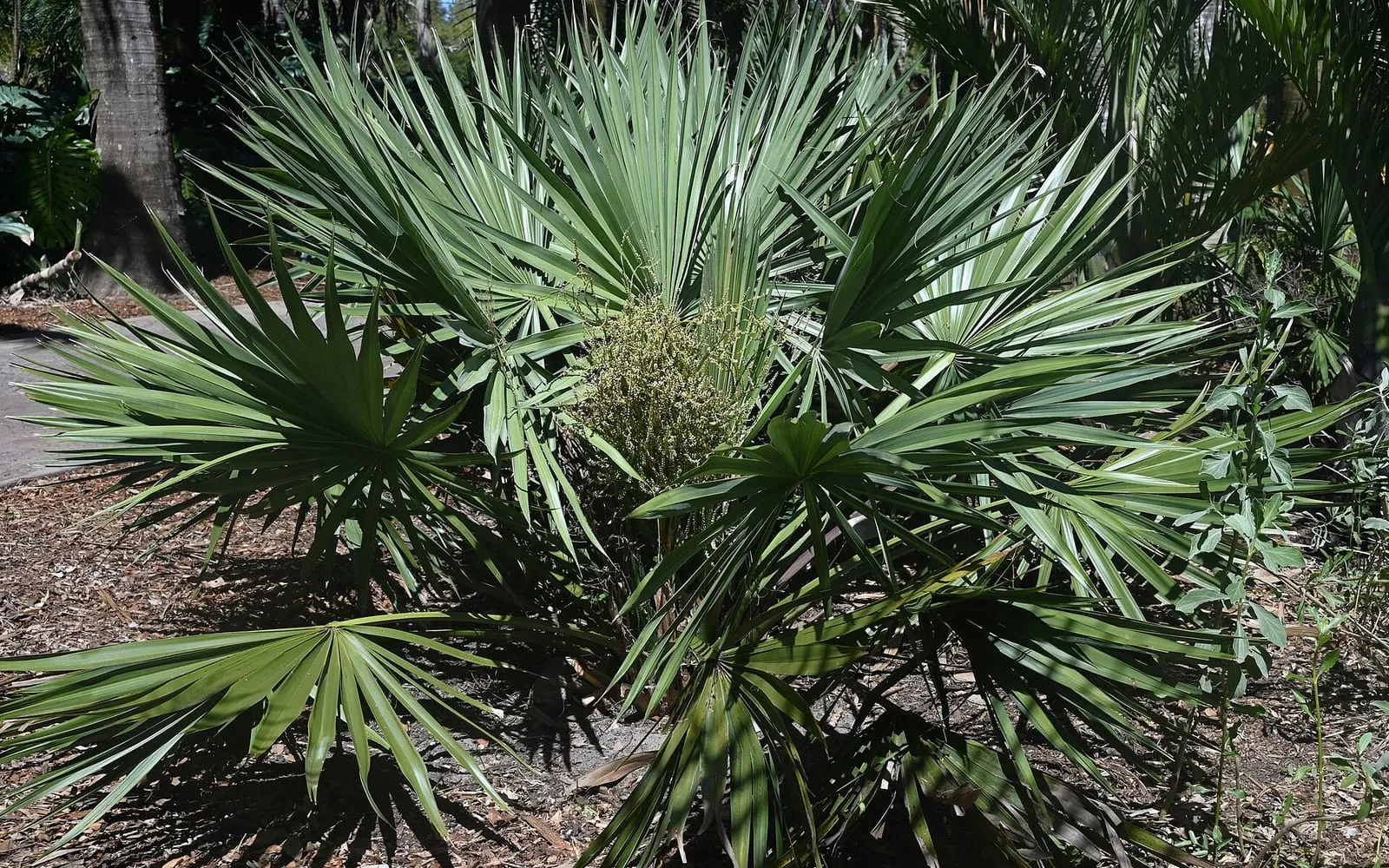
Sabal minor is the low, tough fan palm of the American southeast, a plant that usually has no visible trunk and sends its fans straight out of the ground on long stalks. The blades are stiff and deeply cut, held nearly flat like open hands, and in the best forms they have a clear blue-green cast. A mature clump is low, broad and close to the soil.
Its home is the wet woodland floor of river bottoms, swamp margins and floodplains that flood in a wet season, under a canopy that casts deep shade for much of the day. That habitat explains three useful traits. It tolerates hard frost, grows in shade, and copes with seasonal standing water. Few commonly grown palms handle that combination.
Growth is very slow, often only a fan or two a year, so this is a plant for patience rather than quick effect. In summer a settled clump sends up a slender flowering stalk above the leaves, with tiny cream flowers and later glossy black fruit. Its leaf stalks are smooth and unarmed, with no teeth or spines, which makes it a safe choice beside a path or a seat.
Appearance and character
The leaves are stiff, near-flat fans divided deeply into many narrow segments, running from fresh green to a striking blue-green in selected plants. They rise on long, smooth stalks straight from a short stem that mostly sits underground.
Most plants stay trunkless, building a dense ground-level clump a metre or two across, though a very old specimen may push a short length of stem above the soil in time.
The stalks help identify it. Where many fan palms have hooked teeth or spines on their leaf stalks, Sabal minor keeps them clean and smooth, so it can be handled and sited without the usual caution.
Flowering is held above the leaves. A tall, slender spike rises clear of the fans in summer, carrying small pale flowers and ripening to shiny black fruit, while the rest of the plant stays low.
Where it is from
Sabal minor grows across the lowland southeast of the United States, in floodplain forest, along swamp edges and through damp bottomland woods, from the Carolinas west to Texas and Oklahoma. The ground there stays moist and floods seasonally, summers are warm and humid, winters bring hard freezes, and shade from the tree canopy is the norm rather than the exception.
That background makes it one of the most adaptable palms a grower can keep. It thrives in sun or part shade and needs soil that stays moist yet still drains. It tolerates hard frost and seasonal wet, and rots only where water sits permanently stagnant. Cold, shade and damp are problems for many palms, but normal conditions for this species.
How it grows
It grows slowly through the warm season, adding a few fans a year, and passes the winter fully hardy in the open. Warmth and moisture support what growth there is, while it copes with cold and shade that would check almost any other palm.
Plant it in a moisture-retaining but free-draining soil, in sun or dappled shade, either in open ground or in a large, deep container, and keep it evenly damp while it is growing. It tolerates wet and shade far more readily than its relatives, so it suits spots that defeat other palms.
Match the light to whatever the site offers, since both full sun and part shade suit it, and expect no need to protect it over winter across most temperate gardens. Leave the central bud intact, since losing it kills the plant. There are no spines to guard against.
Through the seasons
Spring Growth resumes as the ground warms, making this the time to pot on a container plant that needs it and to open the feeding season.
Summer Growth continues through the heat, and a settled clump produces its tall flower spike now. Keep the soil evenly moist and feed each month.
Autumn Growth slows. Trim feed and watering back as the nights cool.
Winter Fully hardy and dormant, it needs no protection across most temperate gardens, so long as it never sits in stagnant water.
Care difficulty
Easy, and among the most forgiving palms there is, because it is adapted to cold, shade and wet ground. It tolerates hard frost, deep shade, seasonal flooding and general neglect, and needs no winter cover in most temperate gardens. Its main weak point is permanently stagnant, waterlogged ground. With smooth, spineless stalks it is also one of the safest fan palms to grow near people.
Watering
Water once the top of the soil begins to dry, keeping it evenly moist through the growing season, since this is a floodplain plant far thirstier than the average palm. A hard, complete drying-out is what it dislikes most.
Because it rots only in permanently stagnant water, a soil that holds moisture yet still drains suits it. Ease back a little over winter, letting the ground stay merely damp instead of wet.
Warning signs, diseases and pests
Permanently stagnant, waterlogged ground can rot the roots, shown by a crown that softens and fails, though this is rare in so wet-tolerant a plant. Improve drainage wherever the ground never clears.
Scale insects sometimes settle on the fans as small brown bumps; scrape them off and treat with a horticultural oil. The plant’s habitual slowness is normal for the species and no sign of trouble.
With no teeth or spines anywhere on it, the palm is safe to handle freely. Never cut the single growing bud, since losing it kills the plant.
Growing environment
Both full sun and part shade suit it, since it tolerates far more shade than most palms, growing at a woodland edge or out in the open. The blue-green colour comes through deepest in good light.
It tolerates hard frost to around minus 18 deg C and seasonal flooding, so it lives outdoors year round in most temperate gardens without winter protection. Moist ground and moderate to high humidity suit it well.
Grow it in a moisture-retaining, free-draining soil, in sun or part shade, in open ground or a large deep pot. Its smooth stalks let it stand safely close to paths and seating.
Feeding
A monthly dose of dilute palm feed, or a balanced general fertiliser at low strength, supports its slow but steady growth across the season. Heavy feeding does palms no good, so use less rather than more.
Reduce feeding in autumn and withhold it in winter. New compost feeds a freshly potted plant through its first weeks.
Troubleshooting
The crown is soft and failing. Rot from permanently stagnant, waterlogged ground, which is unusual in this wet-tolerant palm. Improve the drainage wherever the ground never clears.
How much cold will it take? A great deal. It endures hard frost to around minus 18 deg C, along with part shade and seasonal flooding, and needs no winter protection across most temperate gardens.
Can it cope with shade? Yes, far better than most palms, because it comes from shaded woodland, though the blue-green colour comes through strongest in good light.
Does it have spines like a needle palm? No. Its leaf stalks are smooth and unarmed, so unlike the needle palm it is safe beside a path.
Is it safe around pets? Yes. Nothing toxic is recorded in it and it bears no spines, making it one of the gentler fan palms for a household with animals.
Dwarf Palmetto problem guides
Not sure what is wrong? See the common houseplant pests guide.