
Houseplant
Blue Vanda
Vanda coerulea
Also known as Blue Orchid, Blue Vanda of Assam
Practical guidance for growing blue vanda, Vanda coerulea, including basket culture, bare roots, daily watering, strong light, a cool winter rest, and the true blue flower colour.
At a glance
- Difficulty
- Difficult
- Water
- Daily to twice daily in warm weather, since the roots hold no reserve
- Light
- Very bright light, close to full sun for part of the day
- Temperature
- 15 to 29 deg C, with cooler nights in winter
- Humidity
- 60-80 percent
- Hardiness
- USDA 10-12, RHS H1c, hardy to 10 C
- Type
- Evergreen monopodial epiphytic orchid, growing from a single upward stem
- Height
- 60-90 cm
- Native to
- South Asia, Southeast Asia
Native to hill forest in Assam, Meghalaya, Myanmar and northern Thailand at around 1,000 to 1,500 m elevation, cooler than the lowland tropics most vandas come from. It needs warm, wet summers followed by a cooler, distinctly drier winter with wide swings between a warm day and a cold night. That contrast, more than any single temperature, is what sets flower buds. It has no frost tolerance and struggles below about 10 deg C.
Hardiness zones describe winter cold alone. Summer heat, humidity, rainfall and the length of the growing season decide as much, so treat the range as the outer limit rather than as a recommendation.
Not known to be toxic
Vanda carries no known toxic compounds, and the family it belongs to has a consistently clean safety record across the species that have been assessed. The ASPCA lists Vanda as non-toxic to cats and dogs, and it is absent from the RHS list of potentially harmful garden plants. No part of the plant, including the thick aerial roots often chewed on by a curious pet, is considered a poisoning risk, though eating a mouthful of tough plant fibre can cause mild digestive upset in any animal regardless of the species involved. Wild populations of this species have been heavily collected for its striking colour, so buy only nursery-propagated plants.
Sources: ASPCA toxic and non-toxic plants, RHS potentially harmful garden plants
About
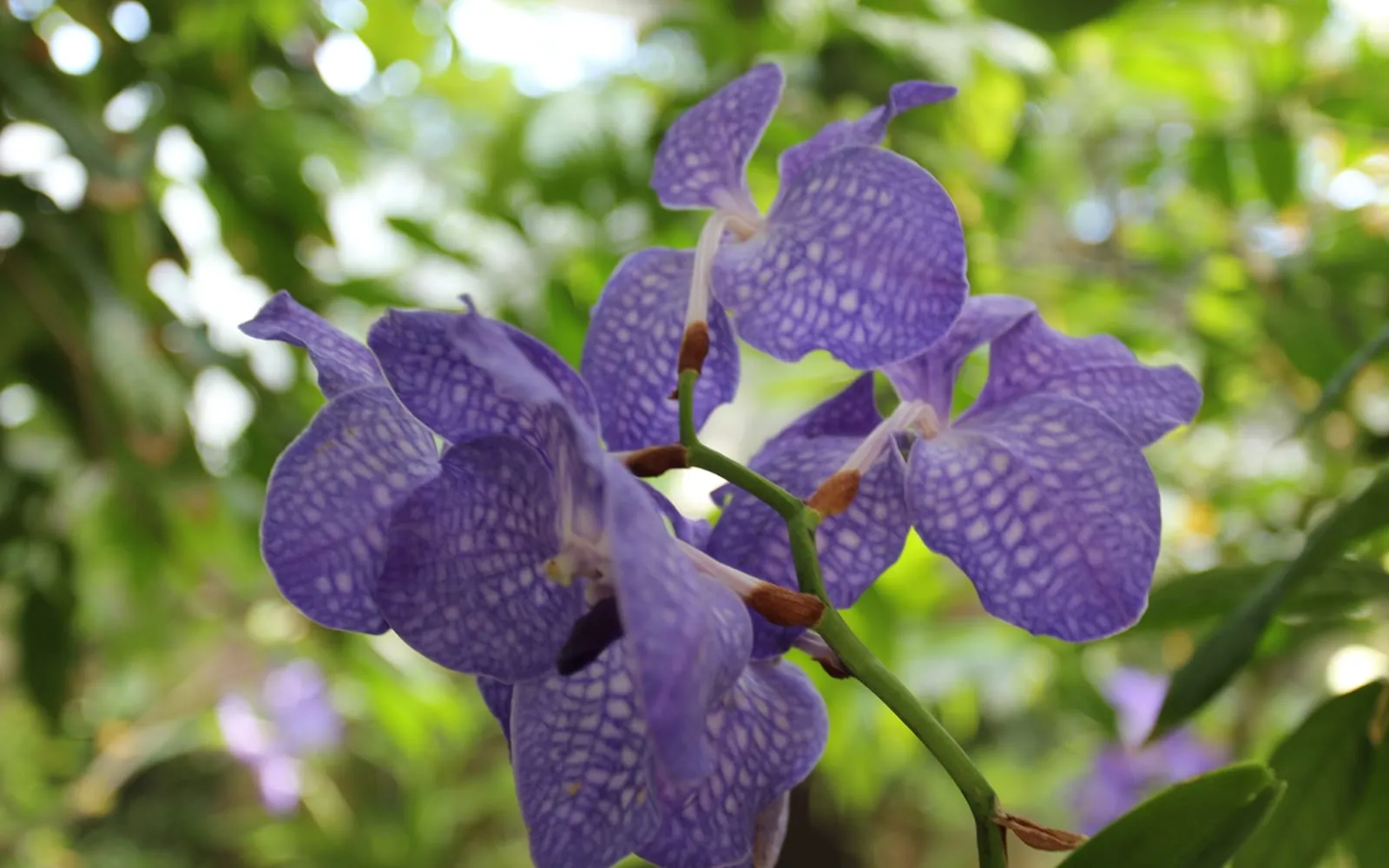
Blue vanda is grown for a colour rare among orchids, a true, soft blue with a tessellated, checkerboard pattern across each petal, unlike the purple-blue most flowers sold as “blue” turn out to be under close inspection. It grows with no soil at all, its thick aerial roots hanging free in the air from a single upright stem, absorbing water and nutrients directly rather than through any potting mix.
The bare-root habit makes it demanding. A vanda’s roots hold almost no water reserve of their own, so the plant depends on frequent, sometimes daily watering through warm weather and on strong light to flower well. A typical indoor room does not provide those conditions without extra work.
Appearance and character
Growth is monopodial, a single stem extending upward year after year from one growing point rather than the fan of separate pseudobulbs a Cattleya produces. Broad, strap-shaped leaves emerge in two ranks along the stem, and thick, cord-like aerial roots, often silvery grey when dry and bright green when wet, hang loosely from along its length.
Flower spikes emerge from the leaf axils and carry several large, flat blooms, typically 8 to 10 cm across, in a true blue shade overlaid with a fine, tessellated grid pattern that darkens towards the flower’s edges. Named cultivars vary from pale sky blue to a much deeper violet-blue, and a well-flowered spike can hold six or more blooms open at once.
The bare roots themselves are part of the plant’s appeal on display, visible and architectural in a way a potted orchid’s roots never are.
Where it is from
Vanda coerulea grows in hill forest across Assam, Meghalaya, Myanmar and northern Thailand, typically between 1,000 and 1,500 m elevation, noticeably cooler and with a more pronounced dry season than the lowland tropical forest most vandas call home. Summers are warm and wet with the monsoon; winters turn cool and distinctly dry, with wide swings between a mild day and a properly cold night.
That elevation makes this species cooler-growing than most of its relatives. It also needs seasonal contrast to flower reliably. A plant kept in constant warmth with no winter dip grows steadily but often skips flowering.
How it grows
Grow it bare-root in a slatted wooden basket or mounted on a piece of bark or cork, never potted in ordinary compost, since the roots need constant airflow around them between waterings. A slatted basket suits most indoor growers best, since it allows regular watering without the roots ever sitting wet for long.
Hang or position it where air moves freely and light is close to what full sun would provide, shaded only enough to stop the leaves scorching in the strongest midday sun. Leaves that stay dark green rather than a fresher yellow-green are a reliable sign of too little light.
Water generously and often through warm weather, since the exposed roots dry out within hours in a dry room, unlike a potted orchid’s roots insulated by bark or mix. A daily soak or thorough spray in summer is not excessive for this species; it is closer to the minimum.
Trim off any dead roots at repotting or remounting time, but otherwise leave the root system undisturbed. Vandas recover slowly from root disturbance after a heavy-handed repot.
Through the seasons
Spring brings a return to vigorous growth as light strengthens. Step up watering frequency and resume regular dilute feeding.
Summer is the peak growing season, needing near-daily watering, strong light and high humidity to support the fast-growing stem and roots.
Autumn brings the start of the cooler, drier period that sets flower buds. Reduce watering frequency gradually as nights cool.
Winter is cooler and drier still, with flower spikes often appearing towards the end of the season on a well-timed plant. Keep it above 10 deg C throughout.
Care difficulty
Difficult, and honestly one of the more demanding orchids commonly grown as a houseplant. The combination of very strong light, high humidity, frequent watering and a genuine seasonal temperature swing is hard to reproduce consistently indoors, and getting any one of those wrong shows up first as poor flowering rather than immediate visible damage, which makes the cause harder to diagnose than it would be on a plant that wilts outright. It suits a grower able to give it a dedicated bright, humid spot rather than a windowsill among other houseplants.
Watering
Water thoroughly and often through the growing season, dunking the whole root system or spraying it heavily until the roots turn bright green, then letting them dry to a silvery grey before watering again, which in warm weather may mean daily or even twice-daily watering.
Reduce watering markedly through the cooler, drier autumn and winter period, letting the roots run drier for longer between soakings, though never so dry that they shrivel badly for an extended period.
Warning signs, diseases and pests
Scale insects settle on the stem and at the base of the leaves, appearing as small, flat brown bumps. Scrape them off carefully and treat with horticultural soap, checking the stem regularly since scale on a monopodial orchid can eventually girdle and weaken the single growing point.
Spider mite thrives in hot, dry indoor air and shows as fine speckling on the leaves with faint webbing between them in bad cases. Raising humidity and spraying the roots and leaves regularly both help keep it from establishing.
Root rot follows roots that are kept constantly damp without enough airflow between waterings, showing as roots that turn brown and mushy rather than the healthy silvery green of a dry root or bright green of a wet one. Improve air movement around the basket and adjust the watering schedule to let roots dry properly between soakings.
Bud drop, buds yellowing and falling before they open, usually follows inconsistent humidity or watering while a spike is developing. Keep the routine as steady as possible once spikes appear, and avoid moving the plant to a different spot during that period.
Growing environment
Very bright light, close to full sun for at least part of the day, is essential for good growth and flowering; this is one of the more light- hungry orchids commonly grown indoors, and a shaded spot that suits a Phalaenopsis will leave a vanda pale and reluctant to flower.
Warmth through the growing season, easing into cooler nights over winter, suits it best. Keep it above 10 deg C at all times, since it has little tolerance for genuine cold.
High humidity, ideally 60 to 80 percent, matters more here than for most houseplant orchids, since the exposed roots have no mix around them to buffer against dry air. A humidifier or a reliably humid bathroom setting suits it far better than an average living room.
Feeding
Feed at very low strength with most waterings through the growing season, using a balanced orchid formula diluted well below the label’s standard rate, since the roots are exposed to the solution directly rather than buffered by any mix.
Cut back sharply on feeding through the cooler, drier winter rest, when growth slows and the plant takes up very little of anything applied.
Troubleshooting
The roots have gone shrivelled and grey and stay that way. Chronic underwatering for the conditions. Increase watering frequency, particularly in warm weather, and check that humidity is high enough to stop the roots drying out again within hours of a soak.
It has grown well for years but never flowered. Almost always too little light or too little of a seasonal temperature and moisture contrast. Move it somewhere noticeably brighter and make sure winter runs markedly cooler and drier than summer rather than kept constant.
The single stem has stopped producing new leaves at the top. The growing point may have been damaged or lost, often to rot or physical injury. Check for keiki growth lower down the stem, which can sometimes be grown on as a new plant if the original point cannot be saved.
Roots near the base have turned brown and mushy. Root rot from insufficient airflow or drying time between waterings. Trim away the dead roots and improve ventilation around the basket, adjusting the watering schedule to allow proper drying.
Do I need a greenhouse to grow this well? Not necessarily, but you need somewhere reliably bright and humid, such as a heated conservatory or a dedicated grow-light setup, since an ordinary windowsill rarely supplies enough of either for this particular species to thrive.
Blue Vanda problem guides
Not sure what is wrong? See the common houseplant pests guide.