
Houseplant
Water Hyacinth
Eichhornia crassipes
Also known as Water orchid, Floating water hyacinth
How to grow water hyacinth, Eichhornia crassipes, a floating tropical pond plant that is illegal to sell or plant across large parts of the world.
At a glance
- Difficulty
- Moderate
- Water
- Floats on open, still to gently moving water
- Light
- Full sun
- Temperature
- Above 10 deg C, thrives above 21 deg C
- Hardiness
- USDA 10-12, RHS H2, hardy to 10 C
- Type
- Tender free-floating perennial, often grown as a summer annual
- Height
- Rosettes 10-40 cm tall, roots trail 20-50 cm below
- Native to
- South America
A frost-tender tropical floater that dies at the first hard frost and cannot survive outdoors year round anywhere with a winter below about 10 deg C. Where the climate does stay frost-free, the same tolerance that makes it easy for a gardener to grow has let it become established and invasive in warm rivers, lakes and irrigation channels on every continent except Antarctica.
Hardiness zones describe winter cold alone. Summer heat, humidity, rainfall and the length of the growing season decide as much, so treat the range as the outer limit rather than as a recommendation.
Not known to be toxic
The ASPCA lists water hyacinth as non-toxic to dogs, cats and horses, and it carries no toxicity warning from the RHS either. It is unrelated to true hyacinths (Hyacinthus orientalis), which are toxic bulbs and share nothing beyond a common name. Eating large amounts of any plant material can upset a pet's stomach, but there is no toxin in water hyacinth tissue to guard against.
Source: ASPCA
About
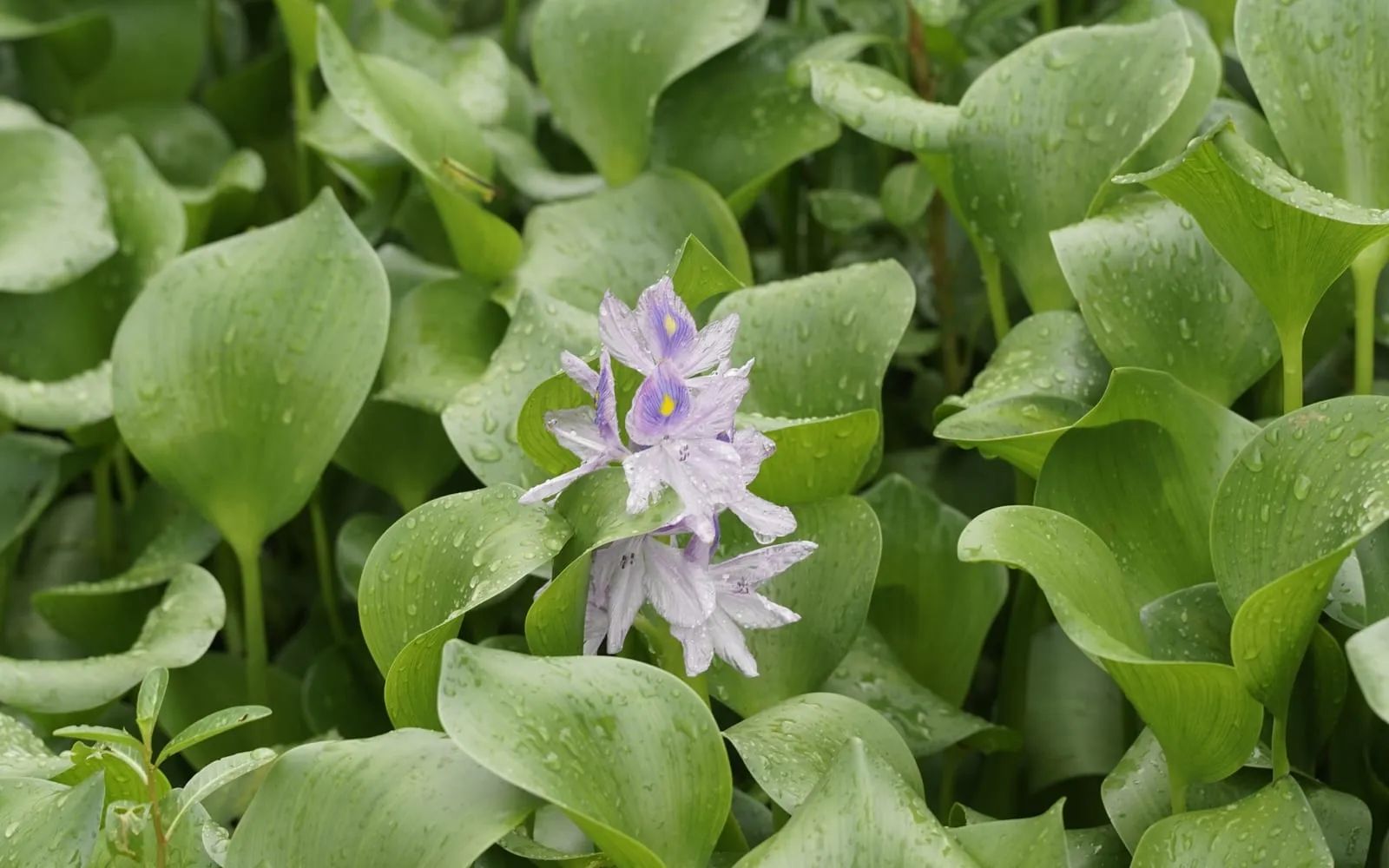
Water hyacinth is a free-floating plant with glossy, rounded leaves held above the water on stalks that swell into spongy, air-filled bladders, giving each rosette enough buoyancy to stay afloat even when crowded several deep. Tall spikes of lilac-blue flowers with a yellow throat marker appear through summer, and a mature planting can flower prolifically in warm, sunny water.
It is also an aquatic plant to check carefully before buying. Water hyacinth is widely rated among the world’s worst invasive species, and its sale, possession or cultivation is illegal or restricted across large parts of the United States, the European Union and Australia. Anyone considering it should check local rules before acquiring it, and never release it, or the water it has grown in, into any river, lake or drainage ditch.
Appearance and character
Each rosette is built around a handful of thick, kidney-shaped leaves with a waxy, water-shedding surface. The stalks swell in the middle into spongy floats, unlike the flat petioles of most pond plants. That buoyancy helps colonies ride out waves and boat wash that would swamp flatter floating leaves.
Below the waterline hangs a dense curtain of dark, feathery roots that trail well below the rosette and shelter fish fry and invertebrates. Flower spikes rise from the centre of a mature rosette in summer, each carrying six to fifteen orchid-like blooms that last only a day or two but are replaced in succession for weeks.
Where it is from
Native to the slow rivers and lagoons of the Amazon basin in South America, water hyacinth was carried to the rest of the world as an ornamental water garden plant, including at the 1884 Cotton States and International Exposition in New Orleans, from where it escaped into Louisiana’s waterways within a few years. It has since been introduced, deliberately or by accident, to warm fresh water on every inhabited continent.
Its botanical name has also shifted. Taxonomists now place it in the genus Pontederia as Pontederia crassipes, and horticultural literature is gradually catching up, though Eichhornia crassipes remains the name most growers, regulators and plant databases still use.
How it grows
A single rosette increases by budding new plantlets on short runners from its base. In warm, nutrient-rich water, a colony can double its coverage in as little as one to two weeks. Because it also tolerates polluted, nutrient-loaded water, a few rosettes bought for a summer pond can cover a lake within a season if they reach open water.
In a garden pond kept within its own boundaries, that vigour is an asset instead of a hazard: it out-competes algae for nutrients and gives fast, reliable summer cover with no risk of it spreading beyond a contained water feature, provided the pond has no outflow into a natural waterway.
Through the seasons
Spring growth resumes once water and air both stay reliably above about 15 deg C, restarting from whatever rosettes were overwintered indoors.
Summer is the main growing and flowering season, with rapid budding of new rosettes and the best flower displays in full sun and warm water.
Autumn growth slows as temperatures fall, and rosettes should be lifted for winter storage well before the first frost, since even a light frost kills the foliage.
Winter requires warm water indoors, in a heated greenhouse, conservatory or aquarium kept above about 15 deg C; anywhere colder than that the plant declines and eventually dies instead of going dormant.
Care difficulty
Moderate. The plant itself needs very little once conditions suit it, but temperate growers have to move it indoors before the first frost and keep it in warm water over winter. Easy floating plants such as duckweed do not need that step. Anyone without a heated overwintering space should treat it as a summer-only annual, bought fresh each year.
Watering
There is no watering as such, since the plant floats on the surface and takes everything it needs from the surrounding water. What matters is keeping that water warm and reasonably clean; growth slows noticeably below about 15 deg C and stops well before ice would ever form. Still or gently moving water suits it better than a strong current or fountain spray, which tends to swamp and break up the rosettes.
Warning signs, diseases and pests
Aphids sometimes colonise the base of new leaves and flower spikes and can be washed off with a jet of water without harming the plant. Spider mites occasionally trouble rosettes kept indoors over winter in dry air above the waterline, uncommon for a plant that otherwise lives on open water.
Mealybug can hide within the dense root mass, usually arriving with new stock, and shows as small white, cottony clusters when the roots are lifted and inspected. Yellowing, collapsing leaves with a soft, translucent texture almost always signal water that has turned too cold instead of disease, and the fix is warmth instead of any treatment.
Because legal restrictions apply across much of the world, watch closely for runaway growth in any pond that drains, even occasionally, into a ditch, stream or storm drain. At that point, a fast-growing ornamental can become the invasive weed it is regulated for. Remove excess growth and compost it well away from any watercourse.
Growing environment
Full sun keeps rosettes compact, flowering freely and coloured a healthy mid-green; in shade the leaves grow larger and paler and flowering drops off sharply. Warm, still or gently moving water suits it far better than a cold or fast-flowing feature, and it does best in a sheltered spot away from strong wind, which can flip and scatter loosely packed rosettes.
Because it is illegal to sell, possess or cultivate in a number of US states, throughout the European Union under the invasive alien species regulation, and in parts of Australia, check local rules before buying. Where it is legal, keep it in a contained, non-draining water feature and dispose of surplus plants by composting instead of by tipping them into any natural water body.
Feeding
Established plants in a nutrient-rich pond rarely need feeding, since the species is very efficient at stripping dissolved nutrients from the water column, the same trait that has seen it trialled deliberately in wastewater treatment systems. A weak liquid feed occasionally benefits rosettes kept in very clean, low-nutrient aquarium or container water where growth looks slow.
Troubleshooting
Leaves are turning yellow and collapsing. Almost always water that has turned too cold. Move the plant to warmer water promptly; recovery is possible if the cold exposure was brief.
Rosettes stay small and produce few flowers. Usually too little direct sun. Move to the brightest, warmest part of the pond available.
Coverage is spreading faster than expected. Expected behaviour in warm, nutrient-rich water. Remove excess rosettes regularly, compost them away from any watercourse, and never tip surplus plants into a river, lake or drain.
Small white, cottony clusters are visible among the roots. Check for mealybug, usually introduced with new stock. Rinse the roots thoroughly and isolate affected plants until clear.
Is it legal to buy and grow where you live? Rules vary sharply by country and, within the United States, by state. Check your national or state invasive species register before buying, since possession or sale can carry a penalty even where the plant is easy to obtain online.
The plant has died back suddenly after a cold snap. Even a brief light frost kills the foliage. Bring remaining stock indoors before the first expected frost each autumn instead of waiting for a warning sign.
Roots have become tangled and matted after several months. Normal for an actively budding colony. Thin the planting and remove older, spent rosettes to keep the remaining plants growing vigorously.
Water Hyacinth problem guides
Not sure what is wrong? See the common houseplant pests guide.