
Outdoor plant
Bugle
Ajuga reptans
Also known as Bugleweed, Carpet Bugle, Common Bugle
How to grow bugle, Ajuga reptans, a native British woodland-edge plant whose bronze-purple rosettes spread by surface stolons and flower in blue spikes.
At a glance
- Difficulty
- Easy
- Water
- Regularly through the first season, then in dry spells only
- Light
- Partial shade to full sun
- Temperature
- Fully hardy, to about -20 deg C
- Hardiness
- USDA 3-9, RHS H7, hardy to -20 C
- Type
- Hardy evergreen to semi-evergreen perennial
- Height
- 10-15 cm in leaf, 15-20 cm in flower
- Native to
- Europe, including Britain, western Asia
Winter cold is the least of its problems in most gardens. A hot, dry summer thins a bugle mat faster than any frost does, and the darkest bronze and purple cultivars keep their colour best where they get some direct sun rather than the deep shade the plain green species tolerates.
Hardiness zones describe winter cold alone. Summer heat, humidity, rainfall and the length of the growing season decide as much, so treat the range as the outer limit rather than as a recommendation.
Not known to be toxic
Bugle is not listed among the RHS potentially harmful garden plants, and university extension plant profiles for Ajuga reptans record no toxicity to people or animals. It has a long history of folk use as a wound herb, giving rise to the country saying that a garden with bugle growing in it has no need of a surgeon, and some sources note trace alkaloids in the foliage without attaching any documented case of harm to them. Treat it as safe for a garden used by children and pets, on the same footing as the great majority of hardy perennial groundcover.
Sources: RHS potentially harmful garden plants, NC State Extension Gardener Plant Toolbox (Ajuga reptans)
About
Bugle grows wild at British woodland edges and along shaded hedge banks, which is where it earned its reputation as a groundcover that thrives without asking anyone to plant it there first. In a garden it does the same job deliberately, filling the ground under shrubs and at the front of a border with a low mat of glossy leaves and, for a few weeks each spring, short spikes of blue flowers.
The foliage is the main draw as much as the flower. Named cultivars run from near-black bronze-purple through variegated pink and cream, and a patch of Ajuga in leaf reads as a foliage planting for eleven months of the year with a flowering bonus in the twelfth.
Bees work the flower spikes hard in April and May, when little else at that low a level is offering nectar, which makes an established patch worth more to a garden’s insects than its modest size would suggest.
Appearance and character
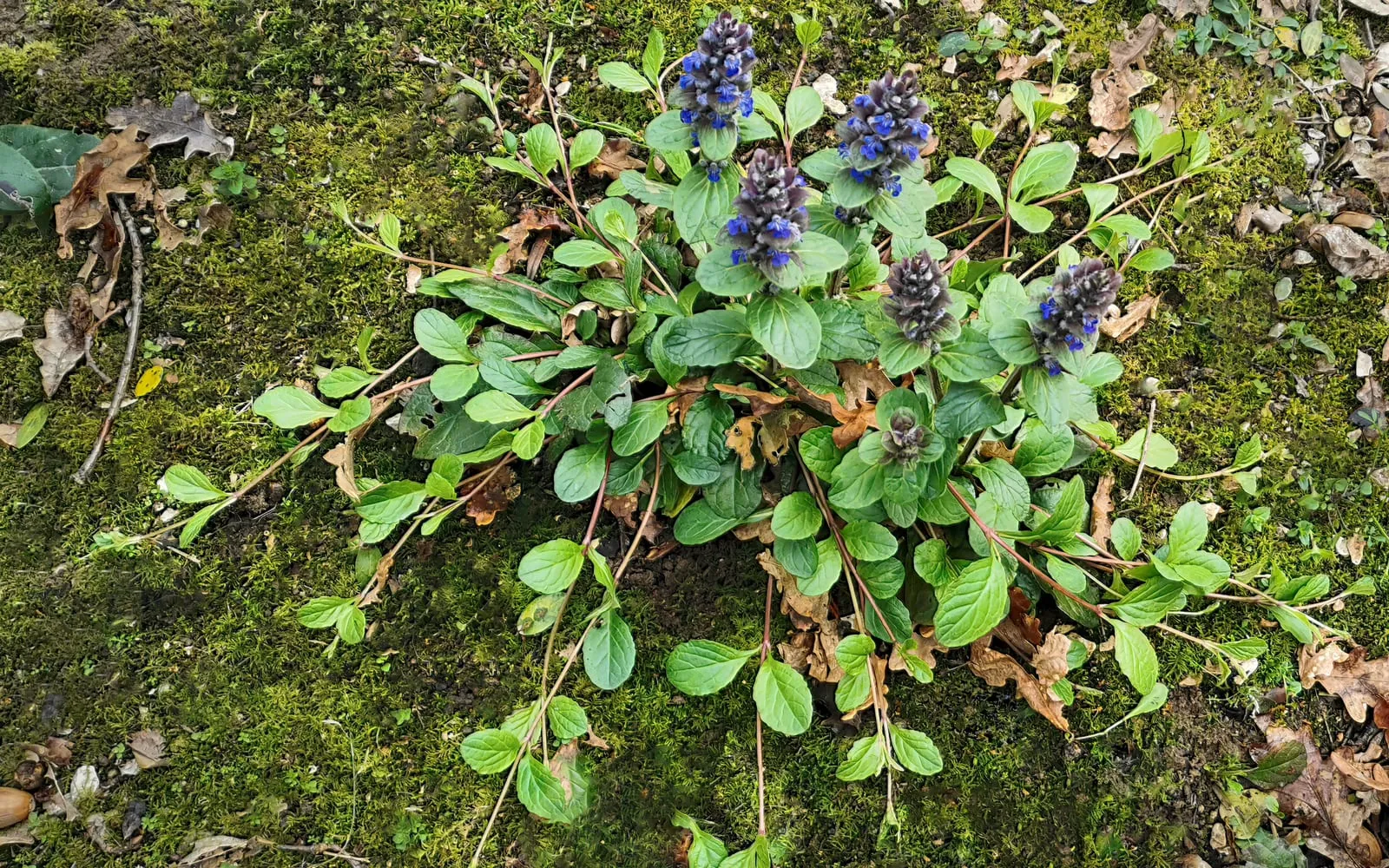
Leaves form flat rosettes 5 to 10 cm across, oval to spoon-shaped, with a slight quilted texture and a glossy surface that varies from plain green in the species to deep bronze-purple, near-black, or variegated pink and cream in named forms such as Black Scallop, Catlins Giant and Burgundy Glow.
Flower spikes rise 10 to 15 cm above the foliage in April and May, each carrying whorls of small two-lipped tubular flowers in blue to violet along the upper half of the stem. A large-flowered form, Catlins Giant, produces spikes closer to 20 cm with proportionately bigger flowers.
The rosettes are evergreen to semi-evergreen depending on the winter, holding their colour through cold spells better than many perennials and sometimes intensifying to a deeper purple in low temperatures.
Texture across a mature patch is dense and even, since each new rosette grows at roughly the same height as its neighbours, which is why bugle reads as a solid carpet rather than a scattering of individual plants within a season or two of planting.
Where it is from
Ajuga reptans is native across most of Europe, including Britain, and east into western Asia. In the wild it grows in damp woodland, on shaded verges and along hedgerows, usually in soil that stays moist through summer under a partial canopy.
It is one of the true native British plants used routinely in cultivated gardens, alongside a shorter list that includes primrose and wood anemone, rather than an import naturalised so long ago its origin is forgotten. Wildlife value in a garden setting mirrors its wild role: early bumblebees and solitary bees use the flowers, and the dense foliage shelters ground beetles and other invertebrates through the year.
Garden selection has run mostly on leaf colour rather than on flower, and the range available now, from near-black to variegated cream, is a twentieth-century development built on a plant that grew wild in British hedgerows the whole time.
How it grows
Bugle spreads by stolons, horizontal stems that run across the soil surface rather than underground, each rooting down and producing a new rosette at intervals of a few centimetres. A single plant can produce several stolons in a season, and the effect after two or three years is a continuous mat rather than a cluster of separate clumps.
Plant divisions or young plants 20 to 30 cm apart for full cover within two seasons on reasonable soil. Growth is markedly slower in dry shade under mature trees, where the stolons still spread but rosettes stay smaller and the mat takes longer to close.
Established plants are simple to increase. Lift a rooted stolon section with a hand fork, sever it from the parent, and replant it immediately. Success is close to guaranteed as long as the piece has its own roots attached.
Through the seasons
Spring is flowering time, with spikes emerging in April and holding colour into May while new stolons also begin their fastest extension of the year.
Summer brings the main flush of stolon growth once flowering finishes. This is the season a patch fills out fastest, and also the one where prolonged heat and dry soil thin it most if watering is neglected.
Autumn suits planting and division, giving new sections a full season to root before summer heat arrives. Fallen leaves should be raked off the mat rather than left to smother the rosettes underneath.
Winter leaves the evergreen forms holding their colour, sometimes deepening to a richer purple in cold weather, while deciduous cultivars die back to resting rosettes that reappear reliably in spring.
Care difficulty
Easy, and more forgiving of shade and poor soil than most flowering groundcover. A newly planted patch needs watching through its first season, after which it largely looks after itself.
The one recurring task is thinning. A mat left to its own devices for several years builds up old, congested rosettes at the centre that are more prone to crown rot and mildew than younger growth at the edges. Lifting and replanting sections every three or four years keeps the whole patch vigorous.
Named colour cultivars are marginally more demanding than the plain species, losing some of their leaf colour in deep shade and needing a brighter position to stay true to type.
Watering
Water regularly through the first growing season after planting, while the stolon network that will later find its own moisture is still establishing.
An established patch on reasonable soil needs little supplementary watering through an average temperate summer with regular rain. In a prolonged dry spell, particularly in full sun, the mat can thin visibly and benefits from a deep soak rather than frequent light watering.
Dry shade under trees is the position most likely to need attention in a drought, since the tree canopy intercepts rainfall the bugle would otherwise rely on.
Warning signs, diseases and pests
Powdery mildew whitens the leaf surface in humid, still conditions, particularly on congested older growth. Thinning the patch to improve air movement is more effective long term than treating individual leaves.
Crown rot affects the centre of an old, dense mat in wet, poorly drained soil, killing rosettes from the middle outward. Lifting and dividing an overcrowded patch before this sets in is the better cure.
Slugs and snails graze the soft new leaves of spring growth, which matters most on young plantings before the mat has bulked up enough to absorb the damage.
Leaf spot appears as small dark blotches in wet weather and is largely cosmetic on an established, well-spaced patch, resolving on its own once drier conditions return.
Growing environment
Partial shade to full sun suits it, with the balance shifting the plant’s character rather than its survival. Deep shade under trees is tolerated by the plain green species but thins the coloured cultivars and mutes their leaf tone.
Soil should stay moist through the growing season without becoming waterlogged. Bugle tolerates clay better than many groundcovers, provided it is not permanently saturated, and it establishes more slowly on light, free-draining sandy ground unless watered through dry spells.
It is not fussy about pH, growing equally well on acid and alkaline soil, and it takes underplanting beneath deciduous shrubs and small trees without complaint, which is one of its main garden uses.
Feeding
Feeding is rarely necessary on reasonable garden soil, where the plant spreads readily without it. A light balanced feed in spring helps on poor ground, particularly where it is being asked to cover an area quickly.
Avoid heavy or repeated feeding. Lush, over-fed growth on bugle is softer and more prone to powdery mildew than growth on modest, well-drained soil.
A mulch of garden compost in autumn does more for the following year’s growth than a fertiliser application, improving soil structure while adding only a modest amount of nutrient.
Troubleshooting
The centre of the patch has died out. Crown rot in an old, congested mat, usually following a wet winter. Lift the surviving edge growth, discard the dead centre and replant divisions into freshly worked soil.
My coloured cultivar has reverted to plain green. Not true reversion in most cases, but leaf colour fading in too much shade. Move a division to a brighter position and the next season’s growth should show the cultivar’s proper colour.
White powder has appeared on the leaves. Powdery mildew, usually in a crowded, still position. Thin the patch and improve airflow around it rather than relying on treating the leaves already affected.
It has not flowered. Most bugle flowers reliably in its second spring. A plant that skips flowering is usually establishing still, or growing in deeper shade than suits heavy flowering.
Slugs have shredded the new spring growth. Most likely on young plantings before the mat is established. Grit around vulnerable plants and check at dusk during the worst weeks in April.
Can I grow it in a lawn as a low-mow alternative? It tolerates occasional mowing at a high setting but does not take regular foot traffic or close mowing the way a true lawn plant does, so it suits a border edge better than a path or play area.
How do I stop it spreading into the lawn next to it? A cut, mown or paved edge stops the surface stolons from rooting beyond it. Trim any stolon that crosses the boundary before it has the chance to root down.