
Outdoor plant
Field horsetail
Equisetum arvense
Also known as Mare's tail, Common horsetail, Bottlebrush
How to identify and control horsetail, Equisetum arvense. The prehistoric weed with roots two metres deep, why weedkillers slide off it, and what does help.
At a glance
- Difficulty
- Difficult
- Water
- Not applicable
- Light
- Full sun to partial shade
- Temperature
- Fully hardy, to about -35 deg C
- Hardiness
- USDA 3-9, RHS H7, hardy to -35 C
- Type
- Perennial, spreading by deep rhizomes and reproducing by spores
- Height
- 20-60 cm
- Native to
- Throughout the northern hemisphere, and native to Britain
- Best month
- April in the Northern Hemisphere, October in the Southern Hemisphere
The rhizome reaches two metres down, which is below any digging, and the plant predates flowering plants by a hundred million years and has outlasted everything sent against it. Nothing in the weather touches it. It contains thiaminase, which destroys vitamin B1, so it poisons horses and cattle cumulatively through contaminated hay rather than through grazing, and it stays toxic when dried.
Hardiness zones describe winter cold alone. Summer heat, humidity, rainfall and the length of the growing season decide as much, so treat the range as the outer limit rather than as a recommendation.
Every month named in this guide is for the temperate Northern Hemisphere. If you garden in the Southern Hemisphere, shift each one by six months, so April becomes October. Closer to the equator the wet and dry seasons matter more than the calendar, and the shift stops being a useful guide.
Toxic to horses if eaten
- Do not eat
- The whole plant, whether fresh or dried in hay
- Harm from
- Eating it
- Affects
- Horses
Horsetail contains thiaminase, an enzyme that destroys thiamine, which is vitamin B1. Horses that eat it in quantity, most often in contaminated hay where they cannot avoid it, develop thiamine deficiency with weakness, incoordination, weight loss and in severe cases collapse. The condition is known as equisetosis and it is well documented. It is treatable with thiamine if caught, and it can be fatal if not. Cattle and sheep are less affected than horses but are not immune. Never make hay from a field containing horsetail and never throw cleared horsetail into a paddock. The plant also contains silica and various alkaloids. For people, horsetail is sold as a herbal supplement and taken in quantity carries the same thiamine risk along with reported kidney effects, so it is not something to experiment with. The RHS does not list Equisetum among harmful garden plants and the ASPCA lists it as toxic to horses. In an ordinary garden with no livestock the plant is a control problem rather than a safety one.
Sources: RHS potentially harmful garden plants, ASPCA toxic and non-toxic plants
About
Horsetail is the hardest weed to remove from a temperate garden, and it has had a very long time to get good at it.
The genus is around 350 million years old. Tree-sized relatives formed a large part of the coal-measure forests, and the plant in your border is close to unchanged since before flowering plants existed. It reproduces by spores rather than seed, which is why nothing sold as a weedkiller was designed with it in mind.
Two features make it almost uncontrollable. The rhizome system runs to two metres deep and carries small underground tubers that regenerate the plant from nothing. And the surface of the stem is coated in silica and wax, so herbicide sprayed onto it runs straight off.
Digging fails, because you cannot reach the roots. Spraying fails, because the chemical does not stick or penetrate. Covering fails on its own, because the plant finds the edge.
What works is a combination of persistence, ground improvement and a bruising treatment that lets herbicide in. None of it is quick, and total eradication in an infested garden is rare.
It favours damp, compacted, poorly drained ground, and improving the drainage is the one lasting change that shifts the balance.
Appearance and character
A spore-bearing perennial reaching 20 to 60 cm, dying back in winter and regrowing from rhizomes.
Two entirely different stems appear at different times, which confuses people.
Fertile stems come first, in March and April. They are pale brown, unbranched, succulent, 10 to 25 cm tall, with no green colour and a cone-like spore head at the tip. They wither within a few weeks.
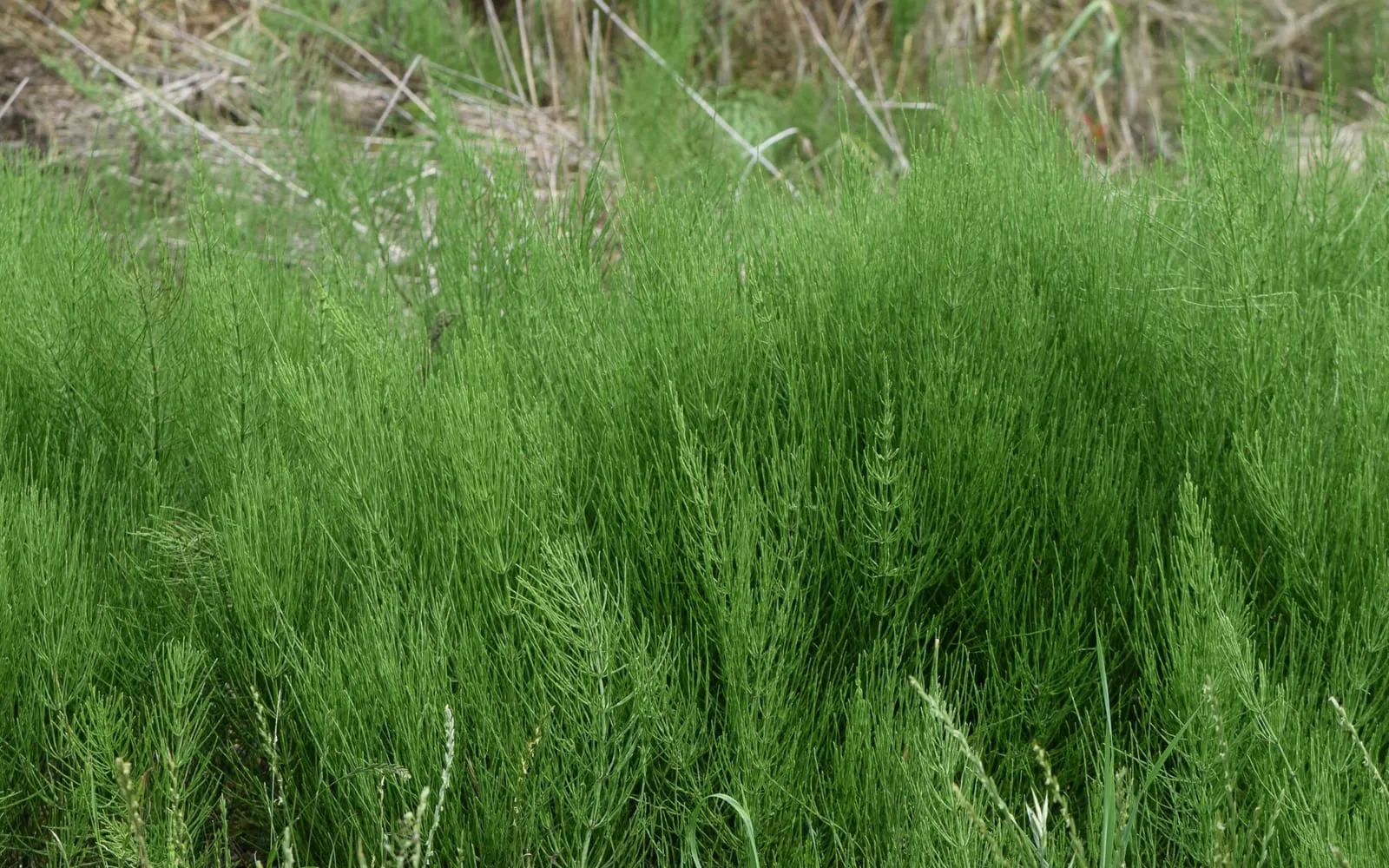
Sterile stems follow from April and last all summer. They are green, 20 to 60 cm tall, jointed and hollow, with whorls of fine needle-like branches at every joint, giving the bottlebrush or small conifer appearance.
Both stem types have a rough gritty texture from silica in the tissues, which is why horsetail was used as a scouring material.
There are no true leaves. What look like leaves are branches, and the actual leaves are reduced to a small toothed sheath at each joint.
Rhizomes are dark, wiry and jointed, running horizontally at various depths and vertically to 2 m, and they carry small round tubers that store food.
Great horsetail, Equisetum telmateia, is the much larger relative found in wet places, reaching 1.5 m, and it is far less common in gardens.
Where it is from
Throughout the northern hemisphere, native to Britain and found in every county.
It grows on damp ground, railway embankments, road verges, ditches, waste ground and gardens, and it favours poorly drained, compacted, disturbed soil.
The genus is ancient. Equisetum is the only surviving genus of a group that dominated Carboniferous forests around 350 million years ago, when relatives reached 30 m.
It reproduces by spores rather than seed, which is one reason ordinary garden practice has so little effect on it.
The silica content is high enough that horsetail was used across Europe as a scouring material for pewter, wood and metal, which is where the name Dutch rush comes from.
Horsetail is regarded as an indicator of poor drainage and compaction, and its presence says something useful about the ground it is in.
It is a serious agricultural and horticultural weed across Europe and North America, and there is no product on the domestic market that reliably kills it.
How it spreads
By rhizome, overwhelmingly, and by spores to a limited extent.
The rhizome network reaches 2 m deep, well beyond any cultivation, and horizontal rhizomes run several metres.
Small tubers on the rhizomes store carbohydrate and regenerate the plant after the top growth is destroyed.
Every fragment of rhizome regrows, so cultivation multiplies it.
It travels in imported topsoil and in the rootballs of plants from infested ground, which is worth checking on anything new coming in.
Spores released in spring from the fertile stems spread it to new sites, and this is secondary to the rhizomes in an established garden.
It comes under fences and through hedges, and a neighbouring infestation is effectively permanent.
Through the seasons
Winter the top growth has died back, leaving bare ground, and the rhizomes are undisturbed.
Spring brings the pale fertile stems in March and April, followed by the green sterile stems from late April.
Summer is full growth, and this is when repeated removal and bruised-stem herbicide treatment do the most.
Autumn the green stems die back, and late summer into early autumn is the last useful window for chemical treatment.
Control without chemicals
Cut or pull every stem as it appears, week after week, for years. This is the honest non-chemical method. Each stem removed costs the rhizome reserves, and the aim is exhaustion over a very long period.
Pull rather than cut where the soil is soft, taking as much stem as comes.
Do it weekly through the growing season. A fortnight missed in June restores a great deal.
Expect three to five years of this to make a real difference, and be prepared for it never to finish where the plant comes in from outside.
Improve the drainage. This is the change that alters the conditions permanently. Horsetail favours compacted, poorly drained, waterlogged ground, and improving structure with organic matter, breaking up compaction, and installing land drains where the problem is serious all reduce its vigour and let other plants compete.
Cover the ground with heavy black polythene or a woven membrane where a bed can be taken out of use, overlapping the edges and leaving it down for at least two full growing seasons. Horsetail will find any gap, so the edges matter.
Do not rotavate. It chops the rhizomes and spreads them.
Bag and bin the material or burn it. Do not compost it.
Plant dense competitive ground cover once an area is under control, since bare soil lets it back in.
Control with chemicals
Nothing on the domestic market kills horsetail reliably before describing what helps.
The waxy silica-rich surface sheds water-based sprays, so herbicide applied to intact foliage runs off and achieves almost nothing.
Bruise the stems before treating. Crush or trample the growth with a rake, a board or your boots, which damages the waxy surface, then apply a glyphosate treatment to the damaged foliage while it is still standing. This is the single adjustment that makes any chemical treatment worth doing.
Treat in late summer when the plant is moving reserves down into the rhizomes.
Repeat every year. Expect several seasons of treatment to reduce rather than eliminate it.
Use a gel or a weed wiper among plants you want to keep, since spray drift kills whatever it lands on.
Read and follow the product label. Keep children and pets off treated ground until dry, and never let it reach a pond or a watercourse.
Do not expect a clear result. Reducing horsetail to a level you can live with is a realistic target and eradicating it usually is not.
Living with it
Accepting a degree of horsetail is the position most gardeners with it end up in, and it is worth arriving there deliberately rather than after five years of frustration.
Improve the drainage first, since it is the only permanent change and it helps everything else in the garden as well.
Plant densely and vigorously. Ground covered by strong competitive planting carries far less horsetail than bare soil, and shrubs, dense perennials and thick mulch all suppress it.
Pull the stems as you pass, every week in the growing season, which keeps the density down without becoming a project.
Mulch thickly and repeatedly. It does not stop horsetail and it slows it and makes what comes through easier to pull.
Keep it out of new ground. Check every rootball coming into the garden and be careful with imported topsoil.
Grow raised beds on membrane where you need clean ground for vegetables, which is often more effective than trying to clear the ground itself.
Accept that a boundary strip may stay infested where it comes in from neighbouring land.
Telling it apart
Horsetail has jointed hollow stems with whorls of fine needle-like branches at each joint, no true leaves, and a rough gritty texture. It looks like a small conifer or a bottlebrush.
Mare’s tail is a confusing common name, since Hippuris vulgaris is an unrelated aquatic plant of ponds and ditches, and the name is applied to horsetail in general use.
Great horsetail, Equisetum telmateia, is the much larger species of wet places, reaching 1.5 m with a stout whitish stem.
Nothing else in a temperate garden looks like it. The whorled branches at jointed nodes are unmistakable once seen.
Troubleshooting
Why does weedkiller not work on it? The stems are coated in silica and wax, so water-based sprays run straight off. Crush or trample the growth first to damage that surface, then treat, which is the only way to get anything into the plant.
How deep do the roots go? Around 2 m, with small tubers along the rhizomes that regenerate the plant. That is why digging it out does not work.
Can I dig it out? No. You cannot reach the rhizomes, and every fragment you chop regrows. Rotavating makes it substantially worse.
What does help? Improving the drainage, since horsetail favours compacted waterlogged ground. Then weekly removal of every stem through the growing season, dense competitive planting, and a bruised-stem glyphosate treatment in late summer if you use chemicals.
How long will it take? Years, and probably not to zero. Reducing it to a level you can live with is the realistic target.
Will covering it work? Heavy black polythene or a woven membrane left down for two full growing seasons helps considerably, and the edges have to be overlapped carefully because it finds any gap.
Is it dangerous? To horses, yes. It contains thiaminase, which destroys vitamin B1, and horses eating it in hay develop a serious deficiency. Never make hay from a field with horsetail in it and never throw clearings into a paddock.
Can I compost it? No. Bag and bin it or burn it.
Is it the same as mare’s tail? The name is used for both, and true mare’s tail, Hippuris vulgaris, is an unrelated pond plant. What is in your border is horsetail.