
Outdoor plant
White Helleborine
Cephalanthera damasonium
Also known as Large white helleborine
How to grow white helleborine, Cephalanthera damasonium, in deep woodland shade. Its near-closed flowers, and why deep leaf litter matters more than sun.
At a glance
- Difficulty
- Difficult
- Water
- Naturally rain-fed in a woodland setting
- Light
- Deep to moderate woodland shade
- Hardiness
- USDA 6-8, RHS H6, hardy to -18 C
- Type
- Hardy deciduous terrestrial orchid
- Height
- 15-60 cm
- Native to
- Europe
Fully hardy through ordinary temperate winters, dying back to its rhizome each year. Its cultivation challenge has nothing to do with cold; it is one of the most shade-tolerant terrestrial orchids available, relying on established deciduous woodland with deep leaf litter and an intact mycorrhizal fungal network rather than on any particular temperature range.
Hardiness zones describe winter cold alone. Summer heat, humidity, rainfall and the length of the growing season decide as much, so treat the range as the outer limit rather than as a recommendation.
Not known to be toxic
White helleborine has no toxicity listing from the RHS or the ASPCA and is considered safe around pets and children. It has no documented history of poisoning.
Source: RHS
About
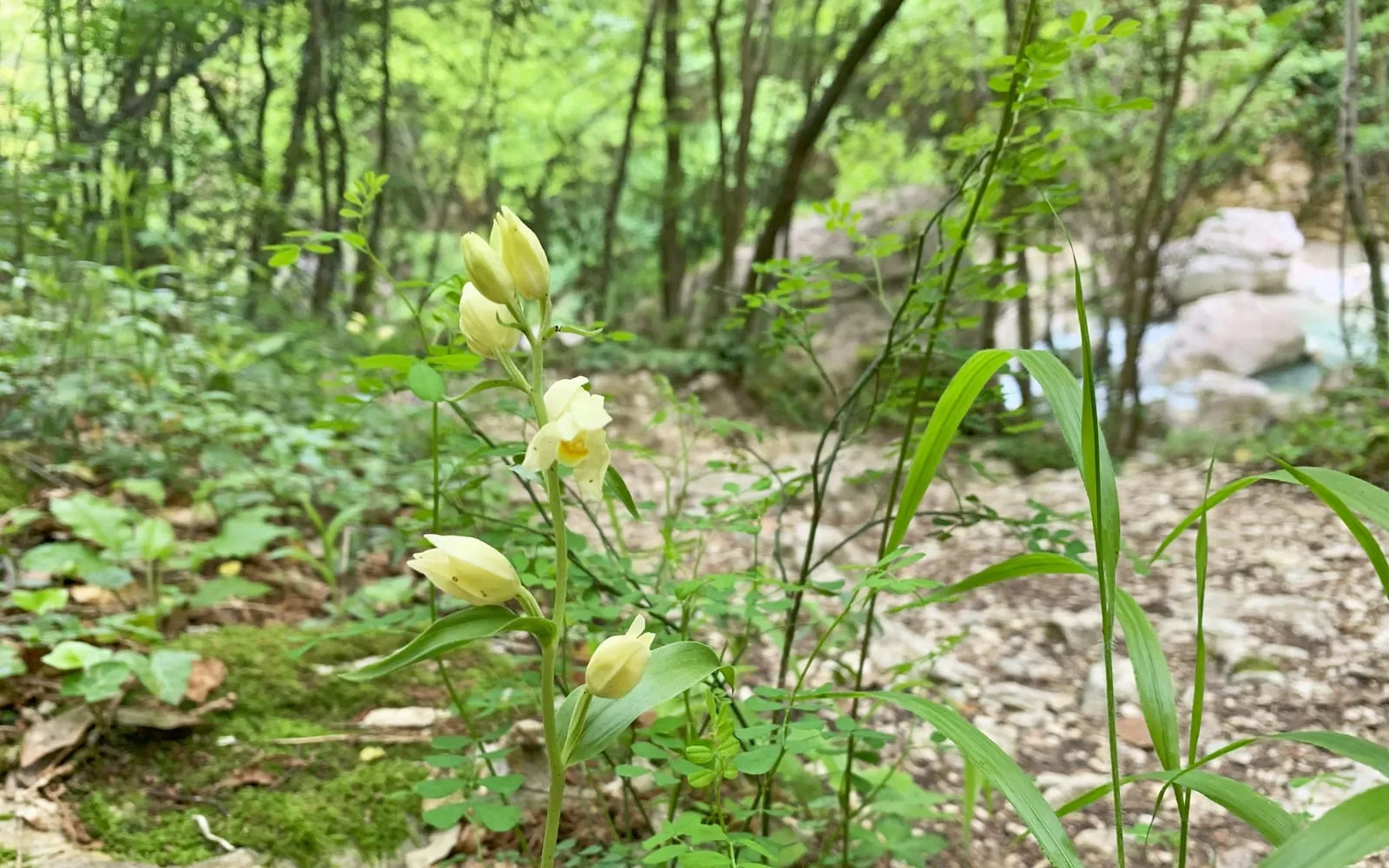
The white helleborine is a plant of deep, established woodland shade, tolerating darker conditions than almost any other hardy terrestrial orchid and often found growing under beech canopy so dense that little else flowers on the woodland floor beneath it. Its creamy white flowers have an unusual habit of barely opening at all, staying largely closed even at their peak, which is thought to encourage self-pollination in the low-light conditions where visiting insects may be scarce.
Because it depends so heavily on the accumulated leaf litter and undisturbed fungal network of mature woodland, it is not a species that transplants or establishes readily from bought stock into an ordinary garden border, and its presence is far more often the result of protecting and encouraging an existing wild population within an established woodland garden than of deliberate planting from scratch.
Appearance and character
Upright stems, variable in height depending on light and soil conditions, carry broad, oval to lance-shaped leaves arranged alternately along their length, somewhat glossy and much less strongly veined than the leaves of some related terrestrial orchids. Flowers cluster toward the top of the stem, creamy white with a soft yellow-orange mark inside the lip, and open only slightly, if at all, giving the plant a demure, understated appearance compared with the wide-open blooms of many other orchids.
The whole plant often persists in the same deep woodland shade year after year with only modest change in height or flower number, a reflection of how stable and slow-changing its favoured habitat naturally is.
Where it is from
Mature deciduous woodland across Europe, particularly on chalk and limestone, most often under beech but also found under oak and other broadleaved trees, always in soil enriched over many years by accumulated leaf litter.
That dependence on long-undisturbed woodland soil and its established mycorrhizal fungal network is central to why this species resists deliberate transplanting so strongly; the conditions it needs take decades to develop naturally and cannot be assembled quickly in a new garden setting.
How it grows
A shallow rhizome persists just below the woodland floor, sending up one or more leafy stems each spring, with the whole plant dying back to the rhizome again after flowering and seed set. Growth from year to year is generally modest and gradual, reflecting the low-light, low-disturbance conditions the species has adapted to rather than any weakness in the plant itself.
Because it can survive for extended periods drawing heavily on its mycorrhizal fungal partner rather than on photosynthesis alone, some individual plants can persist for years in very deep shade with minimal visible growth, a strategy few other garden plants share.
Through the seasons
Spring leafy stems emerge from the rhizome as the woodland canopy begins to leaf out above.
Summer is the main flowering period, typically in late spring to early summer before the tree canopy fully closes overhead.
Autumn stems die back once seed has set, disappearing into the leaf litter.
Winter the plant is fully dormant as an underground rhizome, hardy to significant cold, and relies on an undisturbed layer of leaf litter left in place rather than any active protection.
Care difficulty
Difficult, and largely outside the direct control of typical garden care. Establishing this species from scratch in a new location rarely succeeds; the more realistic approach in a garden setting is protecting and gently encouraging an existing population within mature, undisturbed woodland, leaving leaf litter in place and avoiding soil disturbance nearby.
Watering
This species relies on natural rainfall filtered through the woodland canopy and leaf litter above it, and supplemental watering is rarely appropriate. The greater risk in cultivation is soil disturbance or compaction around an existing population rather than any lack of water.
Warning signs, diseases and pests
Slugs and snails occasionally graze emerging shoots in spring, though damage in an established woodland setting is usually limited. Deer and rabbits can browse flower spikes before they open in a garden bordering open countryside, and protecting a valued population during the flowering period is worthwhile where grazing pressure is a known issue.
A population that fails to flower in a given year, while still producing leaves, is not unusual for this species and does not necessarily indicate a problem; some individual plants skip flowering in poorer years, relying instead on their mycorrhizal partnership to sustain them until conditions favour flowering again.
Growing environment
Deep to moderate woodland shade is what this species needs above almost anything else, tolerating darker conditions than most other terrestrial orchids. Humus-rich, alkaline, long-undisturbed woodland soil, with a thick, intact layer of leaf litter left in place rather than cleared away, gives the best chance of a population persisting and slowly expanding.
Feeding
None at all. Fertiliser has no place near this species, and disturbing the woodland soil to apply it would do far more harm than any nutrient benefit could offset, given how dependent the plant is on an undisturbed mycorrhizal network.
Troubleshooting
A known population has stopped flowering, though leaves still appear. This can be a normal response to a less favourable year rather than a sign of decline, since the plant can persist on its mycorrhizal partnership without flowering every season. Continue leaving the site undisturbed.
Leaf litter has been cleared from around a population, apparently by mistake. Avoid clearing leaf litter from areas known to support this species in future; the litter layer is part of what sustains the soil conditions it depends on, and habitual clearing can weaken a population over successive years.
You want to introduce this species to a new part of the garden. Deliberate transplanting or planting from bought stock has a poor success rate for this particular species, given how specific and slow-forming its required woodland conditions are; protecting and encouraging any existing wild population is usually more realistic than starting one from scratch.
Flower spikes have been browsed before opening. Check for deer or rabbit grazing, particularly in a garden near open countryside, and consider temporary protection around a valued population during the flowering period.