
Edible
Rue
Ruta graveolens
Also known as Common rue, Herb of grace, Herbygrass
How to grow rue, Ruta graveolens. The blue-green herb of grace, the blistering rash its sap causes in sunlight, and why it is no longer a kitchen plant.
At a glance
- Difficulty
- Easy
- Water
- Rarely once established
- Light
- Full sun
- Temperature
- Hardy to about -15 deg C in dry ground
- Hardiness
- USDA 4-9, RHS H6, hardy to -15 C
- Type
- Hardy evergreen sub-shrub
- Height
- 50-90 cm
- Native to
- southeastern Europe
- Best month
- June and July in the Northern Hemisphere, December and January in the Southern Hemisphere
Handle it in gloves and never on a sunny day. The sap carries furanocoumarins that react with sunlight and raise blistering burns that scar for months, and pruning rue in bright weather is how most of those happen. Dry poor soil suits the plant, and winter wet kills it faster than cold does.
Hardiness zones describe winter cold alone. Summer heat, humidity, rainfall and the length of the growing season decide as much, so treat the range as the outer limit rather than as a recommendation.
Every month named in this guide is for the temperate Northern Hemisphere. If you garden in the Southern Hemisphere, shift each one by six months, so June becomes December. Closer to the equator the wet and dry seasons matter more than the calendar, and the shift stops being a useful guide.
Poisonous if eaten
- Do not eat
- The sap above all, and the whole plant if eaten in quantity
- Harm from
- Handling it and eating it
- Affects
- People, cats, dogs and horses
Rue is the most hazardous plant in this wave and the risk is mainly to skin. The sap is loaded with furanocoumarins, and contact followed by sunlight produces a phytophotodermatitis that begins as redness and can develop into severe blistering and burns, sometimes leaving pigmented marks for months. The RHS lists Ruta graveolens as a plant that may cause severe skin blistering, and cases requiring hospital treatment after pruning it on a sunny day appear regularly in the dermatology literature. Always wear gloves and long sleeves, and prune it in the evening or on a dull day. Eaten, rue is a strong irritant and abortifacient, it has caused poisoning and deaths in people taking it deliberately in quantity, and it should not be treated as a culinary herb despite its historical use in that role. The ASPCA lists it as toxic to cats, dogs and horses. Small amounts appear in a few traditional Mediterranean dishes and in grappa, which is a matter of custom rather than a recommendation.
Sources: RHS potentially harmful garden plants, ASPCA toxic and non-toxic plants
About
Rue is a beautiful plant to look at and one to handle carefully. The foliage is an unusual blue-green, finely divided into rounded lobes, and it holds that colour all year on a neat rounded bush, which is why it still earns a place in dry gravel planting.
The sap is the problem. Rue is one of the strongest phototoxic plants that can be grown in a temperate garden, and pruning it bare-armed on a sunny day produces blistering burns that take weeks to heal and can leave marks for months. Gloves, sleeves and a dull evening are the answer, and they are not optional.
It was a kitchen herb for centuries and it is not one now. The flavour is intensely bitter, the plant is an irritant in quantity, and there is no reason to put it in food. Grow it for the foliage and for the history.
Appearance and character
A neat rounded evergreen bush, 50 to 90 cm, woody at the base with soft growth above.
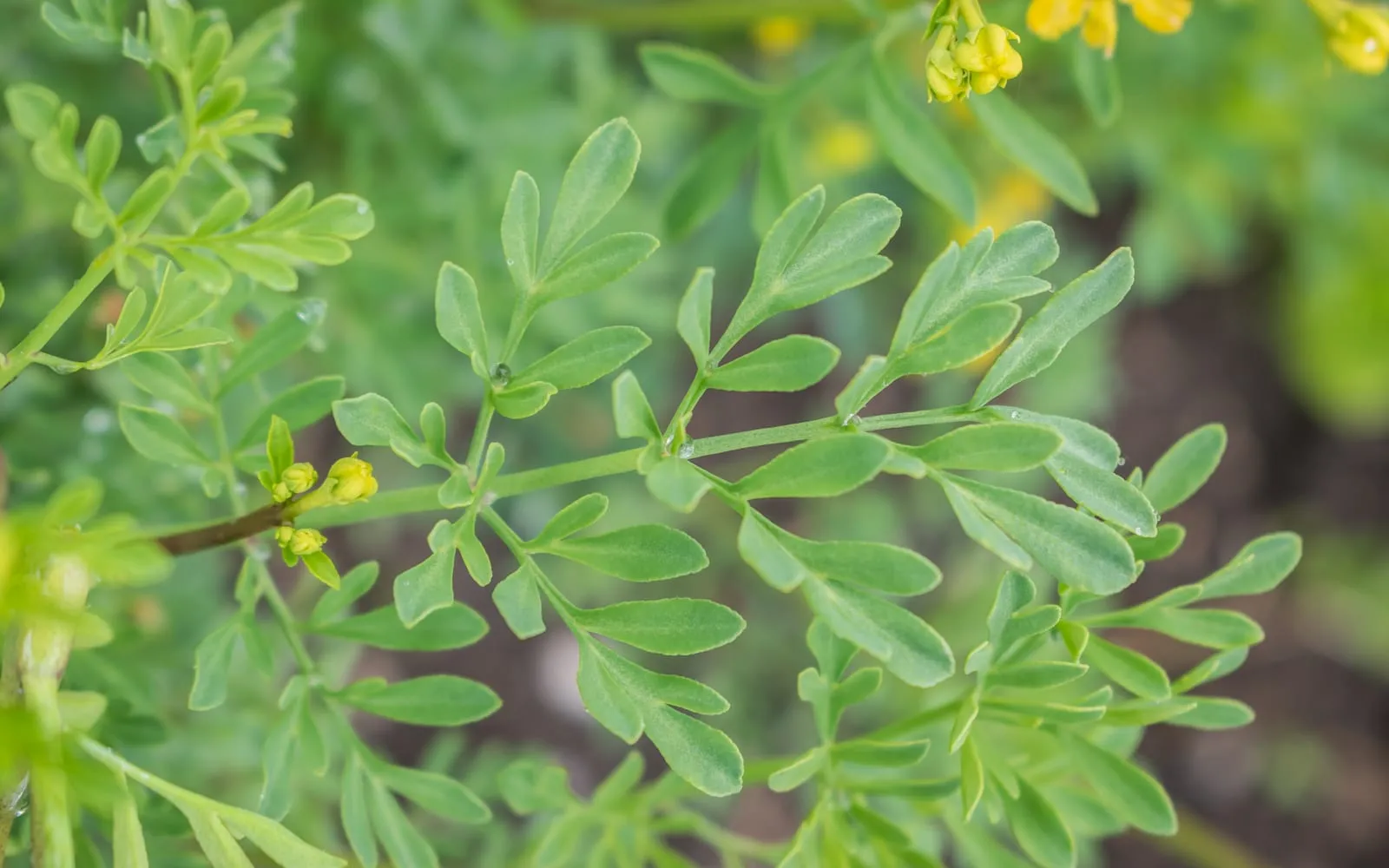
Leaves are the reason to grow it. Twice or three times divided into small spoon-shaped lobes, a distinctive glaucous blue-green, and they hold that colour through winter. The cultivar Jackman’s Blue is bluer still.
Flowers are small, dull yellow, four-petalled with fringed edges, in loose heads from June to August. They are curious rather than showy.
Seed capsules are four-lobed and knobbly, and they persist into winter.
The scent is strong, bitter and unpleasant to most people. The specific name graveolens means strong-smelling and the plant earns it.
Oil glands are visible as translucent dots when a leaf is held up to the light, which is a Rutaceae family character it shares with citrus.
Where it is from
Rue is native to the Balkan peninsula and the eastern Mediterranean, growing on dry limestone hillsides and rocky ground.
Its history in European culture is disproportionate to its use. The Romans grew it heavily, Pliny lists dozens of medical applications, and it was carried through the medieval period as a protection against plague, witchcraft and infection.
Herb of grace is the English name and it came from its use in the Catholic church, where a bunch of rue was used to sprinkle holy water before mass. Shakespeare’s Ophelia hands it out, and Richard II has a gardener plant it as a sour herb of grace.
Courts used it into the eighteenth century. Rue was strewn in courtrooms and carried by judges against gaol fever, a practice that survived as ceremony long after anyone believed in it.
Its culinary use persisted longest in Italy and Ethiopia. Grappa alla ruta still contains a sprig, and Ethiopian cooking uses the leaves and seeds, both in small quantities.
How it grows
Buy a plant or take cuttings, wearing gloves for both. Seed also works, sown in spring at 18 deg C.
Take semi-ripe cuttings in summer. They root readily in gritty compost.
Plant in spring into full sun and sharply drained poor soil. A gravel bed, a raised bed or a dry bank suits it, and heavy wet clay does not.
Space at 45 cm. It makes a rounded dome.
Cut it back by a third in spring, once new growth shows, wearing gloves and long sleeves and working on a dull day or in the evening. Do not cut into old bare wood, which usually kills the stem.
Deadhead if you want to limit self-seeding, which is free in gravel.
Do not harvest it for the kitchen. There is no good reason to and several good reasons not to.
Replace the plant every five or six years when the base goes bare.
Through the seasons
Winter keeps its blue-green foliage and looks better than most things in a January garden. Keep the crown clear of anything holding moisture.
Spring brings new growth in April. Cut back by a third then, into green growth, in gloves.
Early summer is when the plant fills out and the flowers open, from June.
Midsummer is the highest-risk period for handling it. Strong sun plus fresh sap is the combination that burns, so leave any cutting until the evening.
Autumn needs nothing. Leave the plant standing rather than cutting it back now, and clear fallen leaves off the crown.
Care difficulty
Easy to grow and requiring genuine care to handle, which is an unusual pairing.
Cultivation is simple. Full sun, sharp drainage, poor soil, no feeding, no watering once established, and a trim in spring.
Winter wet kills it. As with every Mediterranean sub-shrub here, crown rot in cold clay is the usual cause of death, and grit or a raised bed prevents it.
The pruning rule is the family rule. Cut into green growth, never into old bare wood.
Handling is where the care goes. Wear gloves and long sleeves every time you touch it, and do any cutting on a dull day or after sunset. Children and dogs brushing past a plant in a border is a real consideration when siting it.
Given all that, it is worth asking whether it belongs in a family garden at all. In a gravel bed away from paths, it is a fine plant.
Watering
Water new plants weekly through their first summer, then stop.
Established rue needs no watering in a temperate climate. It comes from dry limestone and survives long drought.
Water a container fortnightly in high summer, letting it dry out fully between times.
Never let it stand in water, and keep the crown dry over winter.
Water at the base if at all, and wear gloves while doing it.
Keep it dry from September so it enters winter with dry roots.
Warning signs, diseases and pests
Root and crown rot in wet ground is the main cause of death. The plant blackens at the base and fails to shoot in spring. There is no cure.
A blistering rash on your forearms is the plant rather than a pest, and it is the most likely problem you will meet. Wear gloves and sleeves, and prune in the evening.
Aphids appear on soft new growth in spring and rarely need action.
Bare woody stems with growth only at the tips mean the plant is old or untrimmed. Cut into green growth in spring, or replace it.
A stem cut into old bare wood that then dies is the plant behaving normally.
Yellowing and collapse in a wet spring is rot rather than a deficiency.
Seedlings in gravel mean it seeded. Pull them in gloves.
Growing environment
Full sun and sharp drainage, as for every Mediterranean sub-shrub in this collection.
Poor, stony, free-draining soil. Rich ground shortens its life and softens the growth.
Alkaline, around pH 7 to 8. It is a limestone plant.
Site it away from paths, seats and anywhere a child or a dog brushes past. A gravel bed at the back of a border is a better position than the front of one.
A container works well and lets you keep it out of reach, using gritty compost in terracotta.
It companions with lavender, thyme and santolina, all of which want the same conditions and none of which needs feeding.
Feeding
None. Rue grown lean is bluer, denser and longer-lived than rue that has been fed.
Do not mulch with compost or manure against the crown, since it holds moisture where the plant cannot take it.
Grit or gravel is the right surface mulch.
A container plant takes a weak balanced feed once in spring.
Refresh a pot with fresh gritty compost every second or third spring rather than feeding it harder.
Troubleshooting
I got a blistering rash after cutting it back. Phytophotodermatitis from the sap plus sunlight. It can be severe and it can leave pigmented marks for months. Wash the skin, keep it out of sunlight, and see a doctor if blistering is extensive. Always wear gloves and long sleeves in future, and prune in the evening.
Can I cook with it? No. It was used historically and it is a strong irritant in quantity, bitter to the point of being unpleasant, and an abortifacient. Leave it out of food.
It died over winter. Crown rot from wet ground. Replant into gravel or a raised bed.
I cut it back hard and the stems died. Rue does not break from old bare wood. Prune into green growth only.
Is it safe to have in the garden with children or dogs? The risk is contact with the sap rather than eating it, so site it away from paths and play areas. In a gravel bed at the back of a border it causes no trouble.
Why is the foliage so blue? A waxy coating on the leaf surface. Jackman’s Blue is the cultivar selected for it.
Does it repel cats? The claim is old and the evidence is poor. Cats mostly ignore it.