
Outdoor plant
Cleavers
Galium aparine
Also known as Goosegrass, Sticky willy, Sticky weed, Robin-run-the-hedge
How to identify and control cleavers, Galium aparine. Seedlings, sticky stems, early hoeing and edible young shoots.
At a glance
- Difficulty
- Easy
- Water
- Not applicable
- Light
- Full sun to partial shade
- Temperature
- Fully hardy, and it grows through mild winters
- Hardiness
- USDA 3-9, RHS H7, hardy to -30 C
- Type
- Annual, germinating in autumn and spring and dying after seeding
- Height
- 1-2 m through a support
- Native to
- Europe, north Africa and Asia, and native throughout Britain
- Best month
- March in the Northern Hemisphere, September in the Southern Hemisphere
It germinates in autumn and again in spring, grows through cold that stops most annuals, and sets seed before midsummer, which is what makes it so hard to stay ahead of. The hooked bristles carry seed on animals and clothing for miles. Pull it before the flowers set, since a plant left to seed puts several hundred into the ground.
Hardiness zones describe winter cold alone. Summer heat, humidity, rainfall and the length of the growing season decide as much, so treat the range as the outer limit rather than as a recommendation.
Every month named in this guide is for the temperate Northern Hemisphere. If you garden in the Southern Hemisphere, shift each one by six months, so March becomes September. Closer to the equator the wet and dry seasons matter more than the calendar, and the shift stops being a useful guide.
Not known to be toxic
Cleavers is not listed by the RHS as a potentially harmful garden plant and is not recorded by the ASPCA as toxic to cats, dogs or horses. It is edible and has a long history of use. The young shoots gathered in early spring are eaten cooked, and the plant is a traditional spring tonic across Britain and Ireland, taken as a tea or a juice. The seeds roasted make a coffee substitute, which is unsurprising since cleavers is in Rubiaceae, the same family as coffee. Geese and poultry eat it readily, which is where goosegrass comes from, and it is a harmless feed. The whole plant is covered in tiny hooked bristles that cling to skin and cause mild mechanical irritation and occasionally a rash in sensitive people, which is a nuisance rather than a hazard, and long sleeves solve it. Where a plant is unlisted by both sources rather than positively assessed, read that as no hazard recorded. Anyone gathering it should avoid roadsides, dog-walking routes and sprayed ground.
Sources: RHS potentially harmful garden plants, ASPCA toxic and non-toxic plants
About
Cleavers is the easiest serious weed to control and the one most people deal with too late.
It is an annual. It has no rhizomes, no taproot, no underground storage and no way of surviving except by seed. A hoe drawn through a bed in March, when the seedlings are 5 cm tall, removes the entire year’s problem in ten minutes.
Left alone until May it is a metre of tangled sticky growth through the middle of a border, it has to be unpicked by hand from every shrub and perennial it has climbed, and by the time it comes out it has usually already set seed.
The stickiness is mechanical. The whole plant, stems, leaves and fruits, is covered in minute hooked bristles that grip cloth, fur and skin, which is how the seed travels. A dog walked through a hedgerow in July comes back carrying a hundred of them.
It germinates in autumn as well as spring, so a bed that looks clean in November can be full of small plants by February, growing quietly through the winter.
Its saving grace is that everything about controlling it is easy provided it is done early.
Appearance and character
An annual reaching 1 to 2 m where it has something to scramble through, and forming a sprawling mat in the open.
Stems are square in cross section, weak, brittle and covered in downward-pointing hooked bristles along the angles, which is what makes them cling.
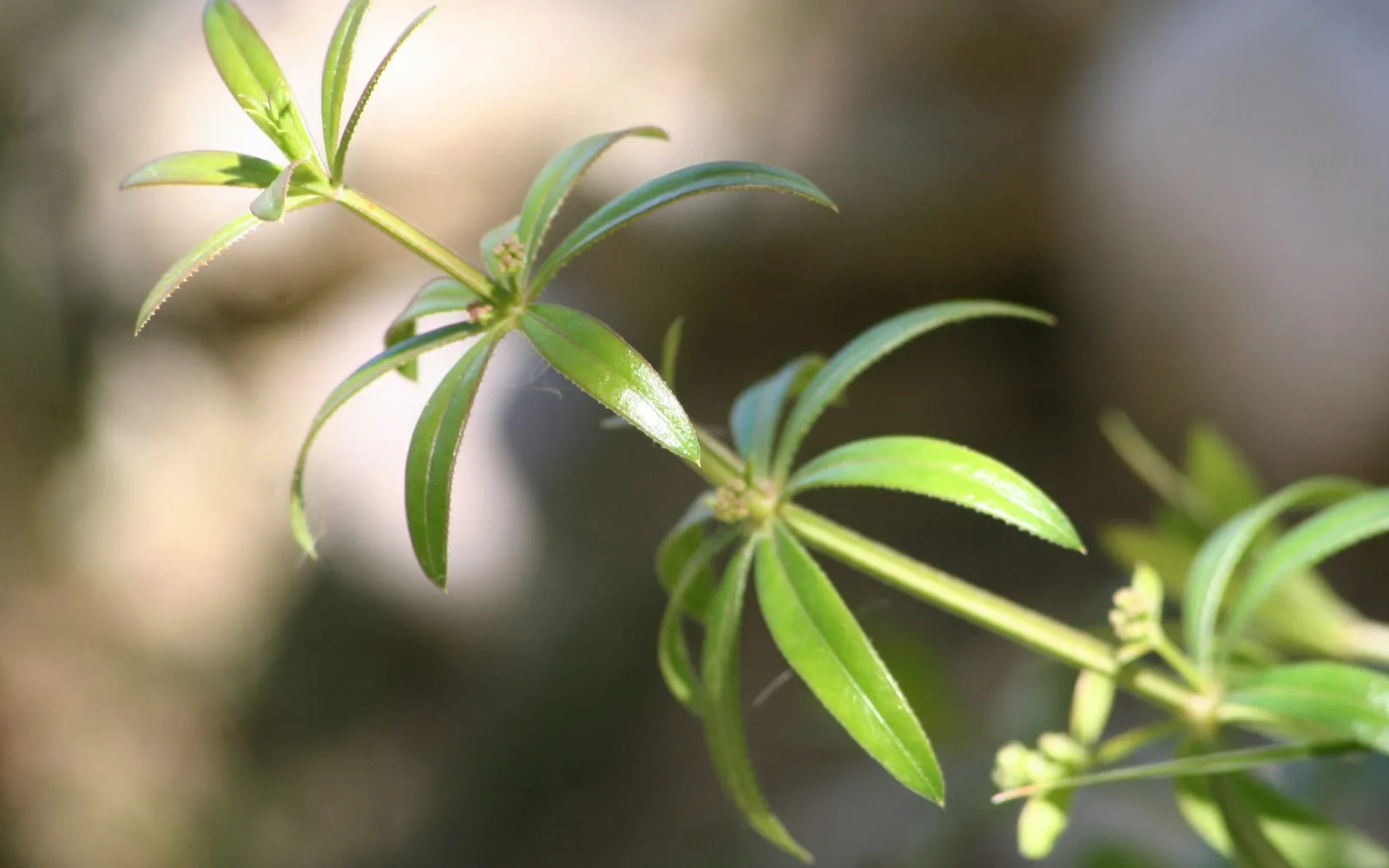
Leaves are narrow and lance-shaped, 2 to 6 cm long, held in whorls of six to eight around the stem at intervals, each with a small bristle at the tip and hooked bristles along the margin.
The whorled leaf arrangement is the identification, and no other common British weed has it in this form.
Flowers open from May to September, tiny, 2 mm across, dull greenish-white with four petals, in small clusters from the leaf whorls. They are easy to miss entirely.
Fruits are the memorable part. Paired round nutlets 3 to 6 mm across, densely covered in hooked bristles, and they stick to anything that brushes past.
Seedlings have two narrow oblong seed leaves and produce their first whorl of true leaves quickly.
The plant dies completely after seeding, leaving a dry brown tangle.
Where it is from
Europe, north Africa and Asia, and native throughout Britain and Ireland.
It grows in hedgerows, on woodland edges, in scrub, on waste ground, in arable fields and in gardens, and it favours rich moist fertile soil.
Nitrogen-rich ground suits it particularly well, so a well-fed vegetable plot or a border that has been mulched with manure is where it grows most vigorously.
It is in Rubiaceae, the same family as coffee and madder, and the roasted seeds have been used as a coffee substitute on that basis.
Its traditional use in Britain and Ireland was as a spring tonic, taken as a tea or a juice in the way nettle was, and it has a long record in folk medicine as a lymphatic remedy.
The bristly stems were used as a sieve for straining milk in parts of Sweden, which the old name records.
Cleavers is a significant arable weed in oilseed rape and cereals, where it smothers the crop and clogs harvesting machinery.
How it spreads
By seed only. There are no perennial roots or rhizomes.
A single plant produces several hundred seeds, and a well-grown one produces considerably more.
The hooked bristles on the fruit stick to clothing, animal fur, boots, gloves, tools and machinery, and the seed travels wherever those go.
Seed germinates in autumn and again in spring, with the autumn cohort growing slowly through the winter and being well established before anybody notices in March.
Seed survives in the soil for several years, so one clean season does not finish it.
It arrives in imported soil, in manure, in the rootballs of donated plants and on the gardener.
Through the seasons
Winter the autumn-germinated seedlings are already growing, small and low and easy to miss, and they are at their most vulnerable.
Spring is the critical month. Growth accelerates from March, and hoeing now removes the whole year’s problem.
Summer flowers from May and sets seed from June, at which point control becomes damage limitation.
Autumn the plants die after seeding, and the next generation germinates into the bare ground.
Control
Hoe in late winter and early spring. This is the whole method. Draw a hoe through beds in February and March, when the seedlings are a few centimetres tall, on a dry day so the uprooted plants shrivel. Ten minutes now saves hours in May.
Go through again a fortnight later, since germination is staggered.
Hand pull larger plants, taking hold at the base and drawing the whole stem out. It comes up readily since the root system is shallow and weak.
Pull before it flowers wherever possible. A plant pulled in April is a plant that never seeds.
Bag anything already carrying fruit rather than composting it, since the seed ripens on pulled plants and survives a domestic heap.
Unpick it from shrubs and perennials carefully, following each stem back to its base, and expect to be picking bristly fragments off your sleeves afterwards.
Mulch beds thickly in autumn, which stops most seedlings establishing.
Keep the ground covered. Cleavers colonises bare fertile soil, and dense planting or a thick mulch removes the opportunity.
Chemical control is rarely worth it in a garden, since hand and hoe removal is so effective. A glyphosate treatment in early spring clears heavily infested waste ground, following the label.
Watch the nitrogen. Heavily manured ground grows enormous cleavers, and a bed that is full of it every year is often a bed that is being fed hard.
Check your clothes, your dog and your tools after working in an infested area or walking a hedgerow, since that is how it reaches new ground.
Using it
The young shoots gathered in early spring, before the plant flowers, are edible cooked. They are best steamed or added to soup, since the bristles soften with heat and raw cleavers is unpleasant in the mouth.
Cleavers tea, made from the fresh young plant, is a traditional British and Irish spring tonic.
The roasted seeds make a coffee substitute, which follows from the family relationship with coffee.
Poultry and geese eat it readily and it is a useful feed, which is where goosegrass comes from.
Avoid gathering from roadsides, from ground used by dogs and from anywhere that has been sprayed.
Be certain of the identification, and cleavers is straightforward with its square bristly stems and whorls of six to eight narrow leaves.
Telling it apart
Cleavers has square stems covered in hooked bristles, whorls of six to eight narrow leaves, tiny greenish-white flowers and round bristly paired fruits that stick to everything.
Hedge bedstraw, Galium mollugo, has smooth stems, whorls of six to eight leaves and showy masses of white flowers, and it does not cling.
Lady’s bedstraw, Galium verum, has fine needle-like leaves in whorls and dense yellow flowers, and it does not cling.
Woodruff, Galium odoratum, is a low woodland plant with whorls of six to eight leaves and white flowers, smelling of new-mown hay when dried, and it does not cling.
The stickiness settles it. Nothing else in a temperate garden clings like cleavers.
Troubleshooting
When should I deal with it? February and March, when the seedlings are a few centimetres tall. Hoeing then removes the whole year’s problem. By May it is a metre of tangled growth through your border.
Does it have deep roots? No. It is an annual with a shallow weak root system and it pulls up readily. Everything about it depends on seed.
Where did it come from? Seed, carried on clothing, boots, tools, dog fur, imported soil or manure. The hooked bristles on the fruit stick to anything that passes.
Can I compost it? Only if it has not set seed. Bag and bin anything carrying the round bristly fruits, since the seed ripens on pulled plants and survives a domestic heap.
It appeared over the winter. Cleavers germinates in autumn as well as spring, and the autumn seedlings grow slowly through the winter. Check beds in January and February.
Why is it so vigorous in my vegetable plot? Rich nitrogen-fed soil suits it. A heavily manured bed grows the largest cleavers in the garden.
How do I get it out of a shrub? Follow each stem back to its base and pull from there, unpicking as you go. The bristles make it cling to itself as well as to the shrub.
Can I eat it? The young spring shoots are edible cooked and are a traditional spring tonic. The roasted seeds make a coffee substitute. Avoid roadsides and sprayed ground.
Will it come back next year? Yes, from seed in the soil, which survives several years. One clean season reduces it and does not finish it, so hoe every spring.