
Houseplant
Spanish Moss
Tillandsia usneoides
Also known as Old Man's Beard, Graybeard
How to grow Tillandsia usneoides. Not a moss and not Spanish, with no roots at all, misted rather than soaked, and hung rather than potted.
At a glance
- Difficulty
- Easy
- Water
- Mist several times a week, or dunk the whole festoon briefly two or three times a week
- Light
- Bright, filtered light, with some gentle direct sun. Avoid deep shade and harsh midday sun alike
- Temperature
- 10-30 deg C. Tolerates brief cold better than most Tillandsia
- Humidity
- Moderate to high, with constant air movement. Stagnant damp air causes rot faster than dry air causes damage
- Hardiness
- USDA 8-11, RHS H2, hardy to -5 C
- Type
- Evergreen epiphyte, spreading indefinitely by fragmentation and by seed rather than by forming a single rosette
- Height
- Individual strands 1-2 m or more; grown indoors typically 15-60 cm
- Native to
- Southeastern United States, Mexico, Central America, Caribbean, South America
A wide native range from the humid subtropical southeastern United States down to northern Patagonia, which makes it one of the most cold-tolerant epiphytic flowering plants known. The zone number covers brief winter dips; it says nothing about the still, humid air that kills a hanging festoon indoors far more often than cold does.
Hardiness zones describe winter cold alone. Summer heat, humidity, rainfall and the length of the growing season decide as much, so treat the range as the outer limit rather than as a recommendation.
Not known to be toxic
Non-toxic. Spanish moss is not related to true mosses at all and carries none of their chemistry; it is a flowering plant in the same family as the pineapple. It does not appear on the ASPCA's toxic plant list, and commonly cultivated Tillandsia species are recorded on the ASPCA's non-toxic register for cats and dogs. The RHS list of potentially harmful garden plants does not include it either. The one thing worth knowing, more folklore than hazard, is that wild-collected festoons hanging in a tree can carry small insects, spiders or chiggers that live among the strands; a plant bought from a nursery has been cleaned and carries no more risk than any other houseplant.
Sources: ASPCA (Toxic and Non-toxic Plants, Tillandsia), RHS potentially harmful garden plants
About
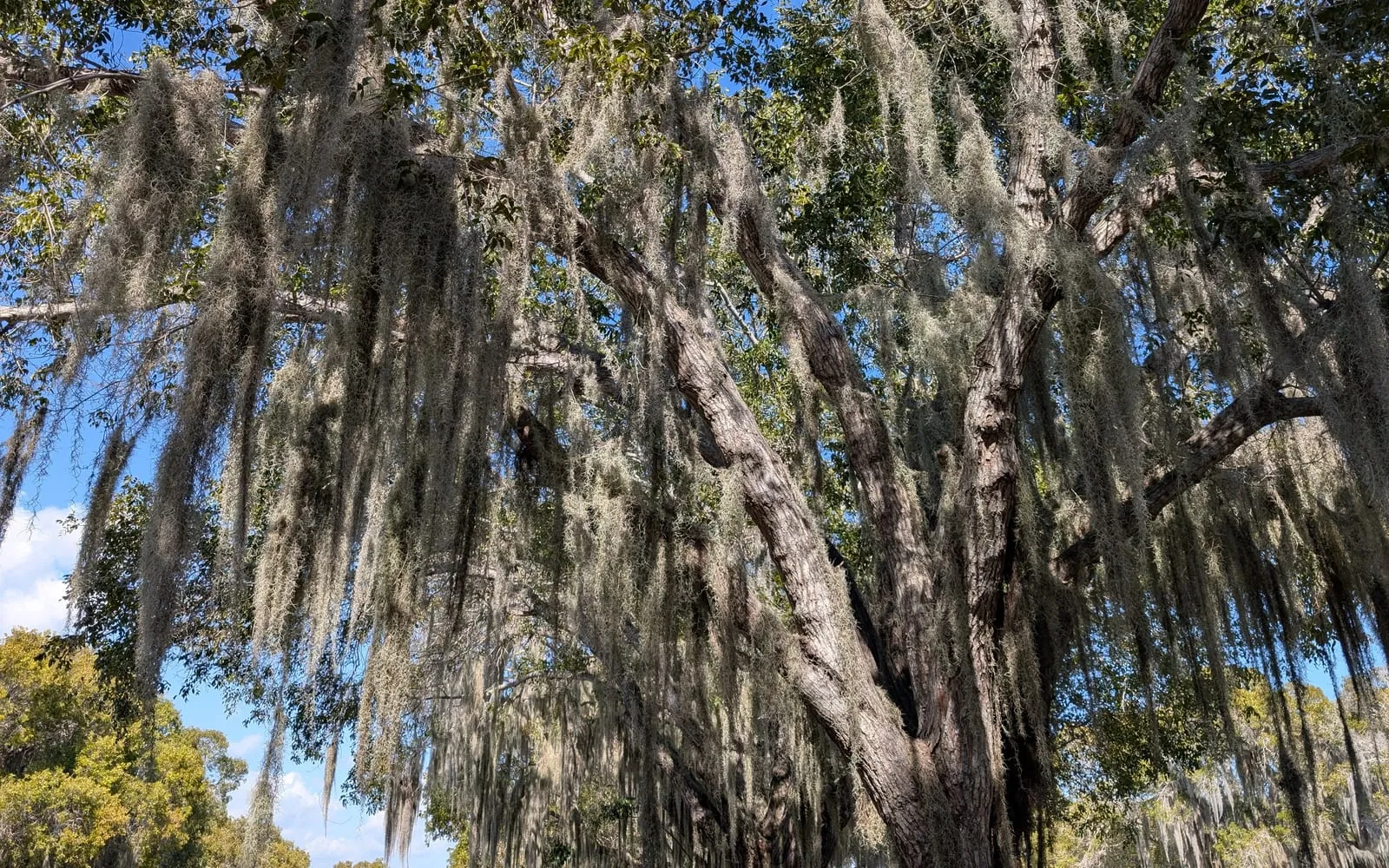
Spanish moss is neither. It is not a moss, which is a bryophyte with no true leaves or flowers, and it did not originate in Spain. It is a flowering plant in the pineapple family, native to a broad swathe of the Americas, and the name is an old English one, coined by settlers who thought the grey festoons hanging from live oaks resembled the beards worn by early Spanish explorers.
The real plant is stranger than either misconception. A mature strand of Spanish moss has no roots whatsoever. A seedling briefly grows a few threadlike roots to anchor itself to a branch, then loses them entirely as it matures. For the rest of its life, the plant takes up water and nutrients through microscopic scales on the surface of its thread-like leaves. There is no soil requirement to work around, because there is nothing below ground for soil to serve.
Grown at home, it hangs rather than sits in a pot, drapes over a branch or wire frame rather than rooting into a container, and needs misting rather than watering in the way most houseplants understand the word.
Appearance and character
Long, thin, silvery-grey strands, each made up of short leaf segments only a millimetre or two wide, linked end to end so the whole thing looks more like a length of thread or fine wire than a conventional leaf at all.
A single strand can reach a metre or more in the wild, hanging in loose chains from a branch, and cultivated indoor festoons are usually kept shorter, from 15 to 60 cm, by trimming and by the more limited light a room provides compared with an open tree canopy.
The grey colour comes from a dense covering of trichomes, tiny water and nutrient-absorbing scales, over the entire surface of every segment. A plant that looks silvery rather than green is covered in more trichomes and built for a drier spell between waterings; one that looks distinctly green has fewer trichomes exposed and wants water more often.
Flowers are small, pale yellow-green or blue, fragrant at night, and easy to overlook entirely against the grey strands, since each one is only a few millimetres across and opens for a short time.
The plant has no rosette form at all, unlike almost every other bromeliad in cultivation. It grows as a continuous, branching chain, spreading both by fragments that break off and lodge elsewhere and by wind-blown seed carrying a feathery parachute similar to a dandelion’s, which is how a single festoon in a tree becomes a whole colony over years.
Where it is from
Spanish moss has one of the widest native ranges of any bromeliad, recorded from the humid coastal plain of the southeastern United States through Mexico, Central America and the Caribbean, and south through much of South America as far as northern Patagonia.
In its best-known range, the low-lying swamps and river bottoms of the American South, it drapes from live oak and bald cypress branches in humid, still air, taking advantage of the shade and moisture those trees hold without drawing any nutrients from the tree itself. It is not parasitic; the branch is only a perch.
That enormous range is also why the species tolerates more cold than most Tillandsia. Populations at the northern edge of its distribution experience real winter conditions, including occasional frost, which a tropical species from a narrower range never has to survive.
The plant provides shelter that nothing else in its habitat does in quite the same way. Several bird species use it as nesting material, and at least one jumping spider is found living almost exclusively among Spanish moss strands and nowhere else, a level of specialisation that shows how much of a miniature ecosystem a single hanging festoon can support.
How it grows
Hang it rather than pot it. A festoon draped over a curtain rail, a piece of driftwood, a wire hoop or looped over a hook does everything a container would, since there are no roots to accommodate.
Mist it several times a week, or take the whole festoon down and dunk it briefly in a bowl or sink of tepid water two or three times a week, which is more thorough than misting alone and worth doing periodically even for a plant that is otherwise misted daily.
Shake it out gently after watering so it is not left dripping. Unlike a soaked rosette, which can be turned upside down to drain, a hanging festoon has no single low point, and water trapped between tangled strands in still air can start rot that spreads through the whole plant rather than staying confined to one spot.
Give it moving air. This matters more for Spanish moss than for almost any other houseplant, because the plant is built to hang loosely in open air in the wild, and a still, humid spot indoors, however well misted, recreates the one condition the plant has no defence against.
Position it in bright, filtered light with a little gentle direct sun. Deep shade slows growth to a crawl, and harsh, unfiltered midday sun through glass can scorch the fine strands faster than it would a broader leaf.
Feed very sparingly by adding a heavily diluted bromeliad or orchid fertiliser to the misting water once a month in the growing season, since the plant absorbs almost no nutrients through anything but its leaf surface and a strong feed burns the delicate trichomes.
Let it spread. A festoon left undisturbed for a year or two thickens and lengthens on its own, and trimming is only needed to keep it to a size that suits the space, since the plant has no natural upper limit the way a rosette-forming Tillandsia does.
Through the seasons
Spring restarts active growth after a slower winter. Increase misting frequency as the room warms and daylight lengthens, and resume the light monthly feed.
Summer is the strongest growing period. Mist several times a week or more in a hot, dry room, keep the air moving with a fan or an open window, and watch for the small fragrant flowers, which are easy to miss but worth looking for close up.
Autumn slows growth gradually. Reduce feeding, and keep an eye on indoor humidity as central heating begins to dry the air faster than the plant is used to.
Winter is the season to watch most closely indoors. Stop feeding, maintain misting even though growth has slowed, since dry heated air can desiccate the fine strands faster than cold ever would, and keep the plant away from cold glass, since a draughty windowsill combines the two stresses it tolerates worst at once.
Care difficulty
Easy, provided the two habits that trip people up are understood from the start.
The first is that it needs no soil and no pot at any point in its life, which surprises anyone used to a Tillandsia that at least sits in a bowl or is mounted on bark, since Spanish moss hangs free.
The second is that still, humid air is more dangerous to it than dry air. A well-meaning owner who mists heavily but never gives the plant any airflow, perhaps by keeping it in a closed or poorly ventilated spot, can rot a festoon that would have thrived with less water and more movement.
Once both habits are understood, the plant needs very little. It has no compost to get wrong, no cup to flush, and no repotting to schedule. A healthy festoon lasts indefinitely, slowly lengthening rather than needing to be replaced.
Watering
Mist thoroughly several times a week, or dunk the whole festoon in tepid water for a few minutes two or three times a week, which reaches strands in the centre of a dense clump that misting alone can miss.
Shake it out well after watering rather than leaving it to drip, since trapped moisture between tangled strands in still air is the main cause of rot in cultivated plants.
Increase frequency in a hot, dry room or over summer, and reduce it slightly in a cool, humid spot, judging by touch: a strand that feels dry and slightly brittle wants water sooner than one that still feels supple.
Use rainwater or filtered water where the tap supply is hard, since mineral deposits collect on the fine strands more visibly than they would on a broader leaf.
Signs of underwatering are strands that feel dry, papery and slightly grey. Signs of overwatering or poor airflow are strands that darken, feel slimy, or come apart when touched gently.
Warning signs, diseases and pests
Strands that have turned dark, slimy or mushy are rotting, almost always from water trapped in a dense, poorly ventilated clump. Separate the affected strands from healthy ones, discard anything beyond saving, and increase airflow around what remains.
Grey, dry, brittle strands that crumble when handled point to underwatering. Increase misting frequency and check the plant is not hanging somewhere unusually hot or dry, such as directly above a radiator.
Scale insects appear as small, flat, brownish bumps along the strands, often more visible where several strands cross each other. Wipe them off with a cloth dipped in dilute soapy water or treat with horticultural oil, taking care not to soak the plant excessively while treating it.
Mealybugs show as tiny white cottony clusters where strands tangle together. A cotton bud dipped in isopropyl alcohol removes them, followed by a check a week later for any missed.
A festoon that has stopped growing but shows no discoloration may be dormant through a cool, dry winter rather than in trouble. Resume normal watering as the season warms and watch for new growth before intervening further.
Bleached, straw-coloured patches point to scorch from harsh direct sun, particularly through glass. Move the plant to a spot with more filtered light.
Growing environment
Bright, filtered light with some gentle direct sun, avoiding both deep shade, which slows growth, and harsh unfiltered midday sun through glass, which scorches the fine strands.
A wide temperature range, from 10 to 30 deg C, with brief tolerance of cold down towards freezing that few other Tillandsia species can match.
Moderate to high humidity combined with constant air movement, which matters more for this species than for almost any other houseplant. An open shelf, a hook near a window that is opened regularly, or an outdoor spot in summer all suit it better than a sealed, still corner.
No soil, no pot and no mount required, though it can be draped over driftwood, a wire hoop or a curtain rail for display.
Good spacing from other plants and surfaces where possible, so air can move through the strands rather than around a dense, tangled mass sitting against a wall or shelf.
A spell outdoors in a sheltered, shaded spot over summer, where local climate allows, tends to produce noticeably stronger growth than a plant kept indoors year-round, since natural air movement is hard to fully replicate inside.
Feeding
Feed once a month during the growing season by adding a heavily diluted bromeliad or orchid fertiliser, no more than a quarter of label strength, to the misting water or the dunking bowl.
Avoid ordinary houseplant fertiliser at normal strength. The trichomes that cover every strand are more easily damaged by concentrated salts than the thicker, less exposed leaves of a rosette-forming Tillandsia.
Stop feeding entirely over winter, when the plant’s growth slows and any unused nutrient is more likely to sit on the strands than be taken up.
A festoon that is never fed will still survive and slowly grow, drawing what little nutrient it needs from dust, rain and decaying organic matter that settles on it, much as it would in the wild.
Never apply fertiliser directly to dry strands. Mist or dunk first so the trichomes are open and able to absorb it, since a dry plant takes up almost nothing through its surface.
Troubleshooting
Does it need a pot at all? No. Spanish moss has no functional roots on a mature plant and grows entirely unpotted, hung over a support of any kind rather than planted in anything.
How is this different from other air plants? Most Tillandsia grow as a rosette, keep a few functional roots for gripping a branch, and are soaked whole before being dried upside down. Spanish moss loses its roots entirely after the seedling stage, grows as a hanging chain rather than a rosette, and is misted or briefly dunked rather than fully soaked and dried in one position.
The strands have gone dark and slimy in the middle of the festoon. That is rot from trapped moisture and poor airflow. Separate any unaffected strands, discard the rest, and give what remains more space and air movement.
Can I keep it in a closed terrarium? It is not the best choice for one. Spanish moss depends on moving air more than most houseplants, and a sealed or poorly ventilated container recreates the still, humid conditions that cause rot fastest.
It looks dry and grey and slightly crunchy. Increase how often you mist or dunk it, and check it is not hanging too close to a heat source such as a radiator or a sun-baked window.
Is it really a moss? No. It is a flowering plant in the same family as the pineapple, unrelated to true mosses, which are a much older and structurally simpler group of plants with no flowers, seeds or vascular tissue at all.
Can I grow it from a fragment? Yes. A healthy broken-off piece will root itself onto a suitable perch given time, moisture and airflow, in the same way wind-carried fragments spread the species naturally in the wild.
Spanish Moss problem guides
Not sure what is wrong? See the common houseplant pests guide.