
Houseplant
Zebra Billbergia
Billbergia zebrina
Also known as Billbergia zebrina, Zebra Urn Plant
How to grow Billbergia zebrina, the zebra billbergia, a tall tubular bromeliad with silver-banded leaves, pendent pink flower spikes and a water-holding tank.
At a glance
- Difficulty
- Easy
- Water
- Keep the central tube topped up; let the mix dry between waterings
- Light
- Bright indirect light with some direct sun
- Temperature
- Warm; keep above about 10 deg C
- Humidity
- Average to high
- Hardiness
- USDA 10-12, RHS H1c, hardy to 8 C
- Type
- Evergreen rosette bromeliad, monocarpic rosettes
- Height
- 40 to 90 cm
- Native to
- Brazil
A tank bromeliad from the warm forests of Brazil, growing mostly perched on trees and catching water in the narrow tube of its rosette. It needs warmth, bright indirect light and an open, fast-draining root run, with its central tube kept topped up. It has little frost tolerance and is safest above about 10 deg C.
Hardiness zones describe winter cold alone. Summer heat, humidity, rainfall and the length of the growing season decide as much, so treat the range as the outer limit rather than as a recommendation.
Not known to be toxic
A safe plant to keep around pets and children. Bromeliads, including Billbergia, are not listed as toxic by the ASPCA or the RHS, and hold no harmful compound. A pet or child that chewed a leaf would be unlikely to come to real harm beyond a possible mild stomach upset. The fine teeth along the leaf edges can scratch, which is the main caution.
Sources: ASPCA toxic and non-toxic plants, RHS potentially harmful garden plants
About
Billbergia zebrina is grown mainly for its silver-banded leaves, with flowers as a bonus. Its stiff leaves roll tightly into a slim, upright column instead of an open vase. The column is olive to bronze and crossed with broad, chalky silver bands from top to bottom. Even between flowerings it is one of the more striking tank bromeliads.
The species grows in the warm forests of Brazil, perched on branches as an epiphyte. It holds water in the narrow tube formed by its rolled leaves. Its roots mainly anchor the plant, so it needs an airy, fast-draining mix and soft water poured into the central tube.
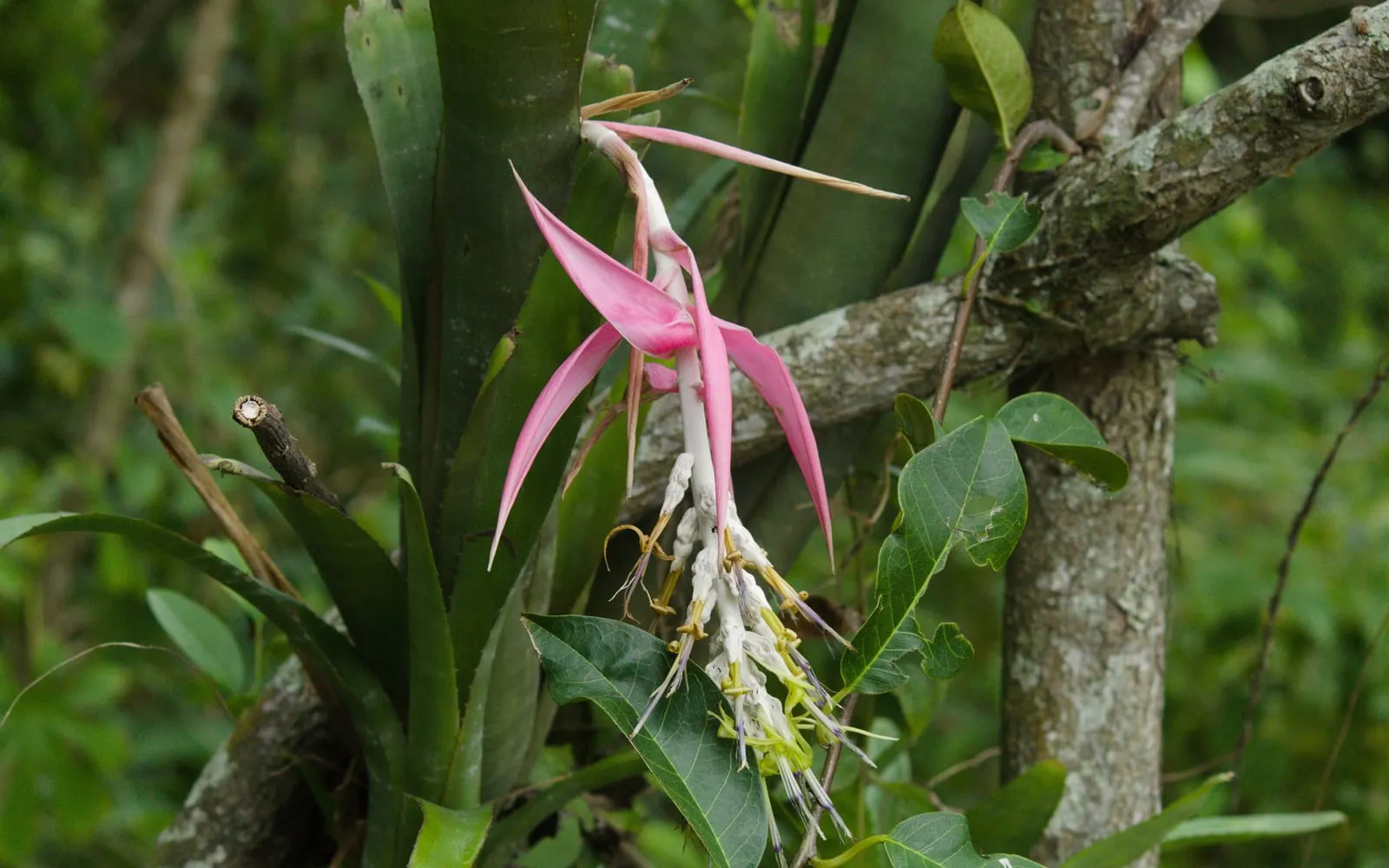
When a column matures it flowers with a long, arching stem that hangs below the foliage, with large rose-pink bracts and slim yellow-green blooms. The flower display is short-lived. After flowering, that rosette dies back over the following months while offsets at the base continue the plant.
Appearance and character
The leaves are stiff and inrolled, forming a tall, narrow shaft instead of a spreading rosette. Their ground colour is a deep olive that turns bronze in strong light, and across it run the wide silver-white bars that give the zebra its name, bold enough to show at a distance.
The central shaft holds the plant’s water, and the whole plant stands slim and vertical, taller than it is wide. Small teeth line the leaf edges and can graze a careless hand, though they are not fierce. The flower is a pendent, arching spray of rose-pink bracts and yellow-green petals, borne once from a mature shaft that then fades as its pups grow on.
Where it is from
Billbergia zebrina lives in the warm, humid forests of Brazil, perched on tree limbs as an epiphyte and catching rain and falling litter in the deep tube of its rosette. The canopy filters its light, the air stays damp, and water drains off its roots quickly.
Those forest habits set the indoor routine. It needs frost-free warmth, bright light with a little direct sun to keep the banding vivid, and a very open bark or orchid mix that drains at once. Keep the central tube topped up with rain or filtered water, and let the mix dry between waterings.
How it grows
Through the warm months it lengthens its banded shaft, and a rosette that reaches full height flowers a single time before dying back. As that rosette declines, offsets at its base grow on and flower in their turn. A pot left alone fills with a group of silver-barred columns.
To increase it, wait until an offset is well grown and has its own small tube, then detach it low with a clean, sharp blade and pot it into the same open medium. It roots readily in warmth, and a tall young shaft may lean until its roots take hold, so a slim support helps.
Through the seasons
Spring starts new growth. Empty the tube of stale water, rinse it, refill with rainwater, and begin weak feeding.
Summer is the growing peak. Keep the tube topped up, give bright light with a spell of gentle sun for the strongest bars, and let the mix dry between waterings.
Autumn may bring the long pendent flower stem from a mature shaft. Reduce feeding as light fades.
Winter is rest. Keep the plant warm, water the roots seldom, and leave only a shallow charge in the tube unless the room is dependably warm.
Care difficulty
It ranks among the easier showy bromeliads. It carries its own water reserve, needs only occasional weak feeding, and tolerates most pests. New growers are sometimes caught out by two normal habits: the central tank is watered down the middle, and each rosette dies once it has flowered. Cold and wet, heavy compost are the real threats.
Watering
Pour soft water into the central tube, using rain or cooled boiled water if possible, because hard tap water leaves chalky spots that dull the silver bands. The roots need less water; wet the mix only when its surface has dried, and let it drain freely so nothing pools at the base.
Change the water in the tube every week or two to keep it fresh. In winter, water the roots rarely and keep the tube barely filled, or dry, if the room runs cool.
Warning signs, diseases and pests
Faded, greyed banding is the most common complaint and almost always means too little light; a brighter position with some direct sun restores the contrast. A soft, darkening base is root rot from a heavy, wet mix. Move it into a coarser medium and water the roots less.
Scale insects settle on the leaves as small brown discs and can be wiped away and treated with horticultural oil. Stale water in the tube can rot the leaf bases, so refresh it regularly. Chalky flecks on the leaves are mineral marks, not poison.
Growing environment
Bright light with an hour or two of direct sun keeps the silver bars sharp and encourages flowering; in shade the banding pales and the plant will not bloom. Guard it from harsh midday sun through glass, which scorches the leaves, but give it enough light to hold the markings.
Warmth above about 10 deg C and reasonably moist air keep it growing, well away from cold draughts. It enjoys a summer outdoors in a warm, sheltered, lightly shaded spot.
Feeding
Feed lightly through the growing season with a balanced feed at a quarter strength, added to the tube or the mix. These are lean feeders that dislike strong fertiliser, which softens the growth and blurs the banding.
Give nothing over winter. The tube traps debris that slowly feeds the plant, and a potted offset lives off fresh mix for its first months.
Troubleshooting
The silver bands have gone dull. Not enough light. Give it a brighter spot with some direct sun and the zebra striping sharpens.
How is it different from the summer torch? This one is a tall, tightly rolled, silver-banded column with a long flower stem that hangs down; the summer torch is a broader, plain-green rosette that lifts an upright red flower head. Both are Brazilian tank bromeliads and both are grown the same way.
The flowered shaft is dying back. Normal. A rosette flowers once, then fades, leaving the offsets at its base to carry on.
How should I water it? Pour soft water down the central tube and give the mix only a light drink once it has dried at the top.
Are the leaves poisonous to pets? Nothing toxic is on record, so a nibble should do no more than upset a stomach mildly; the small leaf teeth can scratch, so place it out of a pet’s easy reach.
Zebra Billbergia problem guides
Not sure what is wrong? See the common houseplant pests guide.