
Houseplant
Summer Torch
Billbergia pyramidalis
Also known as Billbergia pyramidalis, Flaming Torch
How to grow Billbergia pyramidalis, the summer torch bromeliad, an easy tank bromeliad with an upright flame-red flower head.
At a glance
- Difficulty
- Easy
- Water
- Keep the central cup topped up; let the mix dry between waterings
- Light
- Bright indirect light with some direct sun
- Temperature
- Warm to cool; keep above about 5 deg C
- Humidity
- Average to high
- Hardiness
- USDA 9b-11, RHS H2, hardy to -1 C
- Type
- Evergreen rosette bromeliad, monocarpic rosettes
- Height
- 30 to 60 cm
- Native to
- Brazil
A tank bromeliad from the forests of Brazil, growing on the ground and on trees and catching water in the cup at the centre of its rosette. It is one of the hardier bromeliads and takes a brief, light frost to about minus 1 deg C outdoors, but a frozen water-filled cup damages it, so empty the cup before a frost. It needs bright light and an open, fast-draining root run, and it is safest indoors above about 5 deg C.
Hardiness zones describe winter cold alone. Summer heat, humidity, rainfall and the length of the growing season decide as much, so treat the range as the outer limit rather than as a recommendation.
Not known to be toxic
A safe plant to keep around pets and children. Bromeliads, including Billbergia, are not listed as toxic by the ASPCA or the RHS, and hold no harmful compound. A pet or child that chewed a leaf would come to no real harm beyond a possible mild stomach upset, so this bold-flowered bromeliad can sit within reach in a home with animals; its leaf edges carry small teeth that can scratch, the only real caution.
Sources: ASPCA toxic and non-toxic plants, RHS potentially harmful garden plants
About
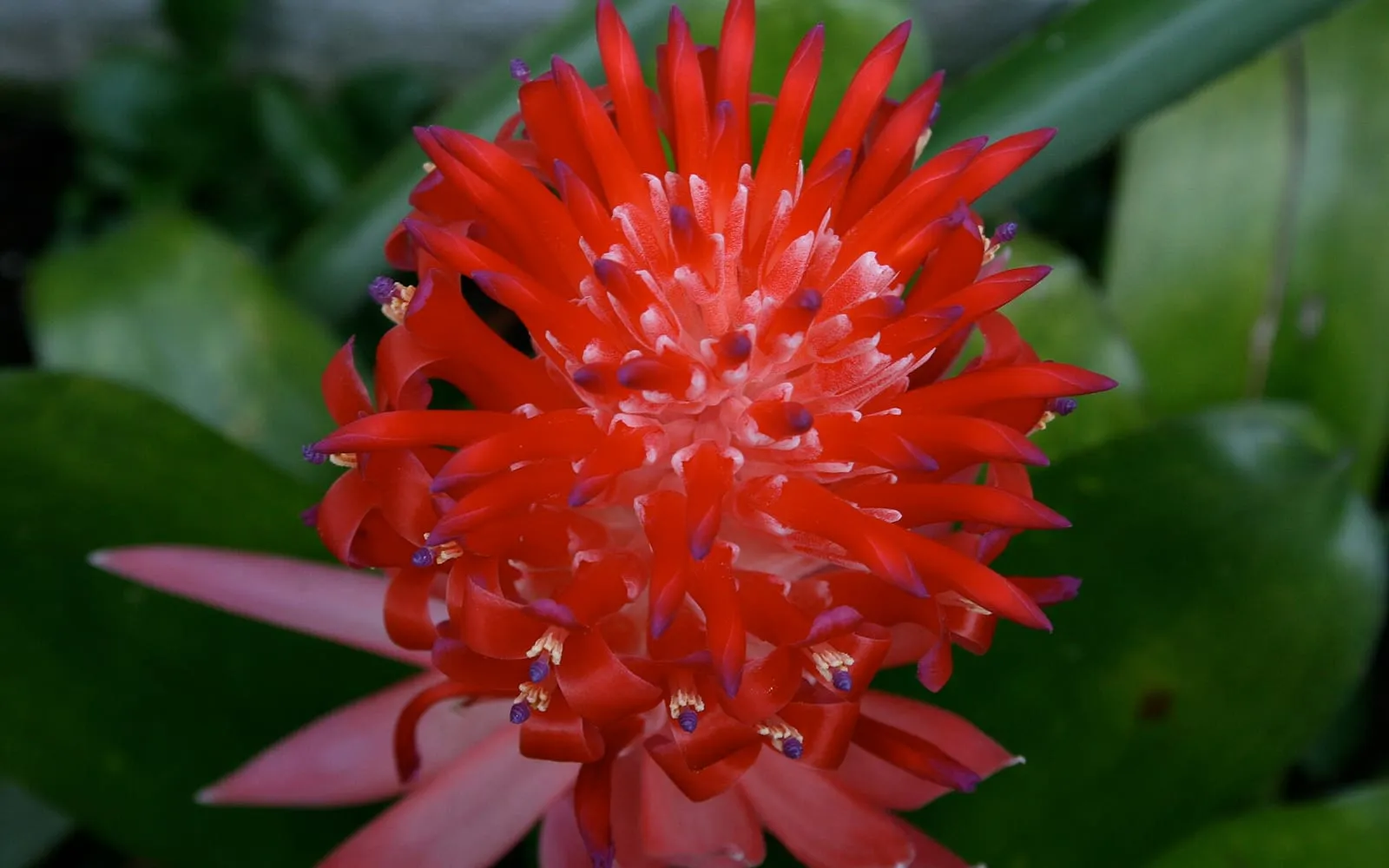
Summer torch is grown for the flower spike. The rosette itself is plain, a loose fountain of broad, strappy green leaves with none of the banding of its cousins, but from its heart in late summer rises a short, stout stem topped with a dense, upright head of bracts in scarlet and rose, each tipped with a touch of blue-purple. That bright cone gives the plant its common name.
It is a Brazilian tank bromeliad, at home both on the forest floor and up in the branches, and it gathers water and debris in the shallow bowl at the centre of the rosette. The plant takes much of its water from that bowl, so keep it clean and filled while the roots sit in a light, quick-draining mix.
The flowers stand up instead of hanging, which sets it apart from many of its relatives. A whole collection often blooms together over a few autumn weeks, and this reliability makes it one of the easier bromeliads to bring into flower. Each rosette blooms only once and then fades, but not before producing the offsets that keep the plant going.
Appearance and character
The leaves are broad, soft and green, arching out from a loose, open rosette whose overlapping bases cup a shallow central bowl of water. There is no silver banding here and little in the way of markings, and the foliage is a plain backdrop for the flower.
The leaf edges carry small, soft teeth that can catch skin lightly but pose no real threat. What defines the plant is its bloom, a dense, erect, cone-shaped cluster of scarlet-to-rose bracts finished with blue-purple, held on a short stalk clear of the leaves. Each rosette produces one such torch, then declines over the following months while its pups take its place.
Where it is from
Billbergia pyramidalis grows across the warm forests of Brazil, both rooted in the ground and perched on trees, catching rain and leaf fall in the bowl at the centre of its rosette. Its light is dappled, its air humid, and its footing sharply drained.
Give it warmth clear of frost, bright light with a little direct sun to bring on the flower, and an open, bark-based mix that sheds water fast. The central bowl is kept filled with soft water, and the mix is left to dry between waterings.
How it grows
It grows steadily through the warm months, widening its leafy rosette, and a mature rosette lifts its scarlet flower head in late summer or autumn. After flowering, that rosette fades slowly while the offsets around its base grow on to bloom in later years. Undisturbed, the clump renews and thickens season after season.
Propagation is straightforward. Once an offset stands about a third the size of its parent and has formed its own little bowl, cut it away low with a clean blade and pot it into the same free-draining mix. Kept warm and lightly shaded, it roots quickly and soon settles.
Through the seasons
Spring wakes the plant as the days lengthen. Tip out the old water, rinse the bowl, refill with rainwater, and start a weak feed as growth resumes.
Summer brings the strongest growth and the first sign of the flower stem. Keep the bowl filled, the mix lightly moist, and the light bright.
Autumn is the flowering season, when the upright red head opens, often across several plants at once. Ease off feeding as the display fades.
Winter is a resting spell. Keep the plant warm, water the roots little, and hold only a shallow charge in the bowl unless the room stays warm.
Care difficulty
This is one of the simplest bromeliads to keep and to flower. It adapts to ground or perch, stores its own water, and blooms readily once mature. Its two habits to learn are watering into the central bowl and accepting that a flowered rosette will die back once its pups are set. A cold, sodden compost is the main thing that kills it.
Watering
Keep the shallow central bowl filled with rainwater or another soft source, since the plant takes much of its drink there, and water the roots only when the mix has dried at the surface. Let every watering drain right through, and never leave the pot sitting in water.
Empty and refill the bowl every week or two so the held water stays clean and does not rot the leaf bases. Through winter, water the roots sparingly and keep the bowl lightly charged, tipping it out if the room turns cold.
Warning signs, diseases and pests
A soft, dark, collapsing base is root rot from a heavy, wet mix; move the plant to a coarser medium and water far less. A foul smell from the bowl means the standing water has gone off, so empty, rinse and refill it before it rots the crown.
Scale insects show as brown bumps on the leaves and wipe off with a cloth and horticultural oil. A rosette failing to flower is usually short of light or not yet mature, both of which patience and a brighter spot will settle. A spent rosette dying after bloom is normal.
Growing environment
Bright light with a spell of gentle direct sun keeps the rosette firm and brings the flower on reliably; deep shade leaves it lush but bloomless. Strong midday sun through glass can scorch the soft leaves, so filter the fiercest of it.
Warmth above about 5 deg C and moderately humid air keep it growing, out of cold draughts. It takes well to a summer outdoors in a warm, sheltered, lightly shaded corner, which often sharpens the following flowering.
Feeding
Feed lightly during the growing season with a balanced feed at quarter strength, added to the bowl or the mix. Bromeliads take little feeding and dislike a strong dose, which pushes soft leaves at the expense of flowers.
Stop feeding over winter. The bowl gathers debris that feeds the plant naturally, and a newly potted offset draws on its fresh mix while it roots.
Troubleshooting
It will not flower. Usually too little light, or a rosette that has not reached full size. Give it brighter light with some sun and let each rosette mature.
The flowered rosette is dying. That is the normal course. Each rosette blooms once, then fades, having set the offsets that replace it.
How do I water it? Fill the central bowl with soft water and give the mix a light drink only once it has dried at the top.
The base has gone soft. Root rot from a wet, heavy compost. Repot into an open, fast-draining mix and water the roots much less.
Is it safe around pets? Yes. Nothing toxic has been reported, so the worst a chewing pet risks is a mild stomach upset; the soft leaf teeth can scratch, so keep it out of the way to be sure.
Summer Torch problem guides
Not sure what is wrong? See the common houseplant pests guide.