
Houseplant
Queen's Tears
Billbergia nutans
Also known as Friendship Plant, Angel's Tears
How to grow Billbergia nutans. The toughest bromeliad in general cultivation, pendant pink and blue flowers, clumping tube rosettes and light cold tolerance.
At a glance
- Difficulty
- Easy
- Water
- Keep the narrow central tube filled with water, and let the compost dry between waterings
- Light
- Bright light with some direct sun. Tolerates more sun than most tank bromeliads
- Temperature
- 10-27 deg C. Established clumps take brief dips towards freezing
- Humidity
- Average room humidity is enough. Not a demanding species
- Hardiness
- USDA 9b-11, RHS H2, hardy to -2 C
- Type
- Evergreen clump-forming perennial, individual rosettes flowering once before being replaced by offsets
- Height
- 30-45 cm tall, spreading indefinitely as a clump
- Native to
- Brazil, Argentina, Uruguay
Subtropical southern Brazil, Uruguay and northern Argentina, where occasional light frost occurs but hard freezes do not. An established, clumping plant shrugs off a short dip towards freezing that would kill most other tank bromeliads outright, though the number alone does not say how long the plant can be left there, and a sustained freeze still kills it.
Hardiness zones describe winter cold alone. Summer heat, humidity, rainfall and the length of the growing season decide as much, so treat the range as the outer limit rather than as a recommendation.
Not known to be toxic
Non-toxic. Billbergia does not appear on the ASPCA's toxic plant list, and the ASPCA's entries for closely related, commonly cultivated bromeliad genera describe the family as safe for cats, dogs and horses. The RHS list of potentially harmful garden plants does not name Billbergia either. The leaf margins can carry fine, backward-pointing teeth, sharper than a Neoregelia's but well short of the rigid spines on an Aechmea or a Dyckia, and they can snag skin or a pet's coat rather than cause any lasting harm. There is no cup of standing water at eye level the way there is with the broader tank species, since Billbergia holds its water in a narrow tube, which removes one of the few hazards those relatives carry.
Sources: ASPCA (Toxic and Non-toxic Plants, general bromeliad genera), RHS potentially harmful garden plants
About
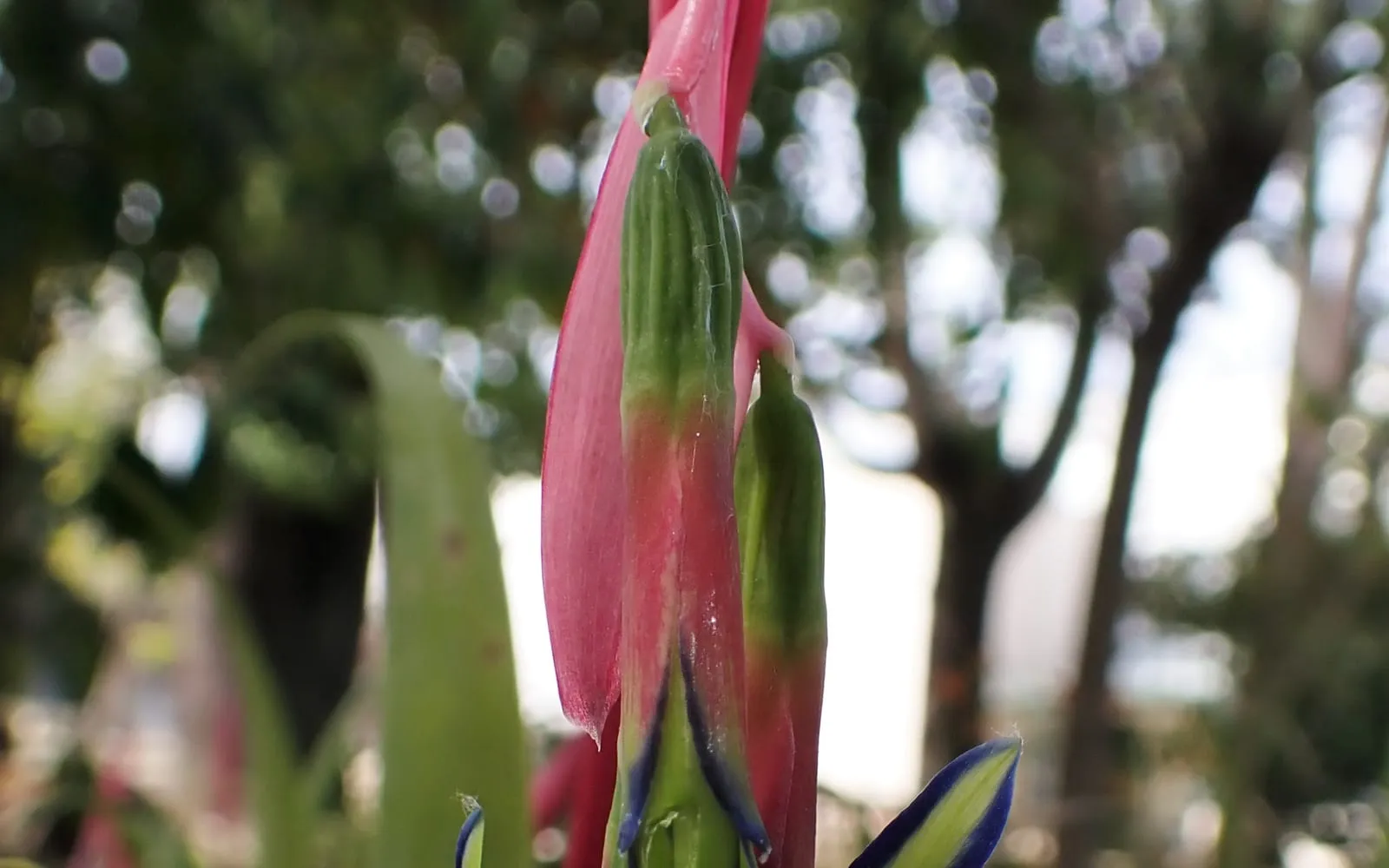
Queen’s Tears earns its name from the way it flowers. A slender, arching stem droops out from between the leaves and opens a cluster of pendant blooms, rose-pink bracts around petals of green edged in indigo blue, the whole thing hanging like a tear about to fall. Each flower lasts only a few days, but a large clump produces new stems in succession through spring, so the display runs longer than any single bloom does.
Billbergia nutans is also, by wide agreement among bromeliad growers, the toughest species commonly available. It tolerates more sun, more cold, poorer soil and more neglect than any of the tank bromeliads it is usually sold alongside, and unlike most of its relatives it multiplies fast enough that a single plant becomes a substantial clump within a couple of years.
Where a Guzmania or a Vriesea is a single rosette that flowers once and is then largely finished, a Billbergia clump keeps producing new rosettes fast enough that flowering becomes a near-annual event for the group as a whole, even though any one rosette still flowers only once.
Appearance and character
Narrow, upright, tube-shaped rosettes of grey-green, sometimes faintly mottled leaves, each rosette 30 to 45 cm tall and only a few centimetres across at the base, growing in a dense clump rather than as a single spreading rosette.
The tube shape sets it apart from the broad funnels of Guzmania or the flat saucers of Neoregelia. Because it is narrow, it holds much less standing water at any one time and loses less to evaporation from exposed surface area, which is part of why the species tolerates being forgotten about more readily than its wide-cupped relatives.
Leaves carry fine, backward-curving teeth along their margins, sharp enough to feel but rarely enough to draw blood, and a faint dusting of grey scurf that rubs off if handled roughly.
The flower stem arches or droops out sideways from the rosette rather than standing upright, carrying rose-pink bracts and a cluster of pendant flowers with pale green petals sharply edged in indigo blue. The colour combination is unusual among bromeliads, most of which lean towards red, orange or yellow.
Each flower opens for only two or three days, but a mature clump sends up several stems across a few weeks in spring, so the display as a whole runs considerably longer than any individual bloom.
Like other bromeliads, each rosette is monocarpic and does not flower a second time. Because Billbergia offsets so freely, though, a clump that started as one plant can hold a dozen or more rosettes within two or three years, at various stages between establishing, flowering and fading.
Where it is from
Billbergia nutans is native to southern Brazil, Uruguay and northern Argentina, a subtropical rather than a strictly tropical range compared with most commonly grown tank bromeliads.
It grows both as an epiphyte on trees and, more readily than many relatives, directly on rocky ground and in leaf litter, which is part of why it tolerates ordinary potting compost better than species that need an open bark mix to avoid rotting.
The region it comes from experiences a real, if mild, winter, with occasional light frost at the cooler edges of its range. That is unusual among tank bromeliads, most of which come from frost-free equatorial forest, and it explains why Billbergia is the one commonly grown species that can be left outdoors year-round in a mild temperate climate, or moved outside for summer and brought in only when a hard frost threatens.
Light in its native habitat ranges from dappled shade under trees to fully open, sunny rock outcrops, which is also why it tolerates far more direct sun as a houseplant than a strictly rainforest epiphyte would.
How it grows
Pot it in an open, free-draining mix. Billbergia is more forgiving of ordinary houseplant compost than most tank bromeliads, though it still benefits from bark or perlite mixed in for extra drainage.
Keep the narrow central tube filled with water, splashing in a little each week and letting the compost around the roots dry out between waterings rather than keeping it constantly moist.
Because the tube is narrow, it holds far less water than a broad Guzmania or Neoregelia cup and is less prone to the standing water going stagnant, though it is still worth tipping it out and refilling every few weeks rather than never changing it.
Give it more sun than most other tank bromeliads would tolerate. A spot with a few hours of direct sun daily, particularly morning sun, produces tighter, more colourful growth than deep shade does.
Let clumps build up undisturbed for a season or two rather than dividing them immediately, since the display gets better as the clump gets larger and produces more flower stems each spring.
Divide an overcrowded clump in spring by cutting away rooted sections with a clean knife and potting each piece separately, or pot up individual offsets once they have their own roots.
Move a pot outdoors for summer in a temperate climate if space allows, since the extra light and airflow it gets outside tends to produce a sturdier, more floriferous clump than one kept indoors year-round.
Feed lightly through the growing season, since Billbergia flowers reliably even on a light feeding regime and heavy fertiliser adds bulk to the leaves without improving the display.
Through the seasons
Spring is the main flowering season. Expect several arching stems in succession from different rosettes across the clump, resume light feeding, and divide an overcrowded clump once flowering finishes if more space is needed.
Summer is active growth. Water and feed as normal, keep the plant in as much sun as the spot allows, and move a potted clump outdoors for the season in a temperate climate if there is a sheltered spot for it.
Autumn slows growth as light and temperature fall. Reduce feeding, bring any plant moved outdoors back in before the first frost is expected, and let the compost run a little drier between waterings.
Winter is the plant’s most tolerant season by comparison with other tank bromeliads. An established clump kept just above freezing will sit quietly rather than suffer, though it should still be protected from a hard, sustained freeze, which it will not survive.
Care difficulty
Easy, and generally regarded as the most forgiving bromeliad in ordinary cultivation.
It tolerates more sun, more cold and less consistent watering than a Guzmania, a Vriesea or an Aechmea, and it multiplies quickly enough that a mistake with one rosette rarely threatens the whole clump the way it might with a single-rosette species.
The main adjustment for a new grower is expectation rather than technique. Individual flowers last only a few days each, so the display feels fleeting compared with the months-long bract colour of a Guzmania, even though a healthy clump produces stems in succession across several weeks.
Because it clumps so readily, the biggest practical task over time is managing size rather than preventing failure, dividing an outgrown pot every couple of years rather than nursing a struggling plant.
Watering
Keep the narrow central tube of each rosette topped up with a little water, checking weekly, and replace it fully every few weeks rather than letting it sit unchanged for months.
Water the compost when the top inch has dried, and let it dry out properly between waterings rather than keeping it constantly damp, since Billbergia is more prone to root problems from overwatering than from being left too dry.
Use rainwater or filtered water where the tap supply is hard, though this species tolerates ordinary tap water better than many bromeliads.
A plant moved outdoors for summer generally needs less supplemental watering than one kept indoors, since rainfall and higher humidity do much of the work.
Signs of overwatering are yellowing at the base of the leaves and a compost that stays wet for days after watering. Signs of underwatering are leaves that thin and curl slightly along their length.
Warning signs, diseases and pests
Yellowing lower leaves with a compost that never seems to dry usually mean overwatering rather than a pest or disease. Let the compost dry out fully before the next watering and check the pot has adequate drainage.
A soft, dark base is rot, though it is less common in this species than in its wide-cupped relatives because the tube-shaped rosette holds so much less standing water. Trim affected tissue and repot into a drier, more open mix.
Scale insects show as small, flat, brownish bumps along the stems and leaf undersides. Wipe them off with a cloth dipped in dilute soapy water or treat with horticultural oil.
Mealybugs cluster as white cottony tufts where the leaves meet at the base. A cotton bud dipped in isopropyl alcohol removes them, with a follow-up check after a week.
Leaves that brown at the tips after a cold snap have likely been chilled below what the plant can shrug off. Move a potted clump under cover before a hard frost is forecast, since brief cold is tolerated but a sustained freeze is not.
A rosette that stops growing and slowly browns after flowering is behaving normally, not failing. Leave it in place; it protects and shelters the younger offsets developing around it until they are established.
Growing environment
Bright light with several hours of direct sun where possible, more than most tank bromeliads tolerate without scorching.
A wide temperature range, from 10 to 27 deg C for steady growth, with an established clump shrugging off brief dips towards freezing that would damage most other bromeliads.
Average room humidity is enough. This is one of the few tank bromeliads that does not particularly benefit from a pebble tray or humidifier.
An open, free-draining mix, more tolerant of ordinary potting compost cut with some bark or perlite than the strict bark mixes other tank bromeliads need.
Good outdoor placement in a temperate summer, in a sheltered spot with morning sun, moved back indoors or under cover before the first frost.
Reasonable air movement, which helps keep the compost from staying wet for long stretches after watering.
Feeding
Feed every four to six weeks from spring to early autumn with a balanced liquid fertiliser at a quarter of label strength, or a specialist bromeliad formula at label strength.
Add feed to the water going into the central tube of each rosette, in keeping with how the plant absorbs nutrients through its leaf bases.
Stop feeding over winter, when growth slows considerably and the plant needs little beyond protection from hard frost.
A Billbergia clump left unfed will still flower reliably given enough light, since this species is markedly less dependent on regular feeding than most of its tank-forming relatives.
Avoid heavy or frequent feeding. It thickens the leaves without improving flowering and can leave a build-up of unused salts in the compost over time.
Troubleshooting
The flowers only lasted a few days. Did I do something wrong? No, that is normal for this species. Individual blooms are short-lived, but a healthy clump sends up new flower stems from different rosettes across several weeks in spring, so the display outlasts any single flower.
Can I leave it outside over winter? In a mild climate where hard frost is rare, an established clump usually copes with brief cold. Where winters bring a sustained freeze, move it under cover or indoors before the first hard frost.
My clump has become huge and congested. Divide it in spring, cutting away rooted sections with a clean knife and potting them separately. This also tends to produce a stronger flowering display the following year than leaving it overcrowded.
The lower leaves are turning yellow. This usually points to overwatering rather than a pest. Let the compost dry out more fully between waterings and check that the pot drains freely.
Does it need the same humidity as other bromeliads? No. Billbergia tolerates ordinary room humidity well and does not need a pebble tray or humidifier the way a Vriesea or Aechmea does.
A rosette flowered and is now looking tired. That is expected. Each rosette flowers once and then fades over the following months while the rest of the clump continues growing; leave the spent rosette in place rather than removing it too soon.
Can it grow in more shade than other bromeliads? It tolerates shade better than it tolerates being kept constantly wet, but growth and flowering are noticeably stronger with several hours of direct sun daily than in a shaded corner.
Queen's Tears problem guides
Not sure what is wrong? See the common houseplant pests guide.