
Outdoor plant
White Water-Lily
Nymphaea alba
Also known as European white water lily
How to grow the white water-lily, Nymphaea alba, in a pond. Planting depth, dividing an overgrown crown, and why the flowers close every afternoon.
At a glance
- Difficulty
- Easy
- Water
- Grown submerged; no watering in the usual sense
- Light
- Full sun for at least 5 hours a day
- Temperature
- Dies back below 5 deg C, regrows from the rhizome each spring
- Hardiness
- USDA 3-11, RHS H7, hardy to -25 C
- Type
- Hardy aquatic perennial
- Height
- Leaves lie flat on the water; the rhizome spreads 1-2 m
- Native to
- Europe, Western Asia, North Africa
Fully hardy wherever the water body does not freeze solid to the bottom. The rhizome sits below the frost line in anything deeper than about 45 cm of water, so the plant survives winters far colder than its leaves ever see. It needs a still or slow-moving water body rather than a stream, and stops flowering well in water that never warms much past 15 deg C.
Hardiness zones describe winter cold alone. Summer heat, humidity, rainfall and the length of the growing season decide as much, so treat the range as the outer limit rather than as a recommendation.
Not known to be toxic
Neither the RHS nor the ASPCA lists Nymphaea alba as toxic to people or animals, and it has no entry on either poisonous-plants register. Pond keepers do report that livestock avoid the tough, leathery leaves, but that is a matter of taste rather than toxicity. The bigger hazard around a water-lily pond is the water itself rather than the plant growing in it.
Source: RHS
About
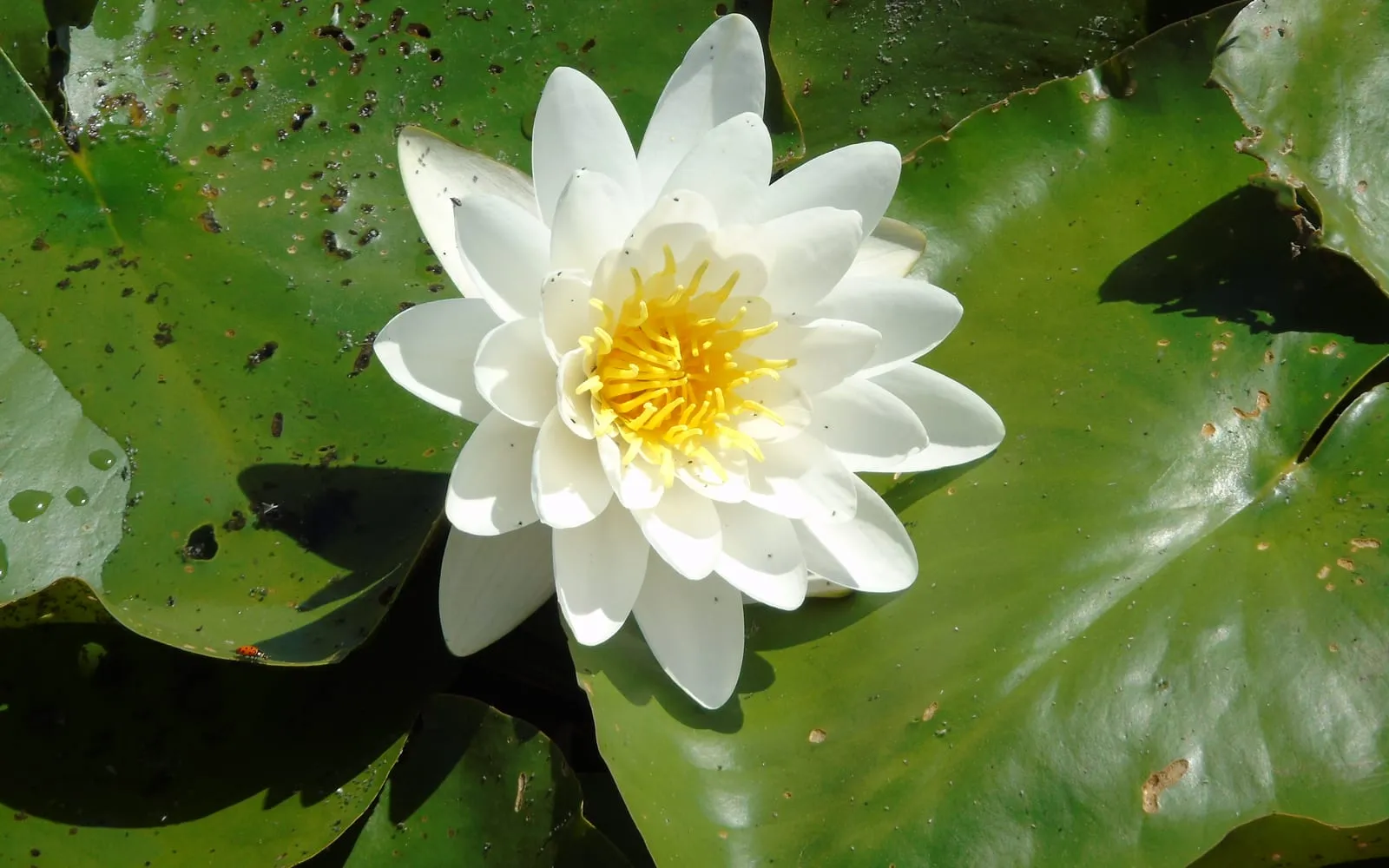
The white water-lily is the plant most people picture when they picture a pond. Round, waxy leaves lie flat on the surface, and from among them rise white flowers with a boss of golden stamens at the centre, each one open for three or four days before it closes for good and sinks its seed head below the surface to ripen.
It is native across Europe, including Britain and Ireland, in lakes, canals and slow rivers, and it is the largest native water-lily on the continent. A single crown can spread to cover several square metres of water once established, so know this before planting one in a small pond.
Appearance and character
Leaves are rounded, glossy and leathery, 10-30 cm across, with a deep notch where the stalk meets the blade. New leaves emerge reddish and green as they mature, and a healthy plant keeps a dense raft of them through summer.
Flowers are pure white, 10-20 cm across, made of many overlapping petals around a ring of orange-yellow stamens, and they float rather than stand proud of the water. Each flower opens in mid-morning and closes again by mid-afternoon, repeating this for three to four days before the stem coils and pulls the spent flower underwater to set seed.
The whole plant grows from a thick, branching rhizome that creeps along the pond floor, sending up leaves and flower stalks on long, flexible stems that lengthen as the water gets deeper.
Where it is from
Still and slow-moving fresh water across Europe, western Asia and North Africa, from lowland lakes to canals and old millponds. It is one of the most widespread native water-lilies in its range.
It needs water that stays put. A rhizome anchored in the mud of a lake copes with ice sealing the surface for months, because the water below insulates it, but the same plant struggles in a stream where current disturbs the rooting zone and washes silt away from the crown.
How it grows
A hardy perennial that dies back to its rhizome each autumn and regrows from it every spring, as a herbaceous border plant would if its border were underwater. The rhizome thickens and branches year on year, and a plant left undivided for a decade can become a solid mat filling a small pond.
Growth is entirely governed by water temperature rather than air temperature. Leaves stay small and sparse in cool spring water and reach full size only once the pond has warmed through, which is why a water-lily planted in a shallow, sun-facing pond outgrows the identical plant in a deep, shaded one.
Through the seasons
Spring: The first leaves rise from the rhizome as the water warms past about 10 deg C. Feed once growth restarts.
Summer is the flowering season, running from June to September, with a fresh crop of flowers opening every few days from a well-established crown. Feed again in early summer if growth looks weak.
Autumn growth slows and the leaves start to die back as the water cools. Cut back yellowing foliage before it rots into the pond, which keeps the water clearer over winter.
Winter the rhizome sits dormant on the pond floor. So long as it is below the depth that freezes solid, it needs nothing from you at all.
Care difficulty
Easy, provided the basic conditions are right from the start. Give it full sun, still water and enough depth over the crown. Getting those wrong is a planting decision rather than an ongoing care failure, and it is much easier to fix before the rhizome has settled in than after.
The main long-term task is division. A vigorous plant fills its allotted space within three to five years and starts crowding out flowering by shading its own new growth, at which point lifting and splitting the rhizome is the fix rather than feeding it harder.
Watering
There is no watering to speak of; the plant lives permanently submerged. What matters instead is planting depth. A newly planted crown needs 30-45 cm of water over it, increasing to as much as 90 cm as the plant matures and its leaf stalks lengthen to reach the surface.
Plant it in a mesh aquatic basket lined with hessian and filled with heavy aquatic loam, never ordinary potting compost, which floats free and clouds the water. Top the basket with a layer of gravel to stop fish disturbing the soil while they forage.
Lower the basket gradually as the plant grows, resting it on bricks at first and removing a brick every few weeks, rather than dropping a small plant straight to its final depth where it may not reach enough light to establish.
Warning signs, diseases and pests
Small leaves and few or no flowers almost always mean too little light or too little depth of clear water above the leaves, rather than disease. Water-lilies need direct sun on the leaf surface and stop flowering well in water clouded by algae or overhung by trees.
Aphids cluster on leaves at the water’s edge in summer, and the simplest control is a jet of water from a hose, which knocks them into the pond for fish to eat. China mark moth caterpillars are more of a problem: they cut neat oval discs from the leaf margin and stitch two together into a floating case they shelter in, and are best picked off by hand since most chemical controls are unsafe near fish and pond wildlife.
A crown that stops flowering after several good years, with leaves crowded and undersized, has usually outgrown its basket. Lift it in late spring, cut the rhizome into sections each with a growing point and some roots, and replant the strongest pieces.
Growing environment
Full sun for at least five hours a day is the single most important condition; water-lilies flower poorly in shade. Still or barely moving water suits them far better than a stream or a pond with a strong fountain, since constant surface disturbance stops the leaves lying flat and the flowers opening properly.
Water temperature governs growth rather than air temperature, and the plant needs the surface layer to warm well into the teens Celsius through summer to flower freely. A large, shallow pond warms faster than a small, deep one and generally flowers better as a result.
Feeding
Aquatic plants cannot use fertiliser scattered on the surface, since it mostly feeds pond algae instead. Push slow-release aquatic plant tablets directly into the basket near the roots, once in spring as growth restarts and again in early summer if leaves look pale or sparse.
Over-feeding a pond, whether the water-lily or the water around it, shows up as a green bloom of algae rather than as a problem with the plant itself. Little and infrequent is the safer approach.
Troubleshooting
Few flowers despite plenty of leaves. Usually too little sun, or water that has been allowed to cloud with algae or blanket weed, both of which cut the light reaching the crown. Clear the water and check the pond gets direct sun for most of the day.
Leaves stay small and yellowish. The basket is often too shallow for the plant’s current size, or has run out of feed. Check the depth and add a fertiliser tablet.
The crown has stopped flowering after years of good bloom. It has outgrown its basket and needs dividing. Lift it in late spring and replant young sections with a growing point each.
Leaves are being shredded or have oval bites missing from the margin. Check for China mark moth cases, which look like two leaf discs stitched together and floating free. Remove them by hand.
The pond has turned green soon after planting. New ponds often go through an algal bloom before the water-lily and any other plants establish enough to compete for nutrients. It usually clears within a season once the plant is settled and covering more of the surface.