
Houseplant
Water Lettuce
Pistia stratiotes
Also known as Nile cabbage, Shellflower
How to grow water lettuce, Pistia stratiotes, on a pond or aquarium surface. Why it needs warmth, and where it is a banned invasive weed.
At a glance
- Difficulty
- Easy
- Water
- Floats on open water; keep the water itself warm and clean
- Light
- Bright light, some direct sun
- Temperature
- Above 10 deg C, thrives above 20 deg C
- Hardiness
- USDA 10-12, RHS H2, hardy to 10 C
- Type
- Tender free-floating perennial
- Height
- Rosettes reach 10-30 cm across, roots trail 20-30 cm below
- Native to
- Pantropical, exact native range uncertain
A frost-tender tropical floater that dies at the first real cold snap and cannot be grown outdoors year round anywhere with a winter below about 10 deg C. In a heated aquarium or greenhouse pond it behaves as a true perennial, multiplying continuously with no seasonal check at all.
Hardiness zones describe winter cold alone. Summer heat, humidity, rainfall and the length of the growing season decide as much, so treat the range as the outer limit rather than as a recommendation.
Harmful if eaten
- Do not eat
- The whole plant
- Harm from
- Eating it and handling it
- Affects
- People, cats and dogs
Water lettuce contains needle-like calcium oxalate crystals throughout its tissue, the same defence mechanism found in dieffenbachia and philodendron, which cause burning and irritation of the mouth and throat if chewed and can irritate skin on contact. The ASPCA lists it as toxic to cats and dogs for this reason. Serious poisoning is unlikely because the reaction is unpleasant enough to discourage repeated eating, but a curious pet or child should be kept from chewing on it regardless.
Source: ASPCA
About
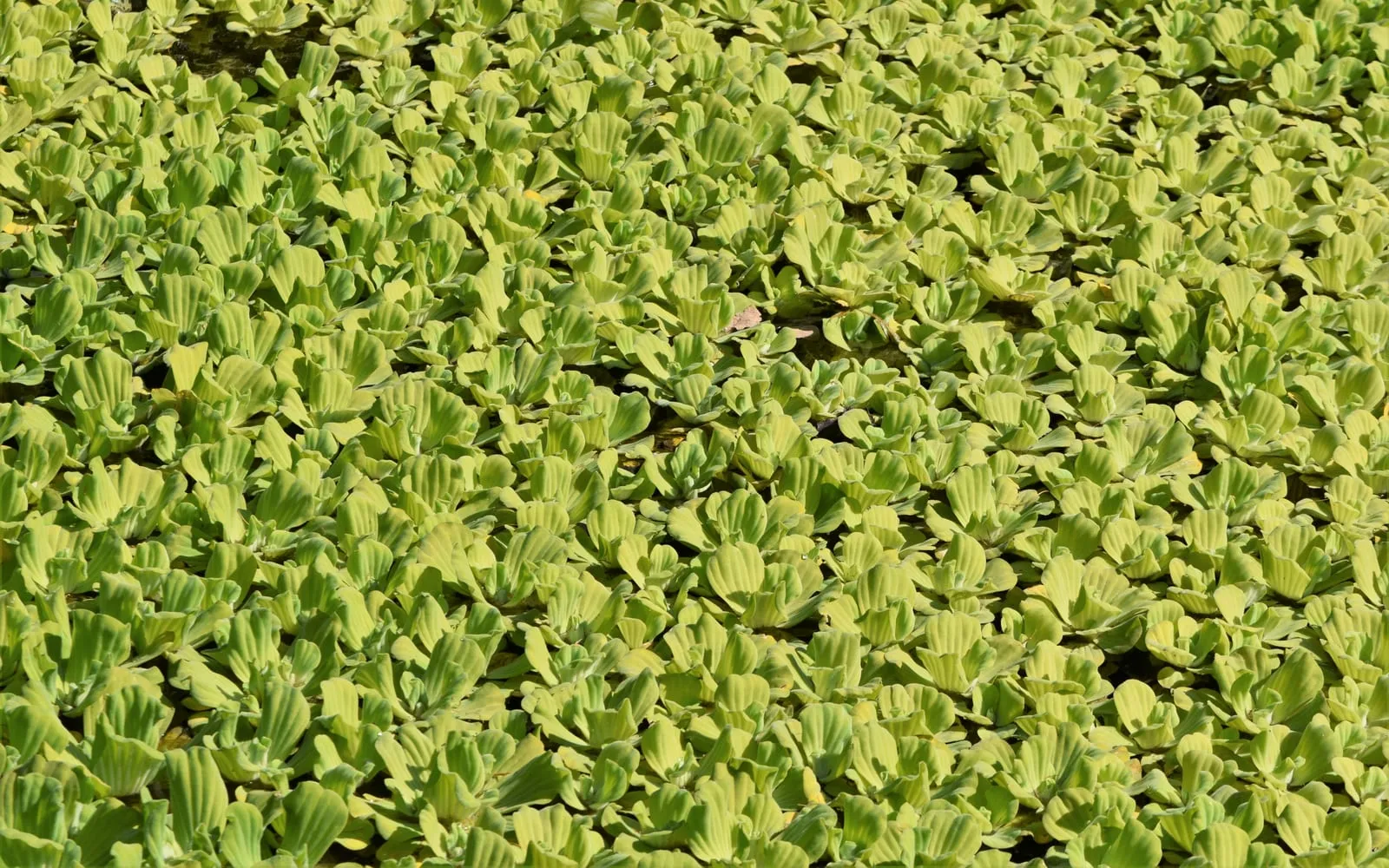
Water lettuce forms loose, floating rosettes of soft, ribbed, velvety leaves that closely resemble a small floating lettuce or cabbage, spreading across the surface of warm, still water and trailing a dense curtain of fine roots below. It is grown in tropical ponds, greenhouses and aquariums for the cover it gives fish and the striking pale green texture it adds to open water.
Its exact native range is disputed among botanists, since it has been carried and naturalised by people and waterways across the tropics for so long that it is now found on every continent except Antarctica. In several warm regions, including much of the southern United States and parts of Australia, it has become an aggressive invasive weed and its sale or possession is restricted; check local rules before acquiring it if you garden somewhere with a naturally frost-free climate.
Appearance and character
Pale to mid-green leaves grow in a tight rosette, each one wedge-shaped, ribbed lengthwise and covered in fine velvety hairs that trap air and give the whole plant a slightly silvery sheen and real waterproofing, letting it shed rain and splashes rather than becoming waterlogged and sinking. Below the surface hangs a dense, feathery mass of roots that both anchors the loose colony together and provides shelter for small fish and fry.
Flowers are tiny, greenish-white and tucked deep in the centre of the rosette, rarely noticed. The plant relies overwhelmingly on vegetative budding from short stolons for its explosive rate of increase rather than on seed.
Where it is from
Warm, still, nutrient-rich fresh water throughout the tropics and warm temperate world, an unusually wide distribution for a floating plant with no wind-blown seed dispersal mechanism, most likely spread historically by waterfowl and water currents and more recently by deliberate human introduction.
It needs warmth above almost everything else. Growth all but stops below about 15 deg C and the plant is killed outright by any real frost, which is what confines it to indoor cultivation across most of the temperate world despite its tropical ubiquity.
How it grows
A free-floating perennial that reproduces mainly by budding new rosettes on short runners from the base of an existing plant, in a manner similar to a spider plant’s plantlets but adapted to drift apart on open water rather than stay attached. Under warm conditions with plenty of light and nutrients, a single rosette can produce several offsets within a few weeks, and coverage can double in well under two weeks in a warm, fertile pond.
Because reproduction is almost entirely vegetative, a colony in a stable indoor aquarium or heated greenhouse pond can persist and multiply indefinitely with no seasonal die-back at all, unlike most other aquatic plants on this site.
Through the seasons
Spring and summer are the main growing period wherever grown outdoors seasonally, with rapid multiplication in warm, sunny water.
Autumn growth slows sharply as water temperatures fall, and the plant should be brought indoors or into a heated greenhouse well before the first frost.
Winter it needs to be kept in warm water indoors; anywhere the water temperature stays reliably above about 15 to 20 deg C it continues growing, if more slowly than in summer, rather than going fully dormant.
Care difficulty
Easy given warmth, and the entire challenge for temperate gardeners is providing that warmth rather than any complexity in the plant’s actual needs. In a heated aquarium or tropical greenhouse pond it more or less looks after itself, multiplying steadily with minimal input.
Watering
There is no watering as such; the plant floats freely and takes everything it needs directly from the surrounding water. What matters is keeping that water warm, since growth slows noticeably below about 20 deg C and stops altogether well before freezing point, long before ice would form.
Warning signs, diseases and pests
Aphids sometimes colonise the centre of the rosette where new leaves emerge, and can be washed off with a gentle spray of water without disturbing the plant’s delicate root mass. Spider mites occasionally appear on plants kept in dry indoor air above the waterline, though this is less common for a plant that spends its life on open water.
The dense root system can also harbour root aphids or mealybug, generally introduced along with new stock rather than developing spontaneously, visible as small white or grey clusters within the root mass when the plant is lifted and inspected.
Yellowing, translucent leaves with a soft, collapsing texture usually indicate water that has turned too cold rather than disease, and the fix is warming the water rather than treating for a pathogen.
Growing environment
Bright light with some direct sun keeps the rosettes compact and healthy; in low light they grow leggy and pale. Warm, still or very gently moving water suits it far better than a strong current or turbulent surface, which tends to break rosettes apart before they can establish.
Feeding
Established plants in a nutrient-rich pond rarely need feeding at all, since this species is efficient at drawing nutrients directly from the water column, which is part of why it is also used deliberately in some wastewater treatment systems to strip nutrients from polluted water. A weak liquid feed occasionally benefits plants in very clean, low-nutrient aquarium water where growth looks slow.
Troubleshooting
Leaves turning yellow and translucent. Almost always water that has turned too cold. Move the plant to warmer water promptly; recovery is possible if the cold exposure was brief.
Rosettes staying small and pale. Usually too little light. Move to a brighter spot with some direct sun.
Coverage has exploded and now dominates the whole surface. Expected behaviour in warm, nutrient-rich water. Remove excess rosettes regularly to keep some open water and light reaching whatever grows beneath.
Small white clusters found among the roots when lifted. Check for root aphids or mealybug, usually introduced with new stock. Rinse the roots thoroughly and isolate affected plants until clear.
Water Lettuce problem guides
Not sure what is wrong? See the common houseplant pests guide.