
Houseplant
Crucifix Orchid
Epidendrum ibaguense
Also known as Star orchid
How to grow crucifix orchid as a houseplant or in a warm garden bed. Its cross-shaped lip markings, and why it is the parent behind most reed-stem hybrids sold.
At a glance
- Difficulty
- Moderate
- Water
- Regular watering in the growing season, reduced in winter
- Light
- Bright light, several hours of direct sun
- Temperature
- 15-30 deg C, avoid below 10 deg C
- Humidity
- Moderate, 40 percent or more
- Hardiness
- USDA 9-11, RHS H2, hardy to 5 C
- Type
- Evergreen terrestrial perennial orchid
- Height
- 40-100 cm
- Native to
- Colombia, Venezuela
Tender to real frost, best grown outdoors year round only in a frost-free or nearly frost-free climate. As with several of its close relatives, it tolerates ordinary potting or garden soil far better than most orchids, which is part of why it and its hybrids turn up so often in subtropical bedding schemes rather than being reserved for specialist collections.
Hardiness zones describe winter cold alone. Summer heat, humidity, rainfall and the length of the growing season decide as much, so treat the range as the outer limit rather than as a recommendation.
Not known to be toxic
Crucifix orchid has no toxicity listing from the RHS or the ASPCA and is considered safe around pets and children. There is no documented history of poisoning associated with this species.
Source: RHS
About
Look closely at almost any of the tough, brightly coloured “reed-stem” Epidendrum hybrids sold at garden centres in shades of orange, pink, purple and bicolour, and there is a good chance the crucifix orchid sits somewhere in that plant’s parentage. It has been used as breeding stock for decades precisely because it combines strong colour, a long flowering season and real tolerance of ordinary garden conditions, a rare set of traits to find together in an orchid.
Its own common name comes from a small but distinctive detail on the flower itself: a raised, cross-shaped callus at the base of the lip, visible on close inspection and unusual enough among orchids to have given the species its lasting nickname long before it became a parent to so many modern hybrids.
Appearance and character
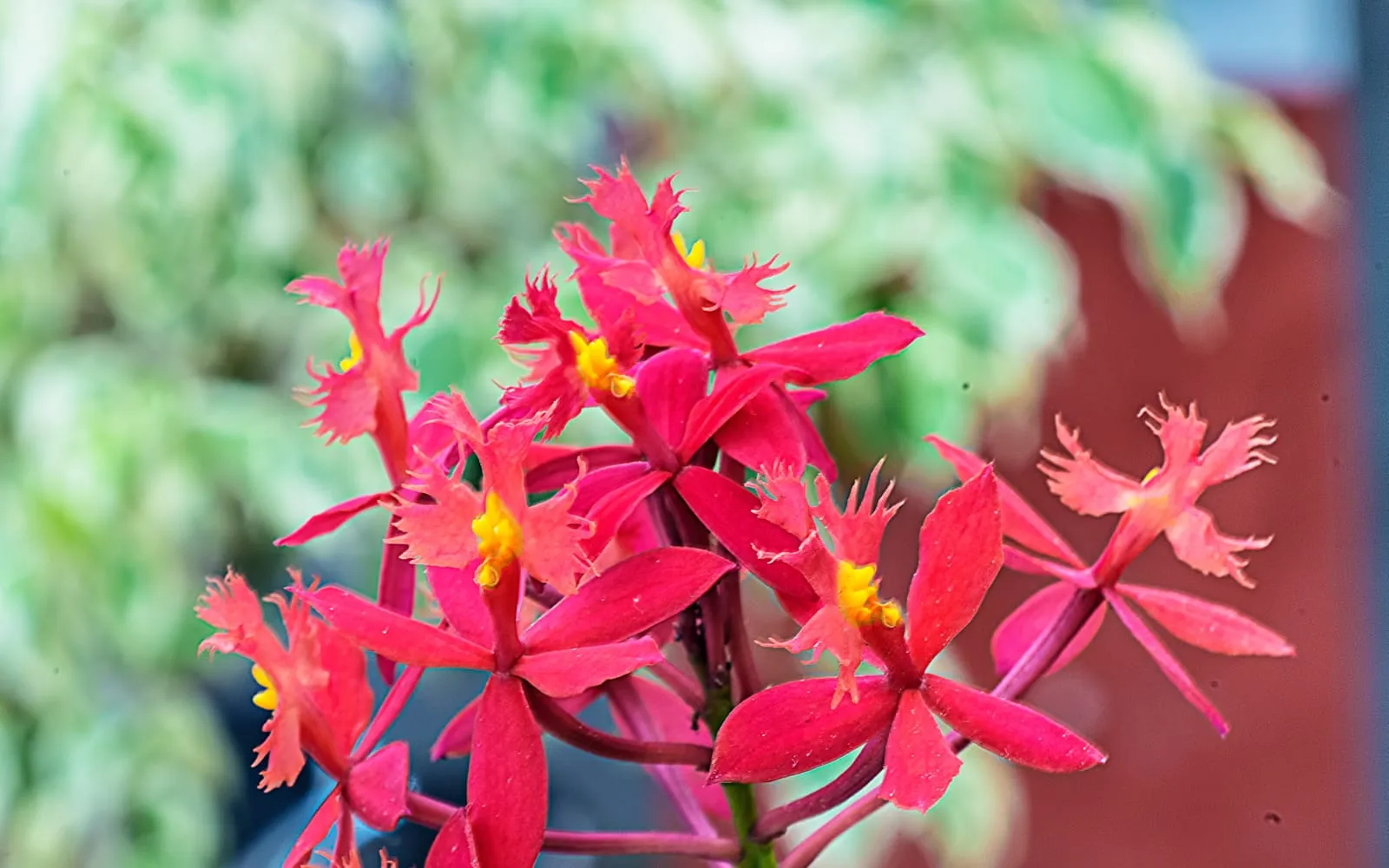
Clusters of upright, cane-like stems carry narrow, fleshy leaves and build gradually into a dense clump as the plant matures, each mature cane eventually topped with a tight, rounded head of small flowers. Colour in the wild species runs mostly to orange and red, though the many hybrids bred from it extend that range much further.
The cross-shaped marking that gives the plant its name sits at the base of the lip on every flower, a raised callus rather than a simple colour pattern, and it is this structure, present across the whole flower cluster at once, that catches the eye on close inspection even when the overall colour is unremarkable from a distance.
Where it is from
Open, sunny grassland and disturbed ground at moderate elevation across Colombia and Venezuela, conditions with strong light and reasonably drained soil rather than the dense forest shade many orchids call home.
Because this habitat is neither particularly wet nor particularly humid by orchid standards, the species arrived at cultivation already adapted to something closer to ordinary garden conditions than most of its relatives, which is the root of its long history as parent stock for tough, garden-worthy hybrids.
How it grows
A clump thickens over successive seasons as new canes rise from the base, and because each cane can flower more than once as it matures, an established plant often has blooms at several different stages across its canes rather than in one single flush. Older canes, once spent, can be cut back to encourage fresh growth from lower down rather than left to decline on their own.
Division is the standard way to propagate a named form or hybrid true to type, separating a clump into sections each with several canes and roots attached, since seed-raised plants from open pollination do not come true and cuttings root far less reliably on this species than on some of its more opportunistic relatives.
Through the seasons
Spring fresh canes begin rising from the base of the clump as temperatures climb.
Summer flowering runs through its peak, with cane after cane opening its cluster of blooms as the weeks pass. Keep watering and feeding on a steady schedule.
Autumn flowering slows as days shorten, though established canes may continue for a while yet.
Winter protect container plants from any real cold, moving them under cover well before frost threatens, and cut back on water while the plant rests.
Care difficulty
Moderate, and the plant’s long history as parent stock for tough garden hybrids says something about how forgiving it is in practice. Strong direct sun through a good part of the day is the one condition worth getting right; almost everything else about its care is closer to a sturdy garden perennial than to a typical orchid.
Watering
Keep the growing medium evenly moist through the growing season without letting it become waterlogged. Ease back once autumn arrives and continue at a reduced rate through winter, particularly for a plant brought indoors, though this species has no need for the sharp, complete dry rest some other orchids depend on.
Warning signs, diseases and pests
Aphids can build up on soft new growth and the flower clusters themselves, and a firm spray of water usually clears a light infestation without further treatment. Scale insects occasionally settle along the canes, calling for careful manual removal or a horticultural soap where numbers are significant, and spider mites can turn up in hot, dry conditions, showing as fine pale speckling across the leaves.
Thin, stretched canes holding few or no flowers point squarely at insufficient sun rather than at any pest, since this species needs real direct light for a good part of the day to bloom to its potential. A clump that has merely paused between flushes, with canes still looking healthy, needs nothing more than patience for the next round to begin.
Growing environment
Strong, direct sun for several hours a day makes the biggest difference to flowering of any single condition, and a shaded spot will keep the plant alive without ever bringing it into full bloom. Ordinary, reasonably free-draining potting or garden soil suits it well, and there is little need to hunt down a specialist orchid mix for this particular species.
Feeding
A balanced orchid or general-purpose fertiliser at half strength, worked in every second watering through the growing season, keeps canes and flower clusters coming steadily. This is one of the less fussy orchids about feeding regime, tolerating an ordinary garden feeding schedule better than most of its relatives.
Troubleshooting
Canes are thin and pale with few flowers. Move the plant into stronger, more direct sun; this is almost always a light problem rather than anything to do with water or feed.
Flowering has paused partway through the season. Established clumps often flower in successive flushes rather than continuously. Healthy canes with no flowers open at a given moment are not necessarily a problem, especially heading into autumn.
You want to propagate a named variety and keep it true to type. Divide an established clump into sections with several canes and roots each, rather than relying on cuttings or seed, since this species does not root from cane fragments as readily as some of its close relatives.
A plant moved outdoors for the summer is struggling to adjust. Introduce it to full sun and any change in temperature gradually over a week or two rather than all at once, giving the canes time to toughen up to the stronger light.
Crucifix Orchid problem guides
Not sure what is wrong? See the common houseplant pests guide.