
Houseplant
Common Staghorn
Platycerium alcicorne
Also known as Platycerium alcicorne, African Staghorn Fern
How to grow Platycerium alcicorne, a staghorn fern with antler fronds and clasping shield fronds, and why it grows mounted instead of potted.
At a glance
- Difficulty
- Easy
- Water
- By soaking, when the mount or mix has nearly dried
- Light
- Bright indirect light
- Temperature
- Warm, 15 to 27 deg C; keep above 10 deg C
- Humidity
- Moderate to high
- Hardiness
- USDA 10-11, RHS H1b, hardy to 10 C
- Type
- Evergreen epiphytic fern
- Height
- 40 to 70 cm
- Native to
- Madagascar, Eastern Africa
A tender epiphytic fern from Madagascar and eastern Africa, growing on tree branches instead of in soil. It has no frost tolerance and needs warmth above about 10 deg C and humid air. Because it perches on bark, it needs its roots to dry and breathe between waterings, so a sodden, airless root ball rots it far faster than a dry spell.
Hardiness zones describe winter cold alone. Summer heat, humidity, rainfall and the length of the growing season decide as much, so treat the range as the outer limit rather than as a recommendation.
Not known to be toxic
Staghorn ferns are not listed as toxic by the ASPCA, which records the elkhorn and staghorn ferns as non-toxic to cats and dogs, and no harmful compound is recorded in them. A chewed frond is unlikely to cause more than mild stomach upset. It is a safe fern to grow around pets and children, grown for its unusual antler fronds instead of for anything edible.
Sources: ASPCA toxic and non-toxic plants, RHS potentially harmful garden plants
About
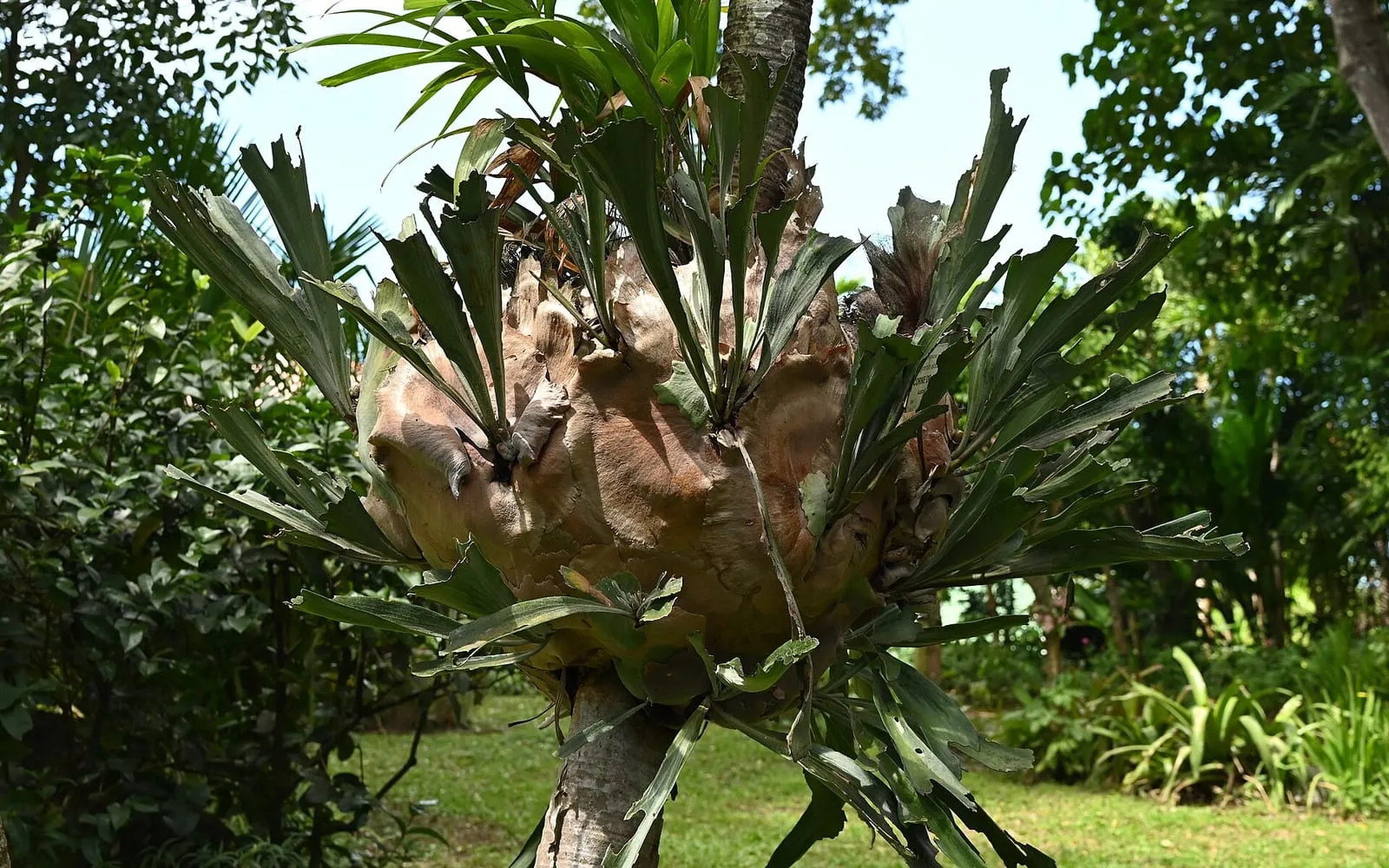
Common staghorn fern grows two different kinds of frond, and both matter to its care. Flat, rounded “shield” fronds clasp the mount and turn papery brown with age, while narrow, forking “antler” fronds arch outward in the shape that gives the staghorns and elkhorns their name. This species has slimmer, less-divided antlers than the familiar staghorn fern, and comes from Madagascar and East Africa.
It is an epiphyte, growing on tree branches in the wild instead of in soil, so it is usually grown mounted on a board or in a hanging basket instead of potted in the ordinary way. Its roots need air around them and must dry between waterings.
Once its growth habit is understood, it is an easy plant. It needs warmth, humid air, bright indirect light and a soak when it dries. The commonest mistakes are keeping it too wet and pulling off the brown shield fronds, which are meant to be there.
Appearance and character
Antler fronds are the most visible part, narrow, forking and arching outward like slender antlers, green and slightly downy, less broadly divided than the common staghorn’s.
Shield fronds are the flat, rounded, overlapping fronds that clasp the mount and anchor the plant, green at first and turning papery brown as they age. They are a normal, permanent feature, not dead growth to remove.
The plant grows outward from the mount instead of upward in a pot, adding layers of shield fronds behind the arching antlers over the years.
New antler fronds unfurl from the growing point behind the shields, and offsets, or pups, eventually form and can be separated to make new plants.
Where it is from
Platycerium alcicorne is native to Madagascar and eastern Africa, growing as an epiphyte on tree branches in warm, humid, lightly shaded forest. It takes its water and food from rain, humid air and the debris that gathers behind its shield fronds.
Give it warmth, humid air, bright filtered light and an airy root run that dries between waterings. It has no frost tolerance and is not adapted to soil or constant wetness.
How it grows
It grows by producing antler fronds and shield fronds against its mount, spreading outward over the years. Growth is steady in warmth and humidity and slows in winter.
Grow it mounted on a board with a pad of sphagnum moss behind the shield fronds, or in a hanging basket of very open, bark-based mix, instead of potted in ordinary compost. Water by soaking the mount or basket, then let it drain and breathe.
Keep it warm, above about 10 deg C, in bright indirect light and humid air, out of direct sun and cold draughts. Leave the brown shield fronds in place, and do not let water sit constantly around the crown.
Separate pups once they have their own shield fronds and roots, mounting them as you would the parent.
Through the seasons
Spring brings renewed growth as light increases. This is the time to remount, divide pups and resume feeding.
Summer is the main growing season. Soak the plant when it nearly dries, keep the air humid, and feed monthly.
Autumn growth slows as light falls. Soak less often as the plant uses less water.
Winter the plant rests in lower light. Keep it warm, humid and only soaked occasionally, and out of cold draughts.
Care difficulty
Common staghorn fern is easy once you grow it as the epiphyte it is. Mounted or basketed, watered by soaking and kept warm and humid, it is undemanding and long-lived. The usual mistakes are keeping it constantly wet, which rots it, and removing the brown shield fronds, which harms it. Treat it as a mounted fern with airy roots rather than as a normal potted houseplant.
Watering
Water by soaking the mount or basket in water for a few minutes when it has nearly dried, then let it drain fully and the roots breathe. This dunking suits an epiphyte far better than dribbling water onto a mount.
Judge watering by weight and by the moss, soaking more often in warm, dry spells and much less in winter. Avoid a mount that never dries, because constant wetness rots the crown.
Warning signs, diseases and pests
Scale insects settle on the fronds as small brown bumps and can be wiped off and treated with horticultural oil, taking care on the downy antler fronds.
Rot at the crown comes from a mount kept constantly wet or water pooling behind the shields. Let the plant dry between soakings to reduce the risk.
Browning shield fronds are not a problem. They are meant to turn papery brown with age and should be left in place, since removing them exposes the crown and harms the plant.
Growing environment
Bright, indirect light suits it, matching the dappled light of the forest canopy. Direct sun scorches the fronds, and deep shade weakens the plant.
Warmth and humid air suit it, above about 10 deg C, with a humid spot such as a bathroom or a kitchen often working well. It grows mounted or in a basket instead of a pot, so air can move around its roots.
Mount it on a board with sphagnum behind the shields, or grow it in a hanging basket of open, bark-based mix, in a warm, humid, brightly lit position out of cold draughts.
Feeding
Feed monthly through spring and summer with a dilute balanced feed added to the soaking water, or tuck a little slow-release feed or banana skin behind the shield fronds, as growers traditionally do. Feed lightly, since the plant needs little.
Ease off in autumn and stop in winter while growth slows.
Troubleshooting
The flat round fronds have turned brown. Should I remove them? No. The shield fronds are meant to turn papery brown with age, and they protect the roots and crown. Leave them in place; removing them harms the plant.
How do I water something grown on a board? By soaking. Dunk the mount in water for a few minutes when it has nearly dried, then let it drain and breathe. Judge by weight, soaking more in warm weather and less in winter.
The crown is going soft and rotten. Too wet. A mount kept constantly damp, or water pooling behind the shields, rots the crown. Let it dry and breathe between soakings.
How is it different from the usual staghorn fern? This species has slimmer, less-divided antler fronds and comes from Madagascar and East Africa, while the common staghorn fern has broader, more heavily forked antlers. Both are grown the same way.
Is it safe around pets? Yes. Staghorn and elkhorn ferns are listed as non-toxic to cats and dogs by the ASPCA, so it is a safe plant for a home with animals.
Common Staghorn problem guides
Not sure what is wrong? See the common houseplant pests guide.