
Houseplant
Spotted Evergreen
Aglaonema costatum
Also known as Aglaonema costatum
How to grow Aglaonema costatum, the spotted evergreen, a low, dark-leaved Chinese evergreen with a bold white midrib. Its habit, toxicity and care.
At a glance
- Difficulty
- Easy
- Water
- When the top few centimetres of mix have dried
- Light
- Bright indirect light to light shade
- Temperature
- Warm; keep above about 13 deg C
- Humidity
- Average to high
- Hardiness
- USDA 10-12, RHS H1b, hardy to 13 C
- Type
- Perennial
- Height
- 20-30 cm
- Native to
- Southeast Asia
A tender tropical foliage plant from Southeast Asia, growing in warm, humid, shaded to filtered light. It needs warmth, humidity and bright indirect light, and it cannot take frost or chill. It is safest above about 13 deg C, and cold, wet compost or dry air spoils it.
Hardiness zones describe winter cold alone. Summer heat, humidity, rainfall and the length of the growing season decide as much, so treat the range as the outer limit rather than as a recommendation.
Toxic if eaten
- Do not eat
- All parts, which contain calcium oxalate crystals
- Harm from
- Eating it and handling it
- Affects
- People, cats and dogs
Like other members of the arum family, the spotted evergreen holds tiny calcium oxalate needles in every part. Chewing a leaf or stem fires them into the soft tissue of the mouth, bringing burning, swelling and a rush of saliva, and vomiting in a pet that swallows any; the sap can irritate skin and eyes. The ASPCA lists this group among the plants that harm cats and dogs. Aglaonema is on the ASPCA list as toxic to cats and dogs, and the RHS rates the arum family as harmful if eaten. The berries are also toxic. Keep the spotted evergreen away from anything that chews, and wash off any sap.
Sources: ASPCA toxic and non-toxic plants, RHS potentially harmful garden plants
About
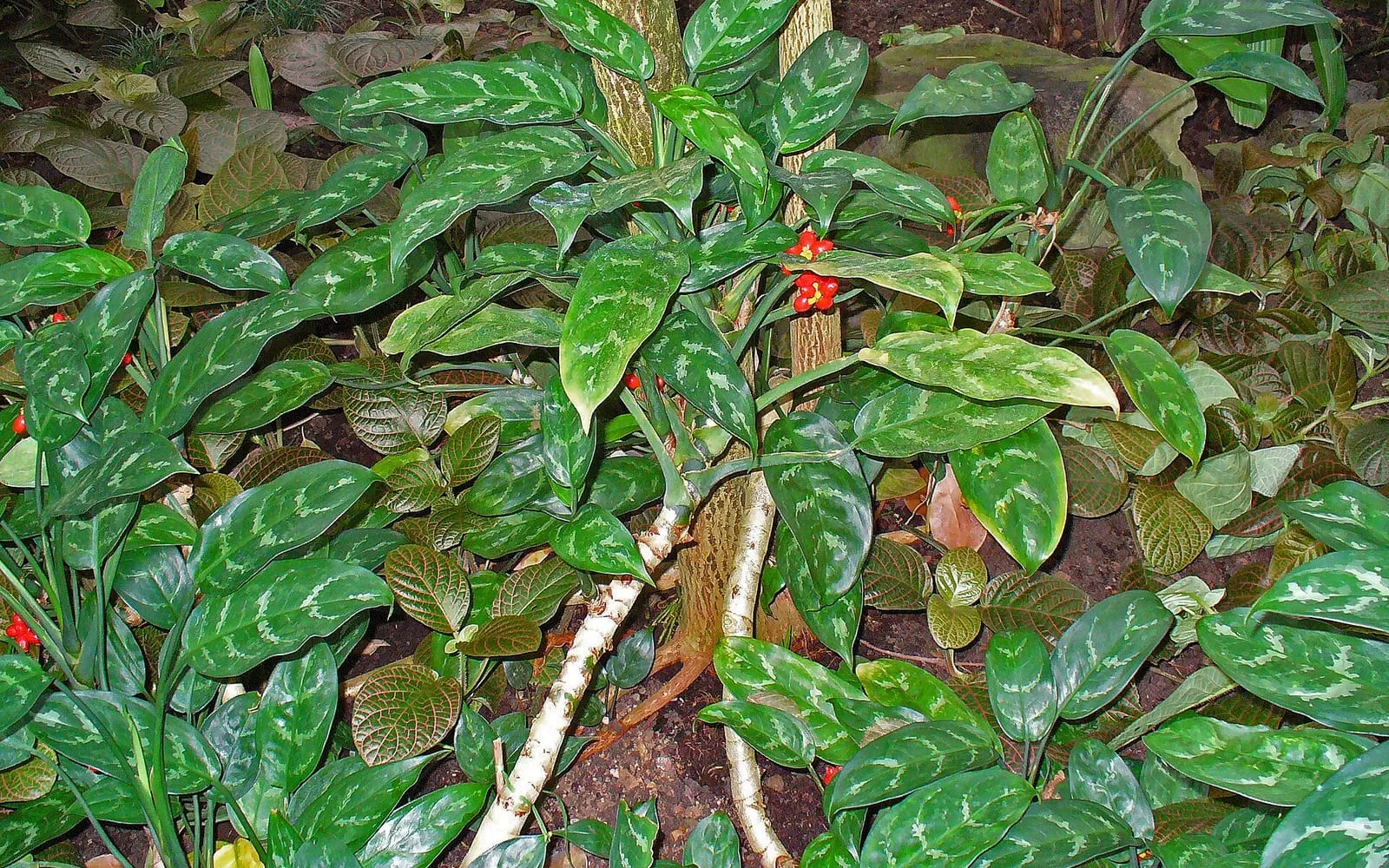
The spotted evergreen is a low, compact Chinese evergreen. Aglaonema costatum stays small where some of its relatives climb, spreading sideways across the soil in a neat rosette of dark leaves. Each leaf has a bright ivory midrib and a scatter of pale spots. The specific name costatum means ribbed, referring to that prominent central vein.
Its compact size makes it a plant for the front of a shelf or a small pot on a desk, rather than a corner-filling clump. Like the rest of the group, it tolerates shade and needs little beyond warmth and careful watering.
It is small, but it carries the same irritant sap as every aroid, so keep it away from pets and small children. Given a warm, shaded spot it keeps its crisp markings through the year with little fuss.
Appearance and character
The leaves are broad ovals of deep, glossy green, blunt at the base and tapering to a short point, held low on stubby stalks that barely lift them above the compost. Down the centre of each runs a thick, chalk-white midrib, and the blade itself is dusted with irregular cream or white spots that give the plant its common name.
Instead of building a tall stem, it creeps along a fleshy rhizome at soil level, sending up leaves in a low, spreading cluster. This keeps it compact and dense, widening slowly instead of reaching for height.
Flowering is sparse and modest, a small greenish spathe on a short stalk, of no ornamental value beside the spotted foliage. Berries that follow ripen red and, like the rest of the plant, should not be eaten.
Where it is from
Aglaonema costatum is native to the tropical forests of Southeast Asia, in Thailand, Malaysia and neighbouring parts of the region, where it grows as a low herb on the shaded floor of evergreen woodland. Its home is warm and wet year-round, lit only by the broken light that filters through a dense canopy far overhead.
A forest-floor plant grows in shade, moisture and steady warmth, and does not encounter cold or strong sun. That background explains what it needs indoors. It struggles on a bright, dry sill and does best in a warm, gently lit spot. Cold is the main hazard to avoid.
How it grows
Growth spreads outward at soil level instead of upward, the rhizome extending and pushing up fresh spotted leaves as it goes. It is a slow, tidy grower, most active in the warmth of summer and near dormant through the darkest weeks, holding its low mound of foliage throughout.
Pot it in a shallow, wide container filled with an open, peat-free mix lightened by bark and perlite, so the creeping rhizome has room to spread and the roots never sit wet. It responds poorly to deep pots of heavy compost, which hold cold moisture around its shallow roots.
Propagate by lifting and dividing the rhizome in spring, ensuring each piece keeps roots and a growing point. Cut sections root readily in fresh mix, and any handling should be followed by washing the sap from your hands.
Through the seasons
Spring brings the rhizome back into growth. Divide a plant that has filled its pot, top up the compost, and start feeding lightly as the light strengthens.
Summer is the main growing spell, when new spotted leaves unfurl fastest. Keep the mix evenly damp, hold the plant in gentle light that preserves the markings, and wipe dust from the low leaves.
Autumn slows it down as daylight shortens. Reduce watering and feeding together, and settle it into a warm winter spot before the heating starts its daily cycle.
Winter is a quiet rest. Keep it clear of cold glass, water sparingly so the shallow roots never chill and sit wet, and wait for spring before looking for new growth.
Care difficulty
For a patterned little plant it is easy. The spotted evergreen keeps its markings in modest light, copes with an occasional missed watering, and stays compact without pruning, which makes it forgiving for a beginner.
Its main risk is cold, waterlogged compost around its shallow roots, which rots them and yellows the leaves. Keep the mix lightly moist rather than wet, use a wide shallow container, and keep the room warm. Beyond its toxic sap, it needs little special care.
Watering
Water once the surface of the compost has dried, giving enough to moisten the shallow rootball, then let the excess drain and empty any saucer. Because the roots sit near the surface, they dry and rewet quickly, so check the top layer often in warm weather.
Scale watering right back in winter, when the cool, slow roots use almost nothing and rot develops quickly. Limp, yellowing leaves signal a rootball kept too wet, while dry, brown edges point to air that is too dry.
Warning signs, diseases and pests
Softening at soil level with collapsing leaves is rhizome rot from cold, sodden compost. Lift the plant, cut back to firm, healthy tissue, and replant the sound pieces in fresh, barely moist mix in a warmer spot.
Warm, dry rooms encourage spider mites, which stipple the leaves with fine pale dots, and mealybugs, which nest as white tufts among the leaf bases. Sponge the foliage clean, raise the humidity, and dab stubborn colonies with diluted alcohol on a cotton bud.
Loss of the crisp white spotting can follow too much light, which bleaches the pattern. Move the plant into softer, filtered daylight and new leaves should show clearer markings.
Growing environment
Gentle, filtered light suits it, bright enough to hold the contrast of the markings but never direct enough to scorch. A shaded windowsill or a well-lit spot back from the glass gives the plant what it needs and deep gloom flattens both its colour and its growth.
Warmth and a humid enough atmosphere matter as much as light. Keep the room above the mid-teens in Celsius through the year, lift the local humidity by grouping plants or standing the pot on damp gravel, and keep it away from draughts and radiator heat.
Feeding
Feed lightly across spring and summer with a balanced liquid fertiliser at half the label strength, once every three or four weeks. A slow, small plant needs little, and heavy feeding only scorches the shallow roots with salts.
Rinse the pot through with plain water from time to time to clear those salts, and give no feed to a plant recently divided or repotted until it is visibly settled and growing.
Troubleshooting
Why has the plant gone soft at the base? Rhizome rot from cold, wet compost. Cut out the mush, replant the firm parts, and keep it warmer and drier.
The white spots are fading. What is wrong? Too much light. Move the plant into softer, filtered daylight and the fresh leaves will show the markings clearly.
The leaf edges are turning brown. How do I fix it? Raise the humidity, keep it clear of heat sources, and water with rainwater if your tap water is hard.
How do I make more of it? Divide the creeping rhizome in spring, keeping roots on each piece, and pot the divisions up in fresh mix with clean hands.
Is it safe around cats, dogs and children? No. Every part burns the mouth if chewed, so keep it out of reach and consult the toxicity note above.
Spotted Evergreen problem guides
Not sure what is wrong? See the common houseplant pests guide.