
Houseplant
Tricolour
Aglaonema pictum
Also known as Aglaonema pictum
How to grow Aglaonema pictum 'Tricolor', the camouflage-leaved Chinese evergreen from Sumatra, and the calcium oxalate toxicity it carries.
At a glance
- Difficulty
- Easy
- Water
- When the top few centimetres of mix have dried
- Light
- Bright indirect light to light shade
- Temperature
- Warm; keep above about 13 deg C
- Humidity
- Average to high
- Hardiness
- USDA 10-12, RHS H1b, hardy to 13 C
- Type
- Perennial
- Height
- 40-60 cm
- Native to
- Southeast Asia
A tender tropical foliage plant from Southeast Asia, growing in warm, humid, shaded to filtered light. It needs warmth, humidity and bright indirect light, and it cannot take frost or chill. It is safest above about 13 deg C, and cold, wet compost or dry air spoils it.
Hardiness zones describe winter cold alone. Summer heat, humidity, rainfall and the length of the growing season decide as much, so treat the range as the outer limit rather than as a recommendation.
Toxic if eaten
- Do not eat
- All parts, which contain calcium oxalate crystals
- Harm from
- Eating it and handling it
- Affects
- People, cats and dogs
Like other members of the arum family, Aglaonema pictum holds tiny calcium oxalate needles in every part. Chewing a leaf or stem of the tricolour fires them into the soft tissue of the mouth, bringing burning, swelling and a rush of saliva, and vomiting in a pet that swallows any; the sap can irritate skin and eyes. The ASPCA lists Aglaonema as toxic to cats and dogs, and the RHS flags aroids as skin and mouth irritants. Keep the tricolour away from anything that chews, and wash off any sap.
Sources: ASPCA toxic and non-toxic plants, RHS potentially harmful garden plants
A leaf built like camouflage
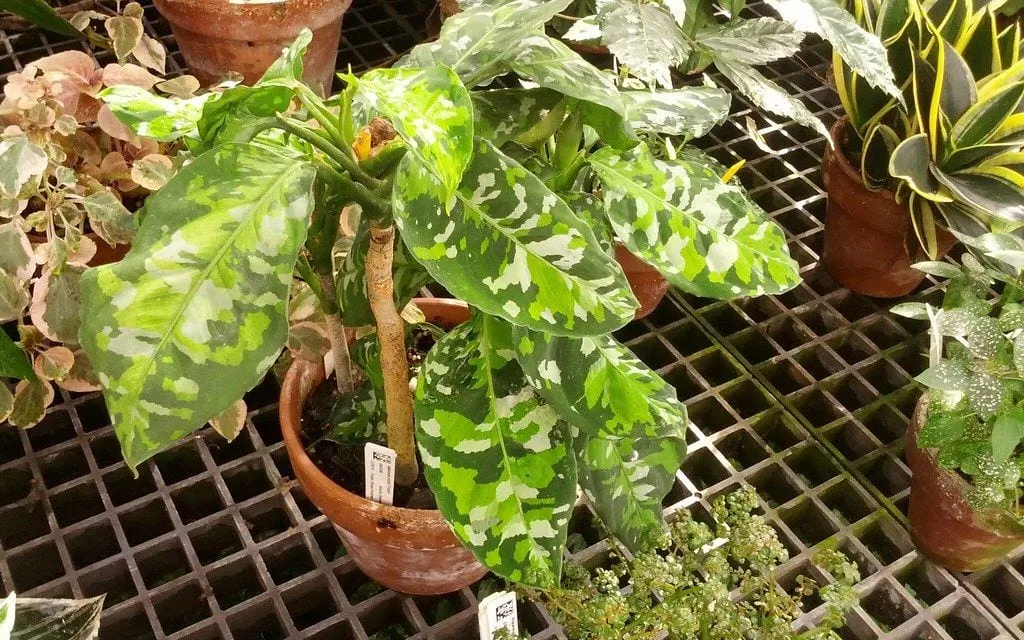
Aglaonema pictum has one of the most unusual leaf patterns in cultivation. Instead of the veins-and-margins design of most foliage plants, each blade is dappled in irregular patches of three distinct greens: a deep forest green, a mid tone and a soft grey-green. The mottling has no fixed layout, so no two leaves match, and the effect looks like military camouflage. The ‘Tricolor’ selection sold under the name tricolour shows that three-tone patterning most clearly. Blades are pointed and held on short, upright, fleshy stems, and a well-grown plant builds into a dense, softly variegated column.
Not a prayer plant
The tricolour is often shelved beside calatheas and marantas because it likes similar shade and warmth, so it helps to be clear about what it is. Aglaonema pictum belongs to the arum family, Araceae, alongside the Chinese evergreens, dieffenbachias and philodendrons. It does not fold its leaves at night, has no hinged leaf joint driving daily movement, and flowers in the arum fashion with a small spadix wrapped in a leafy spathe instead of in the showy sprays of prayer plants. Grow it for the standing pattern of its foliage, not for leaf movement.
Where it comes from
The species is native to Southeast Asia, centred on the Indonesian island of Sumatra and the nearby Nias islands, where it grows on the humid, shaded floor of lowland rainforest. Warmth is constant, rain frequent, and the light that filters down through the canopy is dim and broken. Those origins set its limits indoors. It has no tolerance of frost or cold draughts, it responds poorly to dry air, and it never evolved to face direct overhead sun. A warm, sheltered, softly lit room is the closest indoor match.
Light and where to stand it
Give bright but indirect light or gentle shade. Because it comes from deep forest, the tricolour copes with a dimmer corner than most variegated plants, though the three-tone contrast holds best where the light is good without being harsh. Strong direct sun scorches the blades and washes out the pattern, while very deep gloom draws the stems up thin and dulls the paler greens towards plain. An east or north aspect suits it, or a spot set back from a brighter window. Turn the pot now and then to keep it growing evenly.
Watering
Let the top few centimetres of compost dry out before watering, then moisten the whole pot and drain off the surplus, so the roots stay lightly damp instead of sodden. This is a plant that suffers far more from overwatering than from a short dry spell, and its fleshy stems and roots rot quickly in a mix that never dries. It is less fussy about water quality than a calathea, tolerating ordinary tap water, though soft or filtered water keeps the leaf tips cleaner. Through the darker, cooler months growth slows to almost nothing and the plant needs much less, so keep it on the dry side while it idles.
Warmth, humidity and feeding
Ordinary room warmth of roughly eighteen to twenty-six degrees C suits it, with a firm lower limit of about thirteen degrees C. Cold snaps, chilly draughts and a frosty windowpane all leave blackened or translucent patches on the leaves, so keep it away from them. It prefers humid air and responds well to a tray of damp gravel or a group of leafy neighbours with cleaner, less crispy foliage, though it tolerates average room humidity better than the fussier tropicals. Feed once a month through spring and summer with a balanced houseplant fertiliser at half strength, and give none in winter. It grows slowly, so it needs repotting only every couple of years, moving into a free-draining, peat-free mix.
A serious word on toxicity
The tricolour is not a plant for a household that cannot keep it out of reach. Like its arum-family relatives, Aglaonema pictum contains microscopic needle-shaped crystals of calcium oxalate, called raphides, in every part. When a child or pet bites a leaf or stem, those needles drive into the soft lining of the mouth and throat, causing immediate burning pain, swelling of the lips and tongue, heavy drooling and, in an animal that swallows a mouthful, retching and vomiting. The sap can also redden and irritate skin and sting the eyes. The ASPCA lists this group among the plants harmful to cats and dogs. Wear gloves or wash your hands after cutting or repotting it, wipe up any sap, and site it well clear of anything that chews. If a large amount is eaten, or symptoms are severe or persistent, contact a doctor or vet, or a poison information service in your country.
Propagation
Increase the tricolour by division or by stem cuttings taken in the warmth of spring and summer. To divide, tip a crowded plant out of its pot and separate the clustered stems with their roots into two or three pieces, then pot each up on its own. Stem cuttings root readily. Cut a length of stem bearing a few leaves, let the cut end dry for an hour, and set it in a warm, humid, free-draining mix until new roots form. Wear gloves for both jobs, since the cut sap carries the same irritant crystals as the leaves.
Common problems
Yellowing lower leaves over a wet, heavy mix signal waterlogged, rotting roots, so ease off the water and improve drainage. Brown, crisp leaf tips point to dry air or a build-up of salts, eased by higher humidity and cleaner water. Pale, blotchy scorch marks mean the plant is catching direct sun and should be moved back. In warm dry rooms spider mites may fleck the undersides and spin fine webbing, while mealybugs lodge as white woolly tufts in the leaf joints; treat both early by wiping the plant down and dabbing pests with dilute alcohol on a cotton bud.
Quick answers
Does the tricolour fold its leaves at night? No. It is a Chinese evergreen in the arum family, not a prayer plant, so its leaves stay put.
Is it safe around cats, dogs and children? No. Every part holds calcium oxalate crystals that burn the mouth if chewed, so keep it out of reach.
Why are the lower leaves going yellow? Usually overwatering. Let the mix dry further and check the pot drains freely.
How do I make more plants? Divide the clumped stems, or root a stem cutting in warm, humid conditions. Wear gloves for the sap.
Tricolour problem guides
Not sure what is wrong? See the common houseplant pests guide.