
Outdoor plant
Soft Shield Fern
Polystichum setiferum
Also known as Soft prickly shield fern
How to grow soft shield fern, Polystichum setiferum, in a shaded border. Its finely divided evergreen fronds, and why it tolerates dry shade so well.
At a glance
- Difficulty
- Moderate
- Water
- Regular watering while establishing; moderate thereafter
- Light
- Partial to full shade
- Hardiness
- USDA 5-9, RHS H5, hardy to -15 C
- Type
- Evergreen perennial fern
- Height
- 60-100 cm
- Native to
- Western and Southern Europe
Reliably hardy through most temperate winters, keeping its fronds fully evergreen in milder climates and losing only the oldest ones in a harder frost. It is less tolerant of waterlogged winter soil than of cold itself, and free drainage matters more to its winter survival than any particular minimum temperature.
Hardiness zones describe winter cold alone. Summer heat, humidity, rainfall and the length of the growing season decide as much, so treat the range as the outer limit rather than as a recommendation.
Not known to be toxic
Soft shield fern has no toxicity listing from the RHS or the ASPCA and is considered safe around pets and children. It has no history of accidental poisoning and, like most cultivated ferns, is rarely eaten by anything in the first place.
Source: RHS
About
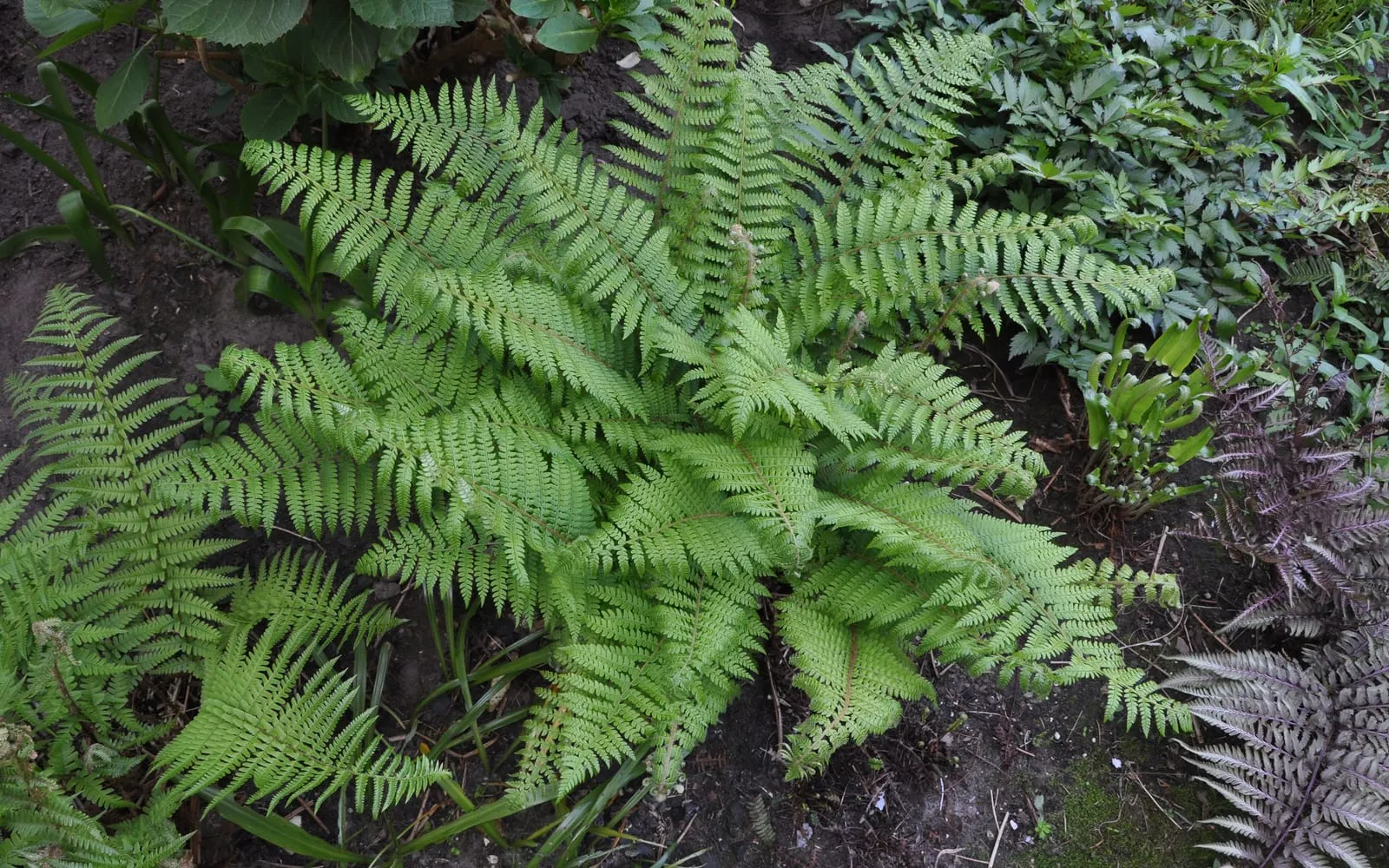
Soft shield fern is prized for the softness and fine division of its fronds, which are cut and re-cut into small, feathery segments that give the whole plant a lace-like texture unusual among hardy garden ferns. Unlike many ferns that look their best only in spring and summer, this one holds its arching, evergreen fronds through winter in all but the harshest climates, making it a reliable source of texture in a shaded border across every season.
It has been popular with gardeners since the Victorian fern-collecting craze of the nineteenth century, when growers selected and named a large number of variant forms with even more finely divided or crested fronds, many of which are still grown today.
Appearance and character
Fronds are broadly lance-shaped in outline but finely divided two or three times over, giving each one a soft, feathery texture quite unlike the coarser, single-cut fronds of many other hardy ferns. New croziers unfurl covered in pale, silvery scales that persist along the midrib of the mature frond, adding a subtle textural detail at close range.
A well-grown plant forms a dense, symmetrical shuttlecock that arches gracefully outward rather than standing stiffly upright, and the evergreen fronds age gracefully, staying reasonably presentable well into their second year before the crown eventually sheds them to make way for new growth.
Where it is from
Shaded woodland, hedge banks and rocky slopes across western and southern Europe, generally in humus-rich soil with reliable drainage rather than the permanently wet ground some other ferns favour.
That preference for drainage over constant moisture sets it apart from damp-loving ferns like the royal fern, and explains why it performs well in an ordinary shaded border where the soil is enriched with organic matter but not waterlogged.
How it grows
An evergreen perennial that builds a compact, slowly expanding crown over years, producing a fresh flush of fronds each spring while retaining much of the previous year’s growth. Because old fronds persist rather than dying back completely, an established plant looks much fuller through winter than a fully deciduous fern would.
Growth is moderate, and named cultivars with unusually finely cut or plumose fronds, propagated by division or from spores collected from the parent plant, are widely available alongside the plain species.
Through the seasons
Spring: New croziers unfurl, unfurling from silvery-scaled tips into fully divided fronds through April and May.
Summer the plant is at its fullest, with both new and the previous year’s retained fronds providing dense structure in shade.
Autumn growth slows, though the evergreen foliage remains largely intact into winter in a sheltered spot.
Winter older fronds may flatten or brown at the tips in hard frost, but the crown itself is fully hardy and the bulk of the foliage typically survives an average winter.
Care difficulty
Moderate while young, easy once established. A newly planted fern benefits from consistent watering through its first one or two growing seasons, and a mature plant then tolerates moderately dry shade with only occasional deep watering in extended dry spells.
Watering
Regular watering supports strong establishment in the first couple of years. Once settled, this species copes with drier shaded conditions better than many ferns, though it still benefits from a deep soak during any long dry period, particularly in a border under trees competing for the same moisture.
Free drainage matters as much as moisture. Waterlogged winter soil is a more common cause of crown loss than cold itself, so avoid planting it in a low-lying spot that collects standing water.
Warning signs, diseases and pests
Slugs and snails are the main pest, grazing the soft, newly unfurling croziers in spring and leaving ragged notches on young fronds; established, fully hardened fronds are much less palatable to them. Vine weevil grubs occasionally feed on the roots of container-grown plants, showing as a sudden, unexplained collapse of an otherwise healthy-looking crown, and are more of a risk in pots than in open ground.
Blackened, collapsed fronds after a hard frost are a normal winter reaction in this species and not usually a sign of a deeper problem; trim them away in late winter and expect fresh growth from the crown in spring.
A crown sitting in poorly drained soil that rots at the base, with fronds yellowing and pulling away easily, points to waterlogging rather than a pest, and the fix is improving drainage rather than treating for disease.
Growing environment
Partial to full shade suits this fern best, and it performs well beneath deciduous trees where it receives some direct light in winter and early spring before the canopy fills in. Humus-rich, free-draining soil gives the best results; heavy clay benefits from generous organic matter worked in before planting to improve drainage.
Feeding
An annual mulch of leaf mould or garden compost around the crown each spring is generally sufficient, both feeding the plant lightly and helping maintain the moisture-retentive but free-draining soil it prefers. Additional liquid feeding is rarely necessary.
Troubleshooting
Young croziers are notched or eaten in spring. Check for slugs and snails on the soft new growth, and use barriers or hand removal around vulnerable young fronds.
A container-grown plant has suddenly collapsed. Check the roots for vine weevil grubs, small white C-shaped larvae that feed on the root system; repot into fresh compost and consider a biological nematode treatment if grubs are found.
Fronds have blackened after a hard frost. A normal reaction in an otherwise hardy plant. Trim away the damaged fronds in late winter and allow the crown to produce fresh growth in spring.
The crown looks rotten and fronds pull away easily at the base. Suspect waterlogged soil rather than disease. Improve drainage around the planting site, and consider moving the fern if the spot regularly holds standing water.
A named cultivar has produced fronds that look like the plain species. Some of the more finely divided or crested forms can occasionally throw a plainer frond. Removing it at the base usually keeps the rest of the crown true to type, since the change is typically confined to that one frond rather than a sign the whole plant has reverted.