
Outdoor plant
Flowering Rush
Butomus umbellatus
Also known as Grassy rush, Water gladiolus
How to grow flowering rush, Butomus umbellatus, a native marginal with pink flower umbels that is a regulated invasive weed across North America.
At a glance
- Difficulty
- Moderate
- Water
- Shallow margin water, tolerates brief drying
- Light
- Full sun to light shade
- Hardiness
- USDA 4-9, RHS H5, hardy to -15 C
- Type
- Hardy marginal perennial
- Height
- Leaves to 1 m, flower stems to 1.5 m
- Native to
- Europe, Western Asia
Hardy across most of the cool temperate world and tolerant of both permanently flooded margins and mud that dries out for short spells in summer, an unusual flexibility for a marginal plant. Its tolerance for a wide range of water levels is part of why it has spread so successfully into rivers and lakes far outside its native range.
Hardiness zones describe winter cold alone. Summer heat, humidity, rainfall and the length of the growing season decide as much, so treat the range as the outer limit rather than as a recommendation.
Not known to be toxic
Flowering rush has no toxicity listing from the RHS and no established record of poisoning people or pets. Its starchy rhizome has historically been eaten in parts of its native range after cooking, though it is grown here as an ornamental rather than a food crop and there is no reason to guard children or animals against contact with it.
Source: RHS
About
Flowering rush is grown for a single striking feature: tall, leafless stems that rise well above its grassy foliage in summer and open into a loose umbel of twenty or more pink, three-petalled flowers, unlike almost anything else that grows at a British pond margin. The strappy, triangular-in-cross-section leaves alone could pass for an ordinary rush, but the flower display, produced from a single planting rather than a mass of stems, makes it a genuine specimen plant rather than background marginal cover.
It is a native British species, found locally in slow rivers, canals and ditches, and it carries a very different reputation abroad. In large parts of Canada and the northern United States it has become an aggressive invasive weed, regulated as a noxious species in several states and provinces, after establishing from both deliberate ornamental planting and accidental introduction through ship ballast water over a century ago.
Appearance and character
Leaves emerge from a thick rhizome in a fan of long, narrow, twisted blades that are distinctly triangular rather than flat in cross-section, a detail that separates flowering rush from true rushes and sedges at a glance once you know to look for it. They stay a fresh mid-green through the growing season and die back to the rhizome each winter.
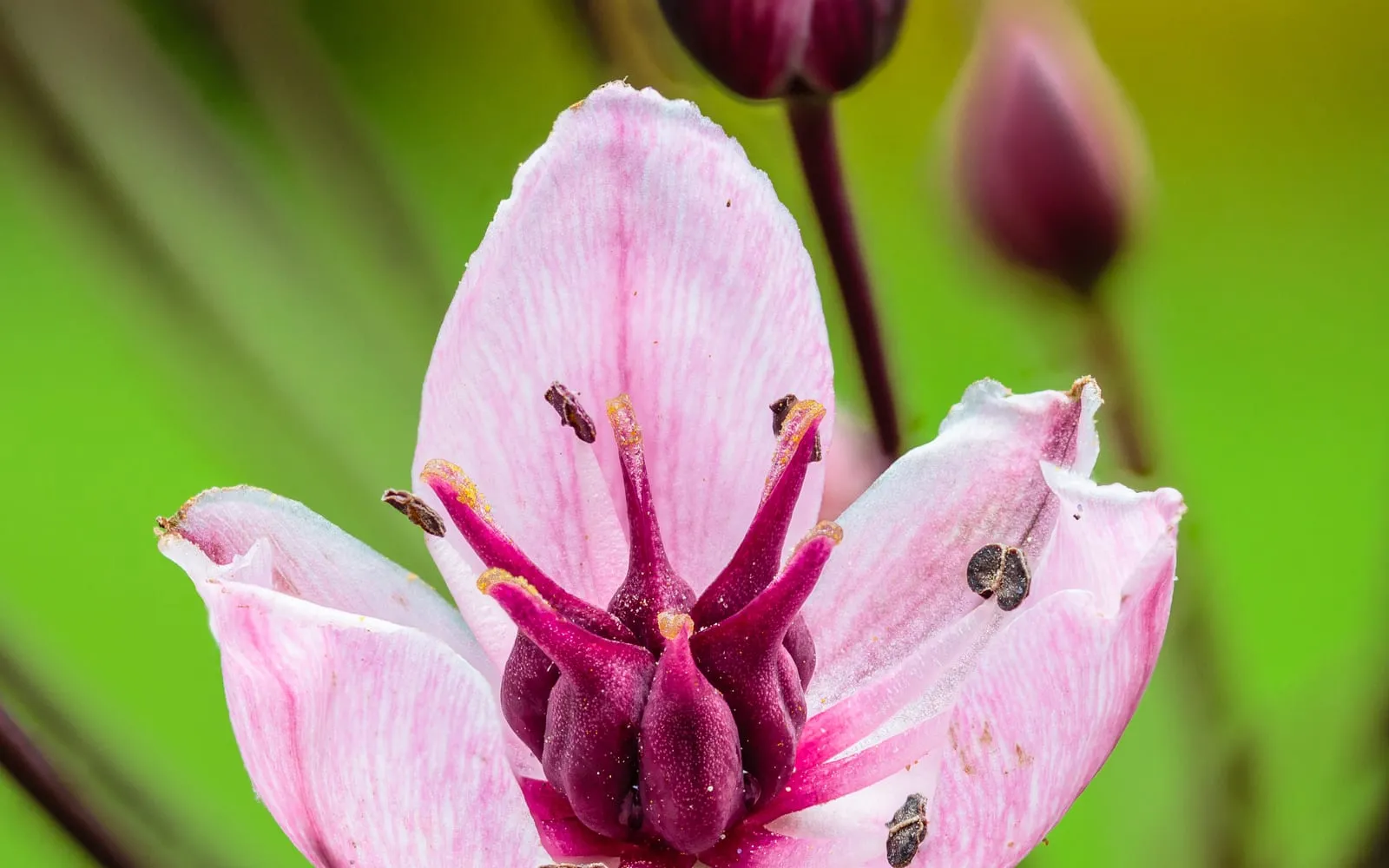
The flower stem rises well clear of the foliage in mid to late summer, topped with an open umbel of pink, occasionally white, flowers that each last only a few days but open in succession across the whole cluster for several weeks. Seed pods follow the flowers, splitting to release large numbers of tiny seeds that float and disperse on water, one of several ways the plant spreads.
Where it is from
Flowering rush grows naturally across temperate Europe and western Asia, in the still or slow-moving margins of rivers, canals, ditches and lake edges. Within Britain it is a native, if locally distributed, wetland plant rather than a garden escape, found most often in the lowland river systems of England.
Introduced into North America by the 1890s, first recorded in the St Lawrence River in Canada, it has since spread through the Great Lakes and much of the northern United States, helped along both by the ornamental water garden trade and by fragments carried in ballast water discharged from ships. It is now a significant management problem across parts of a continent it has no natural claim to.
How it grows
A spreading rhizome produces new leaf fans at intervals, gradually building a clump that thickens rather than travels quickly, similar in pace to many other rhizomatous marginals in a well-managed garden pond. What sets the species apart is a genetic split in how it reproduces across its range. Diploid populations, generally the less aggressive form, spread by seed as well as by small bulbils formed in the flower heads and along the rhizome. Triploid populations, more common where the plant has become invasive in North America, produce little viable seed and instead spread almost entirely from rhizome fragments and bulbils, a form of reproduction that tolerates a wider range of conditions and is much harder to control once established.
In a contained garden pond in its native range, this is largely academic: a single planting builds a modest, well-behaved clump over several seasons and needs no more management than routine division every few years.
Through the seasons
Spring new leaf fans emerge from the rhizome as the water warms, rebuilding the clump’s foliage ahead of the summer flower display.
Summer is the main event, with flower stems rising through June and July and the pink umbels opening in succession over several weeks.
Autumn seed pods split and release their seed onto the water, while the foliage begins to yellow and die back towards the rhizome.
Winter growth dies back completely above the waterline, and the rhizome rests dormant in the wet margin mud, fully hardy through frost.
Care difficulty
Moderate, mostly because of what it demands of the gardener rather than what it demands of the plant. Growth itself is straightforward in any sunny, wet margin, but because the species is regulated as invasive in large parts of North America, growers there need to check local rules before planting it and, where it is legal, take care that spent flower heads and rhizome divisions never reach a natural waterway. In Britain and most of its native range, care amounts to little more than routine division every few years to keep the clump within bounds.
Watering
Flowering rush grows in shallow water at the pond margin or in consistently moist mud, and unlike many true aquatics it tolerates the water level dropping briefly in summer without lasting harm, a trait that suits it to a naturalistic pond edge where levels fluctuate. Plant with the crown covered by up to about 30 cm of water for the strongest growth, or in wet marginal mud for a slightly more restrained clump.
Warning signs, diseases and pests
Snails occasionally graze the softer new leaves without causing lasting damage to an established clump. Aphids can colonise emergent growth above the waterline in a warm, sheltered spot, usually in modest numbers that natural predators or a jet of water keep in check.
The warning sign specific to this species, especially for growers in North America, is unexpected seedlings or new plants appearing some distance from the original planting, which can indicate that seed or rhizome fragments have escaped into open water. Any such volunteers should be removed and disposed of on land rather than composted near water, and a suspected wild population outside a garden pond should be reported to the relevant local invasive species authority rather than left in place.
Growing environment
Full sun brings the best flowering; in light shade the plant still grows well but produces fewer flower stems. Wet, fertile margin mud or shallow still to slow-moving water both suit it, and it copes with a wider swing in water level through the season than most other marginals grown alongside it.
Where legal restrictions apply, choose a pond with no outflow into a natural watercourse, and avoid planting flowering rush anywhere near a river, canal or lake it could realistically reach if it escaped.
Feeding
A general aquatic plant fertiliser tablet pushed into the planting basket in spring supports strong leaf growth and a fuller flower display through summer. Established clumps in a nutrient-rich pond often do well without any additional feeding at all, and feeding is more useful for a newly divided or recently planted specimen still building up its rhizome.
Troubleshooting
Seedlings or new plants are appearing away from the original planting. Check whether seed or rhizome fragments have escaped into open water, particularly in North America, where this species is regulated as invasive. Remove volunteers promptly and report a suspected wild population to your local invasive species authority.
Few or no flowers appear despite healthy foliage. More flowers usually follow more sun. Move a shaded clump to a brighter spot, or wait an extra season if the plant was only recently divided.
Leaves have small ragged patches eaten from them. Check for grazing snails or aphid colonies on the emergent growth, though damage is rarely severe enough to need more than occasional hand removal.
Water levels have dropped and exposed the crown. No cause for alarm in the short term. Flowering rush tolerates a brief dry spell better than most true aquatics, though prolonged drying will eventually weaken it.
Is it legal to plant where you live. Rules vary by country and, in the United States and Canada, by state and province. Check your local noxious weed or invasive species register before buying, since flowering rush is prohibited or regulated across much of the northern United States and Canada despite being freely available in parts of Europe.
The clump has become congested and flowered less this year. A sign it is due for division. Lift and split the rhizome in spring, replanting smaller sections to restore vigorous flowering.