
Houseplant
Orange Snowball Cactus
Rebutia muscula
Also known as Powder puff cactus
How to grow orange snowball cactus as a houseplant. Its dense clusters of small, spiny stems, and why offsets root more easily than you might expect.
At a glance
- Difficulty
- Easy
- Water
- Regular watering in summer, minimal in winter
- Light
- Bright light, some direct sun
- Temperature
- 10-28 deg C; tolerates a cool, dry winter rest
- Hardiness
- USDA 9-11, RHS H2, hardy to 2 C
- Type
- Evergreen perennial cactus
- Height
- 3-5 cm per stem, clumps spreading wider over time
- Native to
- Bolivia
Tolerant of a light chill but not real frost, and best grown as a container plant across most temperate climates. A cool, dry winter rest supports a much stronger following spring flush of flowers than keeping the plant warm and watered year round, mirroring the seasonal contrast of its high-altitude Bolivian origin.
Hardiness zones describe winter cold alone. Summer heat, humidity, rainfall and the length of the growing season decide as much, so treat the range as the outer limit rather than as a recommendation.
Not known to be toxic
Orange snowball cactus has no toxicity listing from the RHS or the ASPCA and is considered safe around pets and children in terms of chemical toxicity. Its fine white spines are soft to the touch compared with many other cacti but can still cause minor skin irritation on contact, so handling with care is still worthwhile.
Source: RHS
About
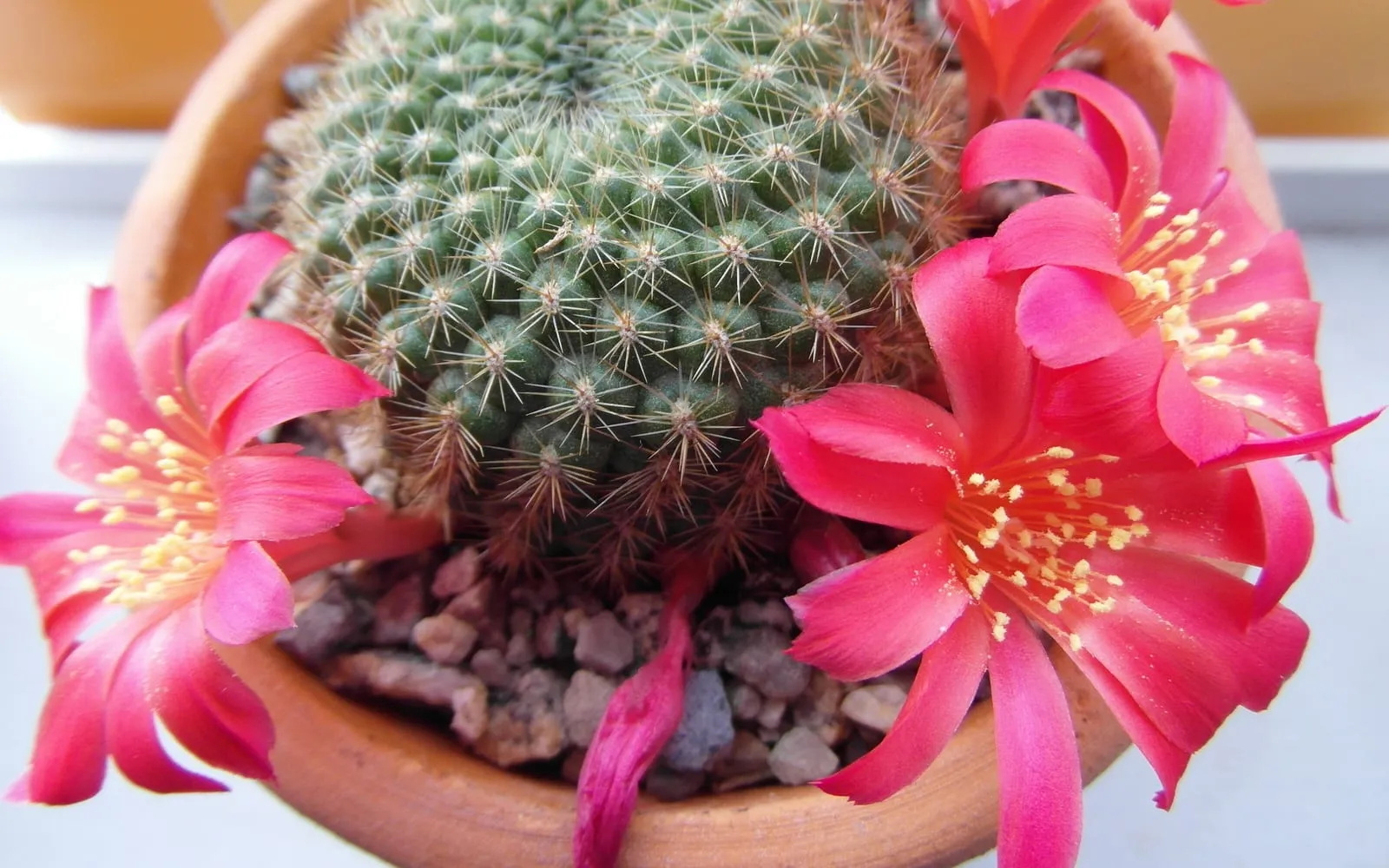
The orange snowball cactus forms dense clusters of small, rounded stems, each one covered in fine, soft, white spines that give the whole plant a snowy, almost fuzzy appearance, an effect that makes the vivid orange flowers it produces each spring all the more striking by contrast. It is one of the smaller and more prolifically clustering members of the Rebutia genus, a group well known among cactus enthusiasts for flowering reliably even on comparatively young, small plants.
A single stem left to grow will typically produce numerous offsets around its base within a few years, gradually building a dense, mounded cluster that can eventually fill a sizeable pot, each individual stem within the cluster capable of flowering once it reaches a modest size.
Appearance and character
Small, rounded, pale green stems are densely covered in short, fine white spines that lie close to the surface, giving the plant a soft, snowball-like texture that has earned it both its common name and considerable appeal among people who find the sharper spines of other cacti off-putting.
Flowers emerge from low around the base of each stem rather than from the crown, a distinctive habit shared by several Rebutia species, and open into a vivid, sometimes almost fluorescent orange, often appearing in a dense flush across the whole cluster in spring, with a well-grown mature plant producing many dozens of flowers over the flowering season.
Where it is from
Rocky, high-altitude slopes in Bolivia, where intense sun, cool nights and a pronounced dry season are all part of the normal yearly rhythm.
That high-altitude origin, with real seasonal cold and a defined dry period, is central to why this species flowers so much more reliably after a cool, dry winter rest in cultivation than when kept constantly warm, since the seasonal contrast is what its flowering response evolved to expect.
How it grows
A single small stem rarely stays single for long. Within its first year or two it starts ringing itself with pups at the base, and each of those pups sets to work producing pups of its own soon after, which is how a lone cutting turns into a mounded cluster faster than almost any other small cactus grown as a houseplant.
Because the offsets themselves mature quickly, a cluster does not need decades of patient growth before it flowers well. Even a cluster only a few seasons old, built from one starting stem, can put on a good show once its earliest offsets reach blooming size.
Through the seasons
Spring is flowering time, with the low, fluorescent-orange blooms opening in a ring around the base of every stem old enough to bloom, all at roughly the same time across the whole cluster.
Summer is the growing season proper. Keep to a regular watering rhythm and work in a feed once or twice while the weather stays warm.
Autumn the display and the growth both wind down together as the days shorten.
Winter hold the plant cool and close to dry; a poor winter rest here shows up directly as a thin spring flowering the following year.
Care difficulty
Easy, and quick to bulk up. Few small cacti form a full, flower-covered cluster this fast, which makes it a satisfying pick if you want results without years of waiting.
Watering
Give the compost a thorough soak, then let it dry out completely before the next one. Back this off hard over winter, keeping things close to dry, since the coming spring’s flowering depends mostly on how well that rest was handled.
Warning signs, diseases and pests
A tightly packed cluster gives mealybug plenty of places to hide between the individual stems, so part the offsets occasionally for a proper look rather than relying on a surface glance. An unexplained halt in growth, with nothing visible above the compost, is worth investigating by tipping the plant out and checking the roots for aphids working unseen.
Pale colour and wider spacing between the spine clusters signal a reach for light rather than any pest; a brighter spot brings new growth back to its normal compact form, though what has already stretched stays that way. Because the stems in a cluster sit so close together, a soft, discoloured patch on one is worth removing promptly rather than waiting, since rot spreads readily from one crowded stem to its neighbours.
Growing environment
Strong light with some direct sun keeps the cluster tight and flowering well; too little and it stretches while flowering drops off. Compost needs to drain sharply regardless of light levels, and a cool, dry winter gives it the best spring display.
Feeding
A low-nitrogen cactus fertiliser, applied once or twice through the growing season, supports steady growth and good flowering. Stop feeding entirely once the plant enters its winter rest.
Troubleshooting
Few or no flowers despite healthy-looking growth. Usually a sign the plant did not get a cool, dry winter rest. Provide a more distinct seasonal contrast the following year.
Growth looks stretched and pale. Too little light is the most common cause. Move the plant to a brighter spot; new growth will be more compact, though existing stretched stems remain as they are.
A stem within a dense cluster has turned soft and discoloured. Suspect rot, possibly from overwatering. Remove the affected stem promptly to protect the rest of the cluster, and check that the compost drains sharply enough.
The cluster has become very dense and crowded in its pot. This species offsets readily, and a congested cluster benefits from being divided or moved to a larger pot in spring, when new roots establish most readily after disturbance.
You want to grow new plants from individual offsets. Remove a pup once it has a reasonable size of its own, let the cut face callus for a few days out of direct sun, then set it on the surface of barely moist, sharply draining compost rather than burying it. Roots typically form within a matter of weeks, after which it can be watered on the same schedule as an established plant.
Orange Snowball Cactus problem guides
Not sure what is wrong? See the common houseplant pests guide.