
Outdoor plant
Lily of the valley
Convallaria majalis
Also known as Convallaria, May bells, Muguet
How to grow Convallaria majalis. Planting the pips, giving it the dry shade it wants, keeping it in bounds, and telling it from wild garlic before anyone eats it.
At a glance
- Difficulty
- Easy
- Water
- Rarely once established
- Light
- Partial to full shade, and it dislikes open sun
- Temperature
- Very hardy, and it needs winter cold
- Hardiness
- USDA 2-7, RHS H7, hardy to -40 C
- Type
- Rhizomatous perennial, spreading into dense colonies
- Height
- 15-30 cm
- Native to
- Europe and northern Asia, including native Britain
- Best month
- May in the Northern Hemisphere, November in the Southern Hemisphere
Cold is no obstacle and heat is, so it grows well through Canada and northern Europe and fails where summers are long and hot. It needs a proper winter chill to flower. The rhizomes run and it forms dense mats that exclude everything else, which has made it a listed invasive across parts of eastern North America, so give it a bed of its own or a place it cannot leave.
Hardiness zones describe winter cold alone. Summer heat, humidity, rainfall and the length of the growing season decide as much, so treat the range as the outer limit rather than as a recommendation.
Every month named in this guide is for the temperate Northern Hemisphere. If you garden in the Southern Hemisphere, shift each one by six months, so May becomes November. Closer to the equator the wet and dry seasons matter more than the calendar, and the shift stops being a useful guide.
Poisonous if eaten
- Do not eat
- Every part, including the berries and the water from a vase
- Harm from
- Eating it
- Affects
- People, cats and dogs
Lily of the valley is seriously poisonous in every part. It contains around forty cardiac glycosides, chiefly convallatoxin, which act on the heart in the same way as digitalis from foxglove. Eating any part causes vomiting, abdominal pain, blurred vision, confusion and a slowed or irregular heartbeat, and a significant dose can stop the heart. The RHS lists it as harmful if eaten, and the ASPCA classes it as toxic to cats and dogs, with dogs at particular risk from the bright red berries that follow the flowers in autumn. Water from a vase that has held the flowers carries enough of the glycosides to be dangerous and should be poured away rather than left within reach of a pet or a child. The most serious risk is misidentification. Lily of the valley leaves emerge in the same woodland, at the same time of year, and look much like those of wild garlic, and people have died in Europe after gathering the wrong plant for cooking. Two checks separate them. Wild garlic smells strongly of garlic when a leaf is crushed and lily of the valley has no smell at all, and wild garlic leaves rise singly, each on its own stalk from the ground, while lily of the valley wraps two or three leaves around one shared stem. Test with clean hands, because once your fingers smell of garlic the smell test tells you nothing.
Sources: ASPCA (Lily of the Valley, Convallaria majalis), RHS potentially harmful garden plants
About
The scent is why anyone grows this. A patch of lily of the valley in May fills the air around it with something clean and sweet that the perfume industry has never managed to extract properly, and every commercial muguet fragrance is synthesised because the flower yields almost nothing to distillation.
It grows in dry shade under trees, which is the hardest position in most gardens, and once settled it needs nothing at all.
The two things to know before planting are that it spreads, sometimes aggressively, and that every part of it is dangerous enough to stop a heart. Neither is a reason to avoid it. Both are reasons to think about where it goes.
Appearance and character
A low rhizomatous perennial, 15 to 30 cm tall, spreading underground into dense colonies that exclude almost everything else.
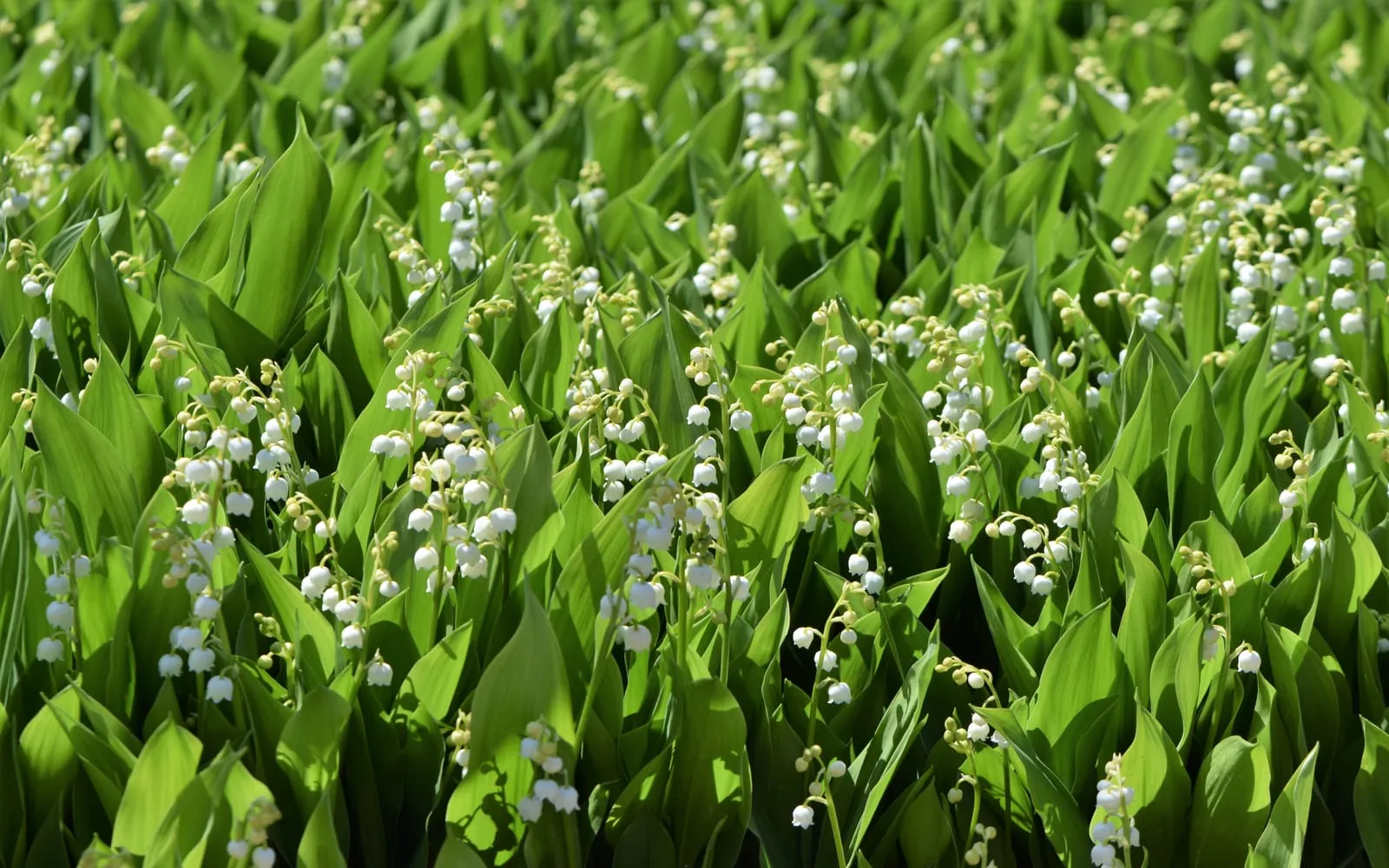
Leaves come in pairs, occasionally threes, broad and elliptical, 10 to 20 cm long, mid to deep green, and the two leaves wrap around a single shared stem at the base. That shared stem is the identifying character.
Flowers open in May on a slender arching stem that rises between the leaves, carrying six to twelve small white bells hanging along one side, each about 8 mm across with six recurved lobes at the mouth.
The scent is strong, sweet and unmistakable, and it carries a surprising distance for such a small flower.
Berries follow in autumn, round and bright orange-red, about 8 mm across. They are the part most likely to attract a child or a dog.
The rhizome is a network of horizontal white underground stems, each with a pointed growth bud at intervals. Those buds are what the trade calls pips.
A pink form, Convallaria majalis var. rosea, exists and is less vigorous than the white.
Where it is from
Europe and northern Asia, including Britain, where it is native and grows in dry ash and oak woodland, usually on limestone, and in a scattering of sites across England.
Wild British colonies are local and often ancient, and many garden plants in hedgerows and churchyards are escapes rather than natives.
Its woodland habitat explains the tolerance of dry shade. A plant growing under a closed canopy on thin limestone soil has to cope with root competition and summer drought, and that is exactly the position it fills in a garden.
In France the first of May is la Fete du Muguet, when sprigs are given for luck, a tradition dating to the sixteenth century, and street sellers are permitted to sell it tax-free on that day alone.
It was carried by Kate Middleton in her wedding bouquet in 2011, which produced a sharp rise in demand and a good deal of confusion about how easy it is to grow.
How it grows
Plant pips, the pointed growth buds cut from the rhizome, in autumn or early spring. Set them 3 cm deep and 10 cm apart with the tip just below the surface.
Plant into humus-rich soil in partial or full shade, and add leaf mould to poor ground.
Choose the position knowing that it spreads. Under shrubs, beneath deciduous trees, in a shaded strip beside a wall or anywhere a colony is welcome all suit it. A mixed border does not.
Water through the first year while it establishes.
Expect nothing much for two years. Lily of the valley sulks after planting, and then it runs.
Mulch each autumn with leaf mould, which is the whole feeding programme.
Divide congested colonies in autumn every four or five years, lifting the rhizomes, cutting them into sections with two or three pips each, and replanting. Wear gloves.
Force pips for winter flowers by potting them in autumn, chilling them for several weeks, then bringing them into gentle warmth, which is how the cut flower trade supplies them out of season.
Through the seasons
Winter is dormancy. The plant disappears entirely and the rhizomes sit just below the surface, so avoid digging the area over.
Spring brings the tightly rolled shoots through in March and April, opening into paired leaves, followed by the flowers in May.
Summer is quiet growth. The leaves feed the rhizome and should be left alone. Water only in a severe drought.
Autumn brings the red berries and the die-back. Divide and plant now, mulch with leaf mould, and clear away the yellowed foliage.
Care difficulty
Easy once it has taken, and the two difficulties sit at opposite ends of its life.
Establishment is slow and unpredictable. Some plantings take hold in a season and others sit and do nothing for two years, and the usual reason is soil that lacks organic matter.
Containment becomes the problem afterwards. A colony that likes its position will travel under paths and into neighbouring beds, and the rhizomes are brittle enough that every fragment left behind regrows.
Shade and moisture are what it wants, and it will not thrive in an open sunny border.
Disease is minor and rarely worth treating.
Watering
Established colonies need no watering, even in dry shade.
Water new plantings through their first year while the rhizomes spread.
A dry spring produces smaller leaves and fewer flowers. Mulching with leaf mould does more to prevent that than watering.
Avoid waterlogged ground, which rots the rhizomes.
Containers work reasonably well for a few years and need repotting once the pot fills with rhizome, which happens quickly.
Warning signs, diseases and pests
Spreading beyond its allotted ground is the commonest complaint. The rhizomes travel horizontally and send up new shoots at intervals, and a colony will move under edging and paving. Sink a physical barrier 30 cm deep around the planting if you need to contain it, or grow it in a large container sunk into the ground. Removing an established colony means digging out every fragment of rhizome and returning for the regrowth over two or three seasons.
Being mistaken for wild garlic is the risk that matters most. Both grow in shaded ground and put up broad green leaves at the same time. Wild garlic smells strongly of garlic when crushed and lily of the valley has no smell, and wild garlic leaves rise singly on individual stalks while lily of the valley wraps two or three around one stem. Never gather leaves from a wood where both grow.
Grey mould rots the flowers and leaves in wet still weather, particularly in a crowded colony.
Leaf spot produces brown or purple blotches and is cosmetic.
Yellow leaves in early summer are normal die-back. Yellow leaves in May mean the ground is too dry or too sunny.
Few flowers on a dense colony usually means congestion. Divide it in autumn.
Growing environment
Partial to full shade. Open sun scorches the leaves and shortens the display.
Humus-rich soil with plenty of leaf mould. It tolerates dry shade and chalky ground once established, which is what makes it so useful.
Under deciduous trees and shrubs is the natural position, and a north-facing border or the shaded side of a wall works equally well.
Give it room to spread, and a boundary it cannot cross. Paving, a wall or mown grass all help.
Avoid a mixed border, a rock garden or anywhere near choice small plants, which it will swamp.
Consider a large container, or a bottomless pot sunk into the ground, where the spread would be a problem.
Site it near a door or a path so the scent gets noticed in May, while keeping it clear of where small children play, since the autumn berries are bright and attractive.
Feeding
Mulch with leaf mould or well-rotted compost each autumn. That is all it needs.
Fertiliser is unnecessary and produces leaf at the expense of flower.
Fallen tree leaves left over the colony in winter do the job for nothing.
A colony that flowers poorly is usually congested rather than hungry, and division is the answer.
Container plants need fresh compost every two or three years.
Troubleshooting
How do I tell it from wild garlic? Crush a leaf with clean hands. Wild garlic smells strongly of garlic and lily of the valley smells of nothing. Wild garlic leaves also rise singly on their own stalks, while lily of the valley wraps two or three leaves around one shared stem. Getting this wrong has killed people.
Are the berries dangerous? Yes. They contain cardiac glycosides and they are bright red and attractive to children and dogs. So is the water from a vase that has held the flowers.
I planted pips and nothing happened. Give it two years. Lily of the valley is slow to establish and then spreads quickly. Add leaf mould and keep it damp through the first year.
It has taken over the bed. The rhizomes run horizontally. Sink a barrier 30 cm deep to contain it, or dig out every fragment and expect to return for the regrowth over two or three seasons.
Leaves but no flowers. Usually a congested colony or too much shade combined with dry soil. Divide in autumn and mulch with leaf mould.
The leaves scorched and yellowed in May. Too much sun or ground that dried out. Move it into deeper shade.
Will it grow in dry shade under a tree? Yes, which is one of its main uses. Water it through the first year to get it going.
Can I grow it in a pot? Yes, and it fills the pot with rhizome within a couple of years and needs dividing. It also keeps the spread under control.