
Outdoor plant
Basket-of-Gold
Aurinia saxatilis
Also known as Golden alyssum, Gold dust, Yellow alyssum
How to grow basket-of-gold, Aurinia saxatilis. Why its felted grey leaves reflect heat rather than trap cold like a Himalayan cushion plant's, its habit of flopping over neighbours, and shearing it back after its early flush.
At a glance
- Difficulty
- Easy
- Water
- Occasional watering while establishing; strongly drought-tolerant once mature
- Light
- Full sun
- Temperature
- Cool to warm temperate; strong drought and heat tolerance
- Hardiness
- USDA 3-7, RHS H5, hardy to -15 C
- Type
- Hardy evergreen perennial
- Height
- 20-25 cm
- Native to
- Europe, Western Asia
The zone number covers cold tolerance reliably, and it is not where this plant runs into trouble. Its real limiting factor is the opposite of most alpines: excess moisture and rich soil, which produce soft, sprawling growth that flops open and smothers nearby plants, a problem no winter temperature reading predicts.
Hardiness zones describe winter cold alone. Summer heat, humidity, rainfall and the length of the growing season decide as much, so treat the range as the outer limit rather than as a recommendation.
Not known to be toxic
Basket-of-gold is a member of the cabbage family and carries no toxicity listing from the RHS or the ASPCA. It has no documented history of causing digestive upset or skin irritation and is commonly grown in beds with unrestricted access for children and pets.
About
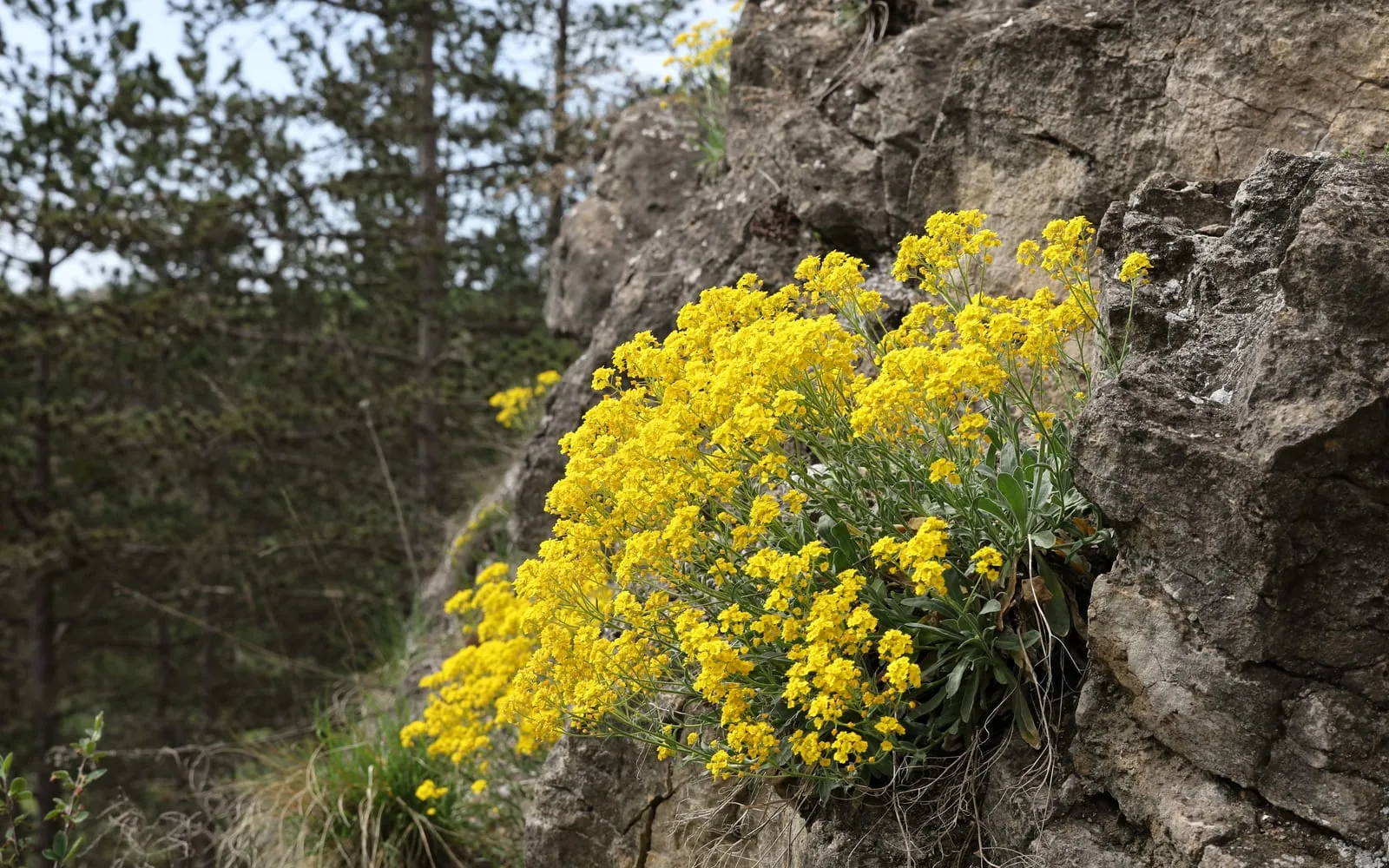
Basket-of-gold is one of the earliest and most brilliant flowering plants in a spring rockery, producing a low mound of grey-green foliage that disappears almost entirely under a dense covering of small, bright yellow flowers for several weeks before most other rockery plants have even begun their season. It was formerly classified as Alyssum saxatile, a name still widely used in the nursery trade, and it remains closely related to true alyssum within the cabbage family.
Its felted, silvery-grey leaves are covered in fine hairs, a feature it shares in appearance with rock jasmine, but for a different purpose: rock jasmine’s hairs evolved at high Himalayan altitude to slow moisture loss in thin, dry mountain air, while basket-of-gold’s serve a Mediterranean and Balkan native plant primarily by reflecting intense summer sun and reducing leaf temperature, the same physical covering doing two different jobs depending on which climate shaped it. Its own main cultivation problem is neither cold nor a hairy leaf rotting from trapped moisture, but a tendency to sprawl and flop over its neighbours if not cut back promptly after flowering.
Appearance and character
Rounded, grey-green leaves covered in a fine felting of hairs form a loose, spreading mound, generally looser and less tightly matted than the dense cushions of mossy saxifrage or rock jasmine. This slightly open habit becomes more pronounced as the plant ages, particularly after a wet or overly fertile growing season.
For several weeks in early to mid spring, often the first significant flower colour to appear in a rockery each year, the whole mound is covered in small, four-petalled, bright golden-yellow flowers held in dense clusters just above the foliage. The display is bright enough to be seen from a considerable distance and is a reliable early marker that the rockery growing season has properly begun.
Where it is from
Aurinia saxatilis is native to rocky, mountainous ground across south-eastern Europe, the Balkans, Turkey and parts of the Caucasus, typically found on dry, sun-baked limestone and rocky banks with intense summer heat and minimal rainfall. The species name, saxatilis, means growing among rocks, a description that applies as literally to this plant as to any in this collection, and its native habitat gives it exceptional tolerance of poor, dry, alkaline soil in full exposure to sun.
That Mediterranean and Balkan origin, shared broadly with aubrieta and perennial candytuft, explains why all three flower early and intensely and then need cutting back to stay compact, though basket-of-gold’s looser, more sprawling growth habit compared with the other two means the consequences of skipping that cutback show up faster, typically within a single season rather than over several years.
How it grows
Growth radiates outward and somewhat upward from the crown as sprawling, semi-woody stems that lean and cascade under their own weight rather than rooting tightly to the ground the way aubrieta’s trailing stems do. Left unpruned, an established plant can smother smaller neighbouring rockery plants through its own bulk and weight, particularly in a favourable growing season, well before any issue of legginess or a bare centre develops.
The plant’s own longevity issue is similar in principle to aubrieta’s, a tendency toward woody, less productive growth at the centre of an untrimmed plant after several years, but the more immediate and common complaint from gardeners is the sprawling habit crowding out other plants nearby rather than a bare patch appearing in the plant itself.
Through the seasons
Spring is the defining season for basket-of-gold, with its bright yellow flowers often opening before most other rockery plants have started. As soon as the flush finishes, cut the whole plant back hard, by around half its size, using shears; this single task controls both the plant’s spread and its tendency to become woody over time.
Summer follows the post-flowering cutback with a period of compact, controlled regrowth, and the plant handles heat and drought with ease during this period, needing very little supplemental water even in a hot, dry summer.
Autumn is a suitable time for planting new basket-of-gold, giving it a full season to establish a root system before winter, and it is generally too late in the year to expect a useful second flush of flowers even if a summer cutback was skipped.
Winter is handled without difficulty by established plants down to around minus 15 deg C, and the grey-green felted foliage persists through most temperate winters, though the loose, spreading habit makes it less of a winter structural feature than the tighter, denser evergreens elsewhere in this collection.
Care difficulty
Basket-of-gold is easy to keep alive, tolerant of poor soil, drought and hard frost with very little attention, and the skill it demands is timing rather than technique: cutting back hard immediately after flowering, every year, before the plant has had the chance to sprawl over its neighbours or thicken into unproductive woody growth. Skip that single task for even one season and the plant’s naturally loose habit tends to show it faster than a tighter, more disciplined mat former like aubrieta would.
Gardeners planting it near smaller, slower-growing rockery neighbours should give it enough space to spread into, or commit to a firmer annual cutback, since its size and sprawl are proportionally larger than several of the other mat-forming plants in this collection.
Watering
Established basket-of-gold needs very little supplemental watering in most temperate climates, drawing on its strong natural drought tolerance from a hot, dry Mediterranean and Balkan native habitat. New plantings benefit from regular watering during their first season while roots establish, after which watering can generally be limited to prolonged dry spells.
Overly generous watering on rich soil is more likely to cause problems than drought, producing soft, lax growth that sprawls and flops even more readily than the plant’s naturally loose habit already tends to.
Warning signs, diseases and pests
Downy mildew occasionally affects basket-of-gold in cool, damp spring conditions, particularly where growth is crowded and airflow is poor, showing as a greyish coating on the underside of leaves. Clubroot, a soil-borne disease of the cabbage family, can occasionally affect this species in contaminated ground, causing swollen roots and stunted growth.
Aphids sometimes cluster on the soft growth that follows the post-flowering cutback, and flea beetles occasionally shot-hole the leaves during warm, dry weather, generally without causing serious harm to an established plant.
Growing environment
Full sun is essential for the dense, bright spring flower display, and in shade the plant grows even looser and leggier than its naturally sprawling habit already tends toward, with poor flowering as a result. A south-facing rockery slope or the top of a low wall suits it well.
Soil should be free-draining and can be poor, sandy or stony without harming the plant, reflecting its native limestone habitat. Rich, moisture-retentive soil produces exactly the soft, sprawling growth the plant is prone to at its worst, and lean, dry ground consistently produces the tightest, most floriferous plants.
Feeding
Basket-of-gold needs no supplemental feeding in ordinary garden soil, and feeding is one of the more reliable ways to make its naturally loose, sprawling habit noticeably worse, producing soft growth that flops further and faster than an unfed plant on lean soil. This pattern is consistent across most of the Mediterranean and Balkan natives covered in this collection. Poor soil keeps growth compact.
A single light feed in early spring is reasonable only where soil is very poor and growth looks stunted rather than merely compact, and most established plantings need nothing at all.
Troubleshooting
The plant has sprawled over and smothered smaller neighbouring plants. This is the expected result of basket-of-gold’s naturally loose, spreading habit combined with a missed or delayed post-flowering cutback. Cut it back hard, by around half its size, and repeat every year immediately after flowering to keep its spread in check.
The centre of an older plant has become woody and unproductive. Similar to aubrieta, several years without an annual hard cutback lead to a woody, less floriferous centre. Renovate with a hard cut in late summer or early spring, and maintain the annual post-flowering trim afterwards to prevent it recurring.
Flowering was weak or delayed this spring. Overly rich soil, shade, or a missed cutback the previous year are the most common causes. Basket-of-gold flowers most densely on compact growth produced after a hard shear, so an unpruned plant from the year before often flowers noticeably worse.
Growth looks soft, lax and pale rather than compact and grey-green. This points to soil that is richer or wetter than the species needs. Reduce or stop feeding, and improve drainage if the soil stays consistently damp.
A greyish coating has appeared on the underside of the leaves. This is downy mildew, more likely in cool, damp, crowded spring conditions. Improve air circulation by thinning nearby planting and avoid watering onto the foliage in the evening.
Roots have appeared swollen and distorted with stunted growth above ground. This suggests clubroot, a soil-borne disease of the cabbage family with no cure once established. Remove the affected plant, do not compost it, and avoid replanting another brassica-family species in the same spot for several years.
Small round holes have appeared across the leaves in warm, dry weather. This is flea beetle damage, generally cosmetic and rarely serious on an established plant. Keeping the plant adequately watered during dry spells reduces the beetle activity that causes it.