
Outdoor plant
Sapphire Tower
Puya berteroniana
Also known as Blue Puya, Turquoise Puya
How to grow Puya berteroniana. A spined Chilean rockery bromeliad whose huge turquoise flower spike traps small birds in its own leaves.
At a glance
- Difficulty
- Moderate
- Water
- Water deeply during the growing season, then let the soil dry out fully before watering again
- Light
- Full sun. This species needs as much direct light as an outdoor bed can give it
- Temperature
- Tolerates heat and dry summers well. Established plants take short dips well below freezing
- Humidity
- Low. A dry-climate plant that dislikes constant damp far more than dry air
- Hardiness
- USDA 8-10, RHS H4, hardy to -8 C
- Type
- Slow-growing succulent perennial, taking several years to flower and forming a spreading clump
- Height
- 1-1.5 m as a rosette; flower spike to 3-4 m
- Native to
- Chile, Andes
Coastal and Andean central Chile, between roughly 500 and 2000 metres, with real winter cold and a dry, mediterranean-type climate rather than anything tropical. The zone number covers cold tolerance only, and it says nothing about the drainage this species needs to survive that cold without its roots rotting first.
Hardiness zones describe winter cold alone. Summer heat, humidity, rainfall and the length of the growing season decide as much, so treat the range as the outer limit rather than as a recommendation.
Not known to be toxic
Not chemically toxic. Puya has no dedicated ASPCA entry, and nothing in published toxicology literature identifies a systemic poison in the genus, so the hazard here is entirely mechanical rather than chemical. Every leaf on a mature Sapphire Tower is lined with stiff, curved, outward and backward-pointing spines capable of tearing skin, snagging clothing, and in its native Chile entangling and killing birds and even sheep that blunder into the rosette. This is a plant to site well away from paths, seating areas, children's play space and anywhere a dog runs freely, and to handle only in thick gloves and long sleeves once it reaches any real size.
Sources: RHS potentially harmful garden plants, NC State Extension Gardener Plant Toolbox
About
A Sapphire Tower’s flower spike does something almost no other garden plant does. Small birds probing the rosette for insects or nectar sometimes become entangled in the recurved spines lining every leaf, unable to work themselves free, and die where they are caught. The plant gains nothing directly from an animal trapped this way; it is not carnivorous in the way a Venus flytrap is, since it has no means of digesting the body. What it gets is slower and indirect: as the carcass decomposes at the base of the rosette, the nutrients released into the soil are ones the plant’s roots can then take up, in a habit botanists describe as protocarnivorous rather than carnivorous. The same species that occasionally kills a bird this way also depends on hummingbirds for pollination, and its flower spikes carry sterile, outward-pointing branches specifically to give visiting birds somewhere safe to perch while they feed, an odd co-existence of hazard and invitation on the same plant.
That flower spike, when it finally appears after years of growth, is one of the most striking any garden plant produces: a branched column several metres tall, densely packed with metallic turquoise-blue flowers and bright orange stamens, a colour combination almost unmatched elsewhere in cultivation.
Everything about growing Puya berteroniana follows from where it comes from rather than from any resemblance to a soft-leaved houseplant bromeliad. It is a terrestrial, ground-rooted plant for a sunny, dry, well-drained rockery, grown far more like a large agave than like any of the tank bromeliads in this collection.
Appearance and character
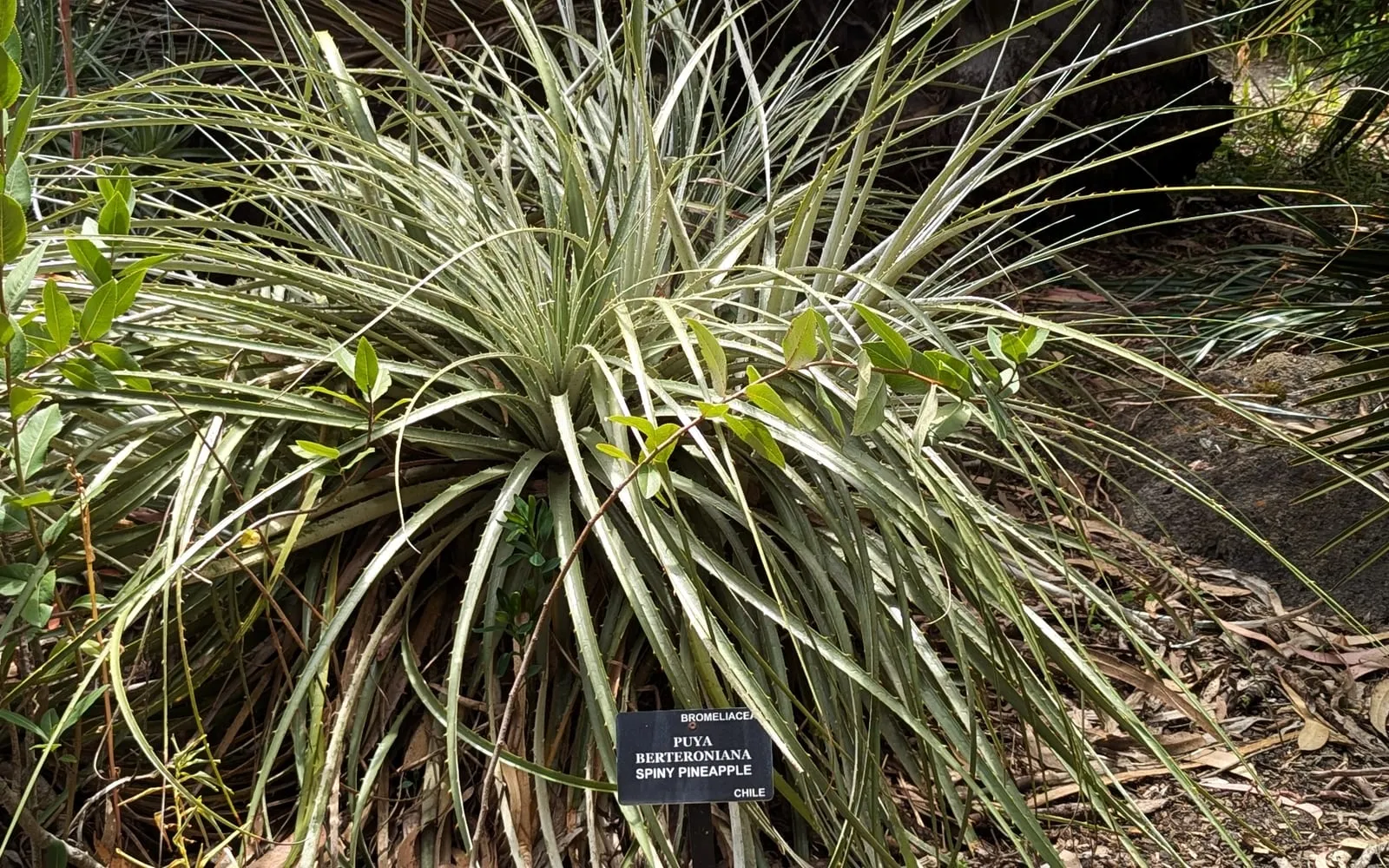
A large, dense rosette of stiff, narrow, silvery-green leaves, reaching a metre or more across at maturity, each leaf lined along its full length with curved, outward and backward-pointing spines that make close contact with the plant dangerous.
The rosette grows slowly, typically taking six years or more from seed or offset before it reaches flowering size, a far longer wait than any of the other bromeliads in this collection.
Once mature, it sends up a single, thick, branched flower spike that can reach 3 to 4 m in height, densely set with waxy, metallic turquoise-blue flowers and vivid orange anthers, held for several weeks in late spring.
The colour is unusual. Metallic blue-green is rare among flowers generally, let alone among bromeliads, and it is the feature the species is grown for above everything else.
Sterile, horizontal side branches on the lower part of the spike function as landing perches for hummingbirds, an adaptation that increases pollination success by giving a visiting bird somewhere stable to sit rather than having to hover while it feeds.
The rosette that flowers, like every bromeliad covered here, does not flower again afterwards, though a plant typically produces offsets around its base before or during flowering, so a single specimen slowly becomes a clump of rosettes at different ages over time.
Where it is from
Puya berteroniana is endemic to central Chile, found on coastal hills and in the Andean foothills at elevations between roughly 500 and 2000 metres.
The region has a mediterranean-type climate: dry, often intensely sunny summers and cool, wetter winters, quite unlike the constant warmth and humidity behind most of the tropical bromeliads in this collection. Frost occurs in winter at the cooler parts of the plant’s range, and the species has adapted accordingly, tolerating cold that would kill a rainforest epiphyte outright.
It grows on open, rocky, often steep ground where drainage is close to absolute, since water cannot pool for long on a slope of bare stone. That habitat is the reason poor, gritty soil suits this species better than a rich garden bed, and why root rot from wet winter soil is a bigger threat to a cultivated plant than cold ever is on its own.
Full, unfiltered sun reaches it across most of its range, and the plant’s tough, narrow, silvery leaves are built to cope with that intensity and with a genuine dry season each year, rather than to make the most of filtered forest light the way a tank bromeliad’s broader leaves do.
How it grows
Plant it in full sun, in soil dug through generously with grit or coarse sand, or in a raised bed or slope where drainage is close to guaranteed. This is the most important decision in growing it well.
Water deeply during the growing season, then allow the soil to dry out completely before watering again, in the same soak-and-drain rhythm the plant experiences naturally on an open rocky slope.
Reduce watering sharply over autumn and winter, since cold, wet soil around the roots through a British or similarly damp winter is a far greater threat to this species than the cold itself.
Give it plenty of space from the outset. A mature rosette spans a metre or more, its spines make later transplanting difficult and unpleasant, and the eventual flower spike needs clear room above the plant to develop without obstruction.
Be patient. A young plant can take six years or longer to reach flowering size, and there is little to do in the meantime beyond providing sun, drainage and an occasional deep watering through the growing season.
Site it well back from paths, seating areas, washing lines and anywhere children or pets pass regularly, given both the spines along every leaf and the entrapment hazard the species is known for in its native range.
Remove the spent flower spike once it has fully browned, cutting it back to the base in thick gloves, and expect offsets to have already begun forming around the parent by that point.
Through the seasons
Spring is the flowering season for a mature rosette, when the huge turquoise spike develops and opens over several weeks. Water deeply during active growth and watch for hummingbird or insect activity around a flowering spike.
Summer is the plant’s most tolerant season, coping easily with heat and a real dry spell once established. Water only occasionally and deeply, letting the soil dry out fully between soakings even in a hot summer.
Autumn is a reasonable time to plant new offsets outdoors, giving them a season to establish roots before winter cold arrives. Reduce watering as growth slows.
Winter tests drainage more than cold tolerance on its own. An established plant in gritty, free-draining soil takes a real frost without serious harm; the risk comes from wet soil sitting cold around the roots, so cutting watering right back, or even stopping it entirely in a wet climate, matters more than any frost cover.
Care difficulty
Moderate, and the difficulty is almost entirely about patience and placement rather than any complicated routine.
Once planted in full sun with free-draining soil, it needs very little ongoing attention, tolerating heat, drought and real cold with far less fuss than most garden plants. The waiting, several years before any flower spike appears, tests most growers more than any technical demand.
Siting it correctly the first time matters more than with almost anything else in this collection, both because a mature plant is difficult and unpleasant to move once its spines develop fully, and because of the genuine entrapment hazard it poses to birds, pets and unwary visitors if placed somewhere with regular traffic.
Given the right spot, poor soil and reliable sun matter more to its success than skill, and a gardener who gets those two things right at planting time has done most of the work already.
Watering
Water deeply during the growing season, soaking the whole root zone, then let the soil dry out completely before watering again.
An established plant in the ground often needs no supplemental watering at all through an ordinary summer once its roots are established, relying instead on whatever rain falls naturally.
Cut watering back sharply, or stop it altogether, over autumn and winter, since this is the season wet soil poses the greatest risk to the roots.
There is no cup or tank on a Puya, and watering the soil deeply and infrequently is the entire routine, in the same pattern as its close relative Dyckia rather than anything resembling a tank bromeliad’s cup care.
Signs of overwatering are yellowing at the base of the outer leaves and a soil surface that stays damp for days after rain. Signs of underwatering, which this species tolerates for long stretches, are leaves that thin slightly, corrected easily by the next deep soak.
Warning signs, diseases and pests
A soft, yellowing or blackening base, particularly after a wet winter, is rot from soil that has stayed damp too long. Improve drainage substantially before replanting, since the plant itself is rarely the underlying problem.
Pale, stretched growth with weaker spine development usually points to too little direct sun. Move a container-grown young plant to the sunniest spot available.
Scale insects appear as small, flat, brownish bumps along the leaves, often hidden between the spines. Treat with horticultural oil, applying it carefully in thick gloves.
Mealybugs cluster as small white tufts at the base of the leaves. A cotton bud dipped in isopropyl alcohol removes a light infestation on a young plant; a heavier one on a mature specimen may be better left to a systemic treatment given how difficult close handling becomes.
A flower spike that fails to develop fully after several years of healthy growth may mean the plant has not yet reached full maturity, since first flowering can take considerably longer than six years in a cooler or less sunny climate than its native Chile.
A dead bird or large insect found caught in the rosette is not a sign of disease. It is the entrapment behaviour the species is documented for, and removing the carcass, in thick gloves, is a matter of preference rather than necessity, since the plant will draw what nutrients it can from it either way.
Growing environment
Full sun, as much direct light as an outdoor bed can provide. This is not a plant for a shaded or even partly shaded corner.
Tolerates real summer heat and drought without difficulty, and an established plant in free-draining soil shrugs off short dips well below freezing.
Low humidity suits it fine, and a dry climate overall is closer to ideal than a damp one, since the greatest risk this species faces is wet soil rather than dry air.
Gritty, sharply-draining, relatively poor soil, either natural rocky ground or a bed heavily amended with coarse grit.
Ample surrounding space, both for the mature rosette’s eventual spread and for the flower spike’s considerable height, along with a clear sightline away from the plant for anyone tending the garden nearby.
Deliberate distance from paths, seating, play areas and anywhere pets run freely, given the genuine entanglement hazard documented in its native range.
Feeding
Feed sparingly, once or twice over the growing season at most, with a dilute balanced fertiliser or a cactus-formulated feed applied to the soil.
This is not a plant that benefits from generous feeding. Excess fertiliser tends to produce soft, weaker growth more prone to rot, working against the tough, compact form the species needs to thrive outdoors.
Skip feeding entirely over autumn and winter, when growth has slowed considerably and the plant needs nothing beyond protection from waterlogged soil.
A mature, established plant growing in reasonable ground typically needs no supplemental feeding at all, particularly once its root system is large enough to draw what it needs from the surrounding soil.
Avoid feeding a plant showing any sign of root rot. Fertiliser will not help damaged roots recover and can add further stress while they are already compromised.
Troubleshooting
Is it true this plant can kill birds? Yes, documented in its native Chile. Small birds occasionally become entangled in the recurved spines while probing the rosette and cannot free themselves; the plant then draws nutrients from the decomposing body, a behaviour called protocarnivory rather than true carnivory, since it cannot digest the animal directly.
How long before mine flowers? Typically six years or more from a young plant, sometimes considerably longer in a cooler or less sunny climate than its native Chile. There is little to do in the meantime beyond providing sun and good drainage.
Do I need to fill a central cup like other bromeliads? No. Puya is a ground-rooted, terrestrial species with no functional tank, watered by soaking the soil deeply and then letting it dry out, in the same way as its relative Dyckia.
The base has gone soft and yellow. That is rot from soil that has stayed too wet for too long, most often after a damp winter. Improve drainage substantially and cut watering back sharply, especially in autumn and winter.
How cold can it really tolerate? An established plant in free-draining soil shrugs off short dips well below freezing without lasting harm, though prolonged hard frost or waterlogged winter soil will still kill it.
Is it safe to grow with children or pets in the garden? Only with careful placement. Site it well away from paths, play areas and anywhere a dog runs freely, and treat it, once mature, as you would any plant with spines capable of causing a real injury rather than a minor scratch.
Why hasn’t my established plant produced offsets yet? Offsetting often happens around the time of first flowering rather than steadily throughout the plant’s early life, so a young, pre-flowering rosette may not have reached that stage yet.