
Houseplant
Horse's Teeth
Haworthia truncata
Also known as Haworthia truncata, Truncate Haworthia
How to grow Haworthia truncata, horse's teeth. Its leaves cut off flat in two rows with windowed tops, why it grows half-buried, and how to water it.
At a glance
- Difficulty
- Moderate
- Water
- When the deep gritty mix has dried right down
- Light
- Bright indirect light; a little gentle sun
- Temperature
- Warm to cool; keep above 5 deg C
- Humidity
- Undemanding; tolerates dry air
- Hardiness
- USDA 9-11, RHS H2, hardy to 5 C
- Type
- Evergreen succulent perennial
- Height
- 3 to 8 cm
- Native to
- South Africa
A small succulent from a limited patch of the South African Karoo, where it lives almost entirely underground with only its flat leaf tops level with the gravel. It has no frost tolerance and prefers to stay above about 5 deg C, coping easily with bright shade and long droughts. Cold, sodden compost is the main thing that kills it.
Hardiness zones describe winter cold alone. Summer heat, humidity, rainfall and the length of the growing season decide as much, so treat the range as the outer limit rather than as a recommendation.
Not known to be toxic
No toxin is recorded in the haworthias, and the ASPCA does not list them among harmful plants. Chewing a leaf would be unlikely to cause more than the mild upset any greenery might, so it is safe to keep where cats, dogs or children might reach it. It is grown for its unusual sliced-off leaves, not for anything edible.
Sources: ASPCA toxic and non-toxic plants, RHS potentially harmful garden plants
About
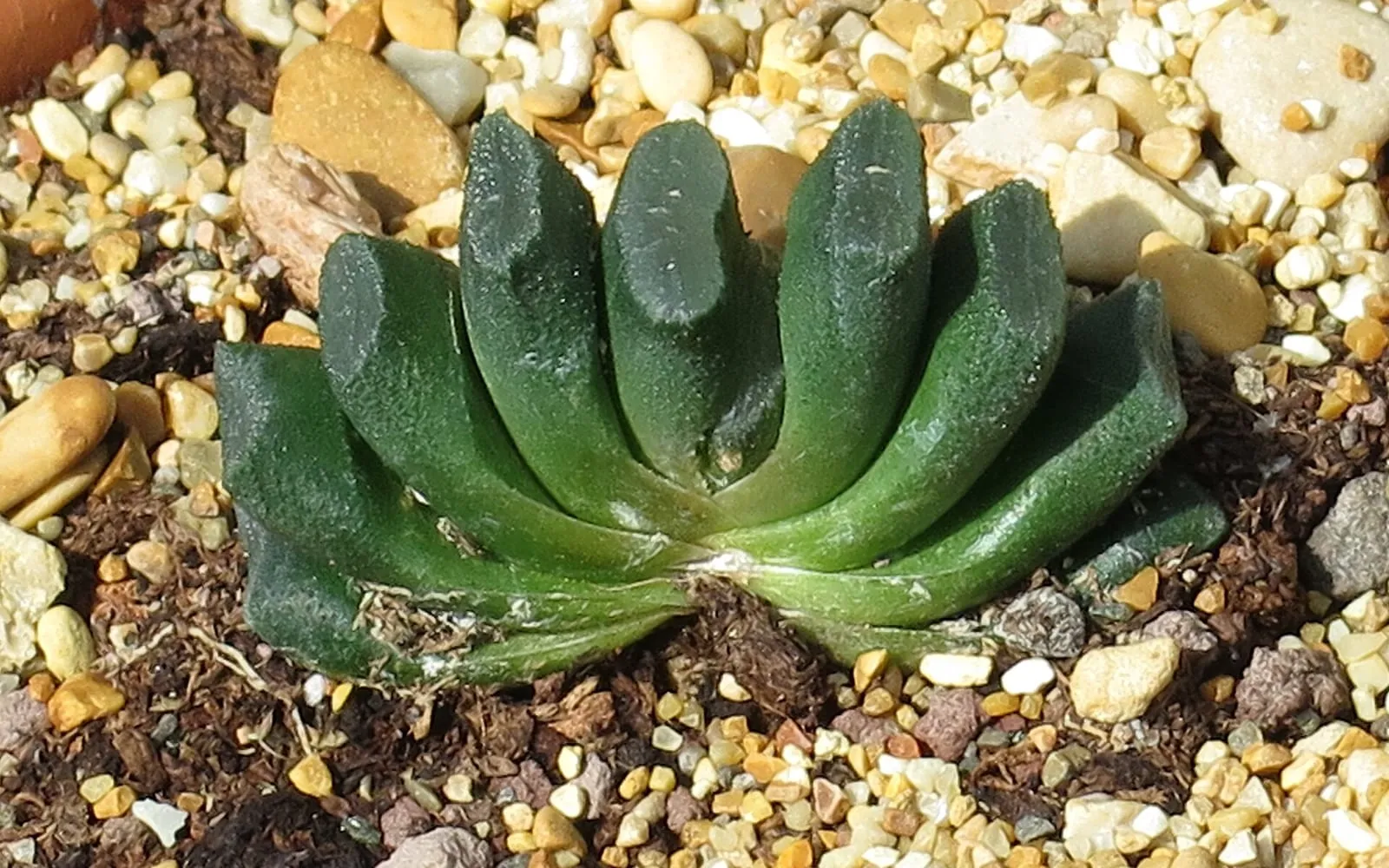
Horse’s teeth is one of the strangest small succulents to look at. Its leaves stand in two flat rows and each one ends as though it has been sliced clean across with a knife, leaving a rough, greyish, part-transparent top. Lined up side by side, those flat tops call to mind a mouthful of worn teeth.
In its Karoo home the plant lives buried. Contractile roots pull it down into the dry, gritty soil until only the sliced tops sit at the surface among the pebbles, and light reaches the buried leaves through the clear windows on those tops.
Collectors value it as a window-leaved haworthia, and it belongs with the other window-leaved haworthias such as the retuse haworthia and the zebra haworthia, all grown the same careful, dry way.
Appearance
The leaves are thick, stubby and upright, each one truncated flat at the top with a rough, greyish, translucent face, and they are held strictly in two opposing rows instead of a rosette. That row of flat tops is the plant’s main identifying feature.
Growth stays very low, only a few centimetres tall, spreading slowly sideways along the two ranks as offsets appear beside the parent.
A slender flower stalk rises well above the leaves in season, bearing small white tubular blooms finely veined in brown, which are easy to miss against the unusual foliage.
The plant increases by offsets and root divisions, and enthusiasts also raise it from seed and from leaf and root cuttings.
Where it is from
Haworthia truncata comes from a small, dry corner of the Little Karoo in South Africa, growing in stony flats and sitting low so that only its flat tops show among the surface gravel. It needs sharp drainage and open, bright, arid ground.
That buried habit is the reason the leaves are sliced off flat and windowed at the top, since only those tops meet the light in the wild. The plant needs a deep, quick- draining root run, bright light and scant water, and it has no defence against frost or sodden roots.
How it grows
Growth is slow and comes mainly in the milder stretches of spring and autumn, the plant adding leaves along its two ranks and budding offsets beside itself. It rests in high summer heat and in winter cold.
Give it a deep pot filled with a gritty, free-draining mix, deeper than the small plant looks as if it needs, to accommodate its contractile roots. Water only after the mix has dried right down, and some growers set the plant a touch low to copy its wild, sunken habit.
Bright, indirect light with a little gentle sun suits it, and it should stay above about 5 deg C and dry through winter. Expect slow progress and resist the temptation to overwater it into faster growth.
Propagate by splitting off rooted offsets, or by leaf and root cuttings, letting each cut surface dry before it goes into gritty mix.
Through the seasons
Spring is one of its two growth spells. Repot or divide off offsets and resume careful watering as growth starts.
Summer heat can pause it. Water only when the deep mix is thoroughly dry, and keep it out of a scorching window.
Autumn brings the second, often stronger, flush of growth as the weather cools.
Winter is a dry rest. Keep it above about 5 deg C and give barely any water, since cold and wet together can kill it.
Care difficulty
Moderate, and satisfying once the watering is judged. It takes bright shade, dry air and neglect well, needing only a deep gritty pot and careful watering. Overwatering is the main risk. Grown dry and bright, it is long-lived and almost trouble-free.
Watering
Wait for the deep, gritty mix to dry right down, then water it through and drain it well. Through the cold months, when the plant is resting, a bare minimum is enough to stop it shrivelling.
The leaves hold the plant’s water supply, so a dry spell is much safer than a wet pot. A plant sinking and softening slightly is thirsty; leaves gone soft and see-through mean it has had too much.
Warning signs, diseases and pests
Rot from a pot kept too wet is the main hazard, showing as soft, translucent leaves and a plant loose in its mix. Stop watering, check the roots, and start again from healthy offsets or root cuttings if the base is lost.
Mealybugs hide among the leaves and deep in the roots as small white woolly clusters. Pick them off or treat with horticultural oil, and inspect the roots whenever you repot.
Leaves that sink and pucker, with the plant dropping into its pot, usually mean it has been too dry for too long. A thorough soak, followed by drying out again, should bring it back up.
Growing environment
Bright, indirect light with a little gentle sun suits the exposed leaf tops, matching the open but stony ground it comes from. Fierce midday sun can scorch the flat faces, and deep shade weakens the plant.
Warmth is welcome but not essential; cool, bright winters are fine so long as it stays above about 5 deg C and dry. It needs no humidity and tolerates dry air.
Grow it in a deep, gritty, free-draining mix to suit its contractile roots, on a bright, sunless sill, ideally among other window-leaved haworthias and Karoo miniatures.
Feeding
Feeding is barely necessary. A dilute cactus feed during the spring and autumn growth spells is enough for such a slow plant, and richer feeding only produces soft growth.
Give none while it rests in summer heat or winter cold, and let fresh mix support a newly potted plant for its first year or more.
Troubleshooting
Why are the leaves cut off flat? That is natural. In the wild the plant grows buried, with only those flat, windowed tops at the surface to gather light, so the sliced-off look is exactly how it should be.
Should I bury it as it grows in the wild? You can set it a little low in a deep, gritty pot to suit its contractile roots, but it does well planted at the normal level as long as the pot is deep.
The leaves have gone soft and see-through. Overwatering. Cut back, check the roots, and root healthy offsets or root cuttings if the base has rotted.
It looks sunken and shrivelled. Usually too dry for too long. Water it well and let the mix dry again; it should plump and rise. This is easier to fix than overwatering.
Is it safe around pets? Yes. Haworthias are not on the ASPCA’s toxic list, so it is a safe succulent for a home with animals.
Horse's Teeth problem guides
Not sure what is wrong? See the common houseplant pests guide.