
Outdoor plant
Henbane
Hyoscyamus niger
Also known as Black henbane, Stinking nightshade, Hog's bean
How to recognise Hyoscyamus niger, a native British poison. The veined cream flowers and the smell, what the tropane alkaloids do, and what to do if a child eats the seed.
At a glance
- Difficulty
- Moderate
- Water
- Never plant it deliberately where children play
- Light
- Full sun
- Temperature
- Hardy, and the biennial form overwinters as a rosette
- Hardiness
- USDA 4-9, RHS H6, hardy to -20 C
- Type
- Annual or biennial, dying after it sets seed
- Height
- 30-80 cm
- Native to
- Europe including native Britain, north Africa, western Asia
Two forms exist, an annual that flowers in its first summer and a biennial that overwinters as a rosette, and seed packets rarely say which. Poor sandy ground suits it. Every part carries tropane alkaloids at doses that kill, and the root has been mistaken for parsnip with fatal results.
Hardiness zones describe winter cold alone. Summer heat, humidity, rainfall and the length of the growing season decide as much, so treat the range as the outer limit rather than as a recommendation.
Poisonous if eaten
- Do not eat
- Every part, and the seeds and roots most of all
- Harm from
- Eating it, handling it and sap in the eyes
- Affects
- People, cats, dogs and horses
Henbane is one of the three great tropane alkaloid poisons of the European flora, alongside deadly nightshade and thorn apple, and it contains the same compounds: hyoscyamine, scopolamine and atropine. NC State Extension lists Hyoscyamus niger as poisonous and names all parts, describing dilated pupils, dry mouth, flushing, hallucination, rapid heart rate, convulsions and coma. Poisoning follows the same course as deadly nightshade, described in medicine as dry as a bone, red as a beet, blind as a bat, mad as a hatter and hot as a hare. The seeds are the danger in practice. They sit in a capsule that opens by a neat lid, hold high concentrations of alkaloid, and have been eaten by children and by adults who mistook the plant for something else. Fatal cases are on record. The alkaloids are also absorbed through skin and through the eye, so wear gloves if you remove a plant, wash afterwards and keep your hands away from your face. Any suspected ingestion is a medical emergency. Get emergency care at once, take a piece of the plant, and do not wait for symptoms.
Sources: NC State Extension, Hyoscyamus niger, RHS potentially harmful garden plants, ASPCA toxic and non-toxic plants
About
Henbane smells wrong. Brush past a plant on a warm day and the scent is heavy, oily and faintly rotten, and it is the first thing anyone who has met the plant remembers about it. Stinking nightshade is the other English name and it is the more useful one.
It is a native British plant, though an uncommon one, growing on light sandy soil near the sea, on disturbed ground, on rabbit warrens and around old buildings. It appears and disappears, since the seed stays viable in the soil for decades and germinates when the ground is broken, so a plant can turn up on a site where nobody has seen one for fifty years.
The plant’s history is longer than its current obscurity suggests. It was in the medieval soporific sponge used before surgery, it appears through the literature on European witchcraft as an ingredient of flying ointments, and hyoscine extracted from it was used by Hawley Crippen to poison his wife in 1910, which put the name in every newspaper in Britain. Scopolamine remains a licensed medicine.
Appearance and character
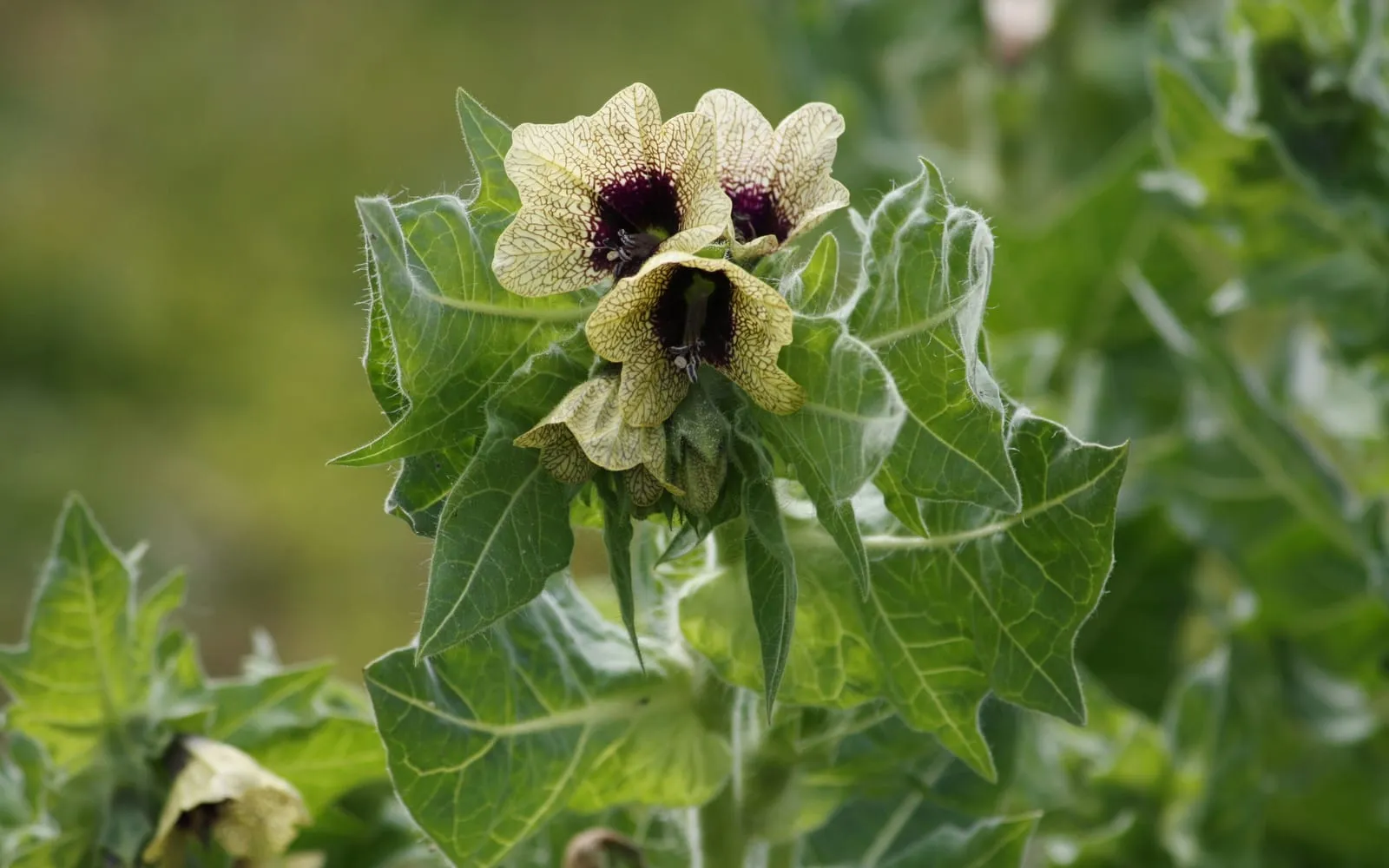
The whole plant is covered in sticky glandular hairs, so leaves and stems feel tacky and pick up dust and grit. The foliage is a dull grey-green, coarse, with irregular lobed and toothed margins, and the leaves clasp the stem where they join it.
Flowers are the identifying feature and are unlike anything else in the British flora. Each is a shallow funnel about 2 to 3 cm across, dull cream to pale yellow, netted all over with a fine tracery of purple veins, with a dark purple throat. They are borne in a one-sided leafy spike that uncurls as it grows.
The fruit is as distinctive as the flower. Each capsule is urn-shaped, about 1.5 cm long, sitting inside a ring of five stiff spiny teeth formed by the persistent calyx, and it opens by a neat circular lid to release many small greyish seeds. A dried stem of these is a common sight in autumn and looks like a row of tiny pots.
Where it is from
Henbane is native across Europe including Britain, north Africa and western Asia, and it has been carried to North America, Australia and elsewhere as a weed of cultivation and a medicinal plant.
In Britain it grows on light sandy and chalky soils, most often near the coast, on disturbed ground, field margins, dunes and around ruins. It is scattered and local rather than common, and it has declined with the loss of the disturbed ground it needs.
The seed bank is the reason the plant persists. Buried seed remains viable for many decades, and archaeological excavations have germinated henbane from soil undisturbed for centuries. Ground works on an old site are a classic way for a population to reappear.
How it grows
The plant is annual or biennial depending on when the seed germinates. Spring germination gives an annual that flowers and dies the same year; late summer germination gives an overwintering rosette that flowers the following June.
Flowering runs from June to August, and each plant produces a great deal of seed, which is what maintains the seed bank. The plant dies after setting it.
It needs open disturbed ground and cannot compete in closed vegetation, so it is a plant of gaps. That is why it follows ground works, rabbit activity and coastal erosion rather than settling into a fixed site.
Through the seasons
A biennial plant overwinters as a flat rosette of coarse lobed leaves, which is the stage most likely to be mistaken for something harmless.
Stems rise in May and flowering runs from June into August, with the one-sided spike uncurling as it goes so a plant carries buds, open flowers and forming capsules at the same time.
Capsules ripen from July and the dried stems stand into the winter, holding seed and shedding it gradually. Those dried heads are attractive and are sometimes picked for dried arrangements, which puts a large quantity of poisonous seed indoors.
Care difficulty
This guide is not an encouragement to grow it. Henbane is grown in physic gardens and by specialist collections, and it has no place in a garden used by children or pets.
Anyone who does keep it should site it away from paths, remove the capsules before they shed, and wear gloves for any handling. The alkaloids cross skin.
If a plant appears uninvited, which happens after ground disturbance on sandy soil, the safe response is to remove it with gloves before it seeds and to bag the material rather than composting it.
Watering
Do not plant it deliberately in a family garden. That is the only watering advice this guide gives.
Where a plant is being grown in a collection, it needs nothing beyond the rain. It is a plant of dry sandy ground and drought tolerant.
Handling wet foliage is worse than handling dry, since the sticky glandular hairs transfer more readily to skin. Gloves either way.
Warning signs, diseases and pests
The warning signs here are about people rather than about the plant’s health. A plant in seed near a path, a child’s play area or a chicken run is a problem to act on rather than to monitor.
The seed capsules are the specific hazard. They look like small containers, they rattle, and they open by a lid, all of which invites a child to investigate. Cut them off before they ripen if the plant is staying.
Livestock poisoning is recorded where the plant grows on grazed sandy ground. Animals avoid it when other forage is available and eat it when it is not, and horses are particularly susceptible.
Growing environment
Full sun on light, sandy, disturbed ground, often near the sea. It grows on chalk and on sand and dislikes heavy wet soil.
The plant is hardy and the overwintering rosette survives temperate winters without difficulty.
It needs open ground. Henbane cannot compete in grass or in a planted border and disappears as vegetation closes over a site.
Feeding
Never. There is no circumstance in which encouraging this plant to grow larger is the right decision in a garden.
On its native ground it grows on poor sandy soil and needs nothing.
Nitrogen-rich ground around old buildings and dung heaps does suit it, which is part of why it turns up around ruins and farmyards.
Troubleshooting
How do I tell henbane from something harmless? By the flower and the smell. The flowers are dull cream netted with purple veins and have a dark throat, and nothing else in the European flora looks like them. The plant is sticky to the touch and smells heavy and rank.
A child has eaten some. What do I do? Treat it as an emergency. Get emergency care at once, take a piece of the plant with you, and do not wait for symptoms. Tropane alkaloid poisoning can develop within a few hours and is treatable when treatment starts early.
Is it safe to pull up? Wear gloves and cover your arms. The alkaloids are absorbed through skin, so wash afterwards and keep your hands away from your eyes and mouth. Bag the plant rather than composting it.
Why has it appeared in my garden? Ground disturbance, most likely. The seed stays viable in soil for decades and germinates when it is brought to the surface, which is why the plant follows building work and excavation.
Is it related to deadly nightshade? Both are in the Solanaceae and both contain the same tropane alkaloids. Deadly nightshade is a tall perennial with glossy black berries; henbane is a sticky annual or biennial with veined cream flowers and lidded capsules.
Can I dry the seed heads for a display? It is a bad idea. Dried capsules hold a great deal of poisonous seed, they shed it, and putting them within a child’s reach indoors is the opposite of what the plant’s hazard calls for.
Is it protected? No. It is uncommon and declining in Britain but carries no legal protection, so removing one from your own garden is entirely a matter for you.