
Outdoor plant
Persian Buttercup
Ranunculus asiaticus
Also known as Garden ranunculus, Turban ranunculus
How to grow Persian buttercup, Ranunculus asiaticus. Soaking the claw-shaped tuber before planting, avoiding rot in wet soil, and its long history as a cut flower.
At a glance
- Difficulty
- Moderate
- Water
- Regularly through growth, none once dormant
- Light
- Full sun, with some relief from the hottest afternoon sun
- Temperature
- Grows best in cool weather, dislikes summer heat and humidity
- Hardiness
- USDA 8-11, RHS H4, hardy to -5 C
- Type
- Tuberous perennial, usually grown as an annual outside mild climates
- Height
- 30-45 cm
- Native to
- The eastern Mediterranean and the Middle East, from Crete and Cyprus to Iran
Below zone 8 the tuber does not reliably survive an outdoor winter and is grown as an annual, planted in spring and discarded or lifted in autumn instead of left in the ground. The zone number understates the main constraint, which is wet soil instead of cold as such. A dormant tuber sitting in cold, saturated ground rots long before frost alone would kill it, so free drainage matters even in a mild-enough zone where the winter cold itself would not otherwise be a problem.
Hardiness zones describe winter cold alone. Summer heat, humidity, rainfall and the length of the growing season decide as much, so treat the range as the outer limit rather than as a recommendation.
Harmful if eaten
- Do not eat
- The whole plant, sap most of all
- Harm from
- Eating it and handling it
- Affects
- People, cats, dogs and horses
Like all buttercups, Persian buttercup contains ranunculin, which converts to the acrid irritant protoanemonin when the plant tissue is crushed or chewed. Eating any part causes drooling, oral irritation, vomiting and diarrhoea in people and pets alike, and fresh sap on skin causes redness, burning and blistering in sensitive individuals, an effect long known to florists who handle large quantities of cut stems. Buttercups are generally regarded as a low practical risk to household pets specifically because the bitter, acrid taste puts most animals off after a single mouthful, so serious poisoning is uncommon despite every part of the plant containing the irritant compound. Protoanemonin breaks down into the harmless compound anemonin once the plant is dried, so dried cut flowers pose considerably less risk than fresh foliage or a freshly cut tuber.
Sources: RHS potentially harmful garden plants, ASPCA toxic and non-toxic plants
About
A Persian buttercup flower is built from far more petals than any wild buttercup produces, layered so densely that the open bloom looks closer to a peony or an old-fashioned rose than to the simple five-petalled flower most people picture when they hear the word buttercup. That density is the product of centuries of selective breeding, going back to gardens in the Ottoman Empire, where the species was cultivated and refined alongside tulips and hyacinths during a period of intense courtly interest in bulbous and tuberous flowers.
Modern cut flower varieties, sold under names like the Elegance and Amandine series, are the direct descendants of that long breeding history, and the plant remains one of the most sought-after cut flowers for weddings and formal arrangements, valued for its wide range of colours and the way a single stem can carry a flower the size of a small rose.
Underground it grows from something quite different from a bulb or a corm: a cluster of narrow, claw-shaped tubers joined at a central point, resembling a tiny bunch of claws more than anything else in this collection of plants.
Appearance and character
A low rosette of finely divided, celery-like leaves gives rise to tall, wiry flower stems, each carrying one large bloom well above the foliage.
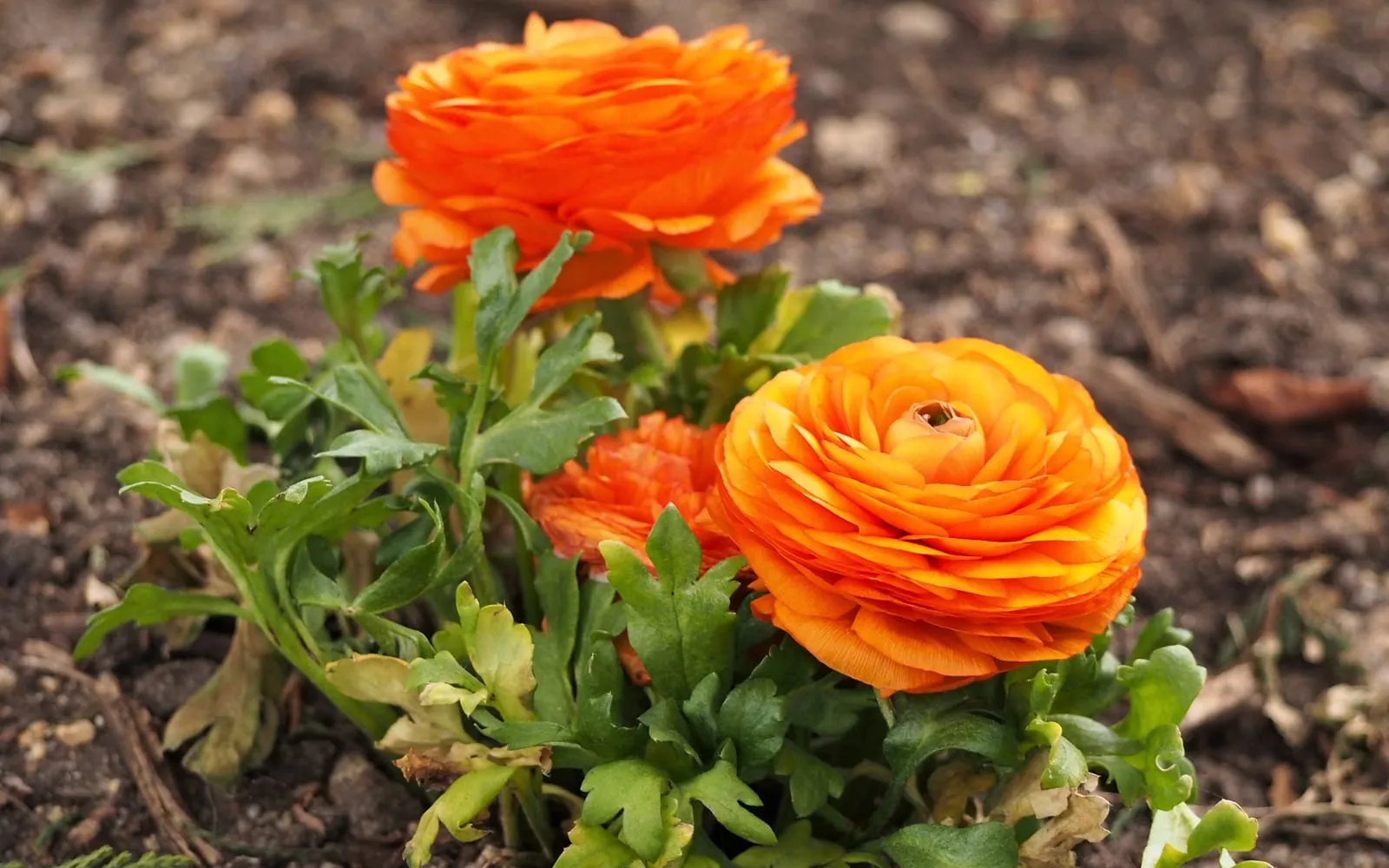
The flower is the reason the plant is grown: rounded, densely double, made up of dozens of thin, papery petals overlapping in tight concentric layers, in colours running through white, cream, yellow, orange, pink, red and deep burgundy, frequently with a darker centre. Unlike many showy cut flowers, it carries little to no fragrance, which is a point worth knowing before buying it expecting a scented arrangement.
The tuber is a small cluster of narrow, finger-like projections, each two to five centimetres long, joined at a single crown, giving the whole structure a claw-like shape that is the source of the standard planting advice: claws pointing down, crown pointing up.
Flowering lasts several weeks per plant if spent stems are cut regularly, and individual cut flowers hold in a vase for a week or more, which is a large part of why the flower has such a strong following among cut flower growers.
Where it is from
The eastern Mediterranean and the Middle East, native from Crete and Cyprus through Turkey, the Levant and Iran, growing wild in open grassland and rocky ground. The species name suggests a broader Asian range than it holds; the wild plant is concentrated in the eastern Mediterranean basin and adjoining western Asia instead of spread across the continent generally.
That native range gives it a Mediterranean-type climate pattern. Winters and springs are cool and wet, which is when the plant grows and flowers, and summer turns hot and dry while it survives as a dormant tuber underground. Growing it well outside that climate means recreating the cool growing season as closely as possible and protecting the tuber from both hard frost and summer wet, so it is treated as an annual in most of North America and northern Europe instead of left in the ground.
Ottoman gardeners were cultivating refined double-flowered forms by at least the sixteenth century, well before the plant reached wider European cultivation, and it arrived in Western Europe as one of a wave of Ottoman garden flowers that also included the tulip.
How it grows
A tuberous perennial in its native climate, grown as a spring-planted annual almost everywhere colder, since the small claw-shaped tubers rot readily in cold wet winter ground outside mild zones.
Soak the dry tubers in tepid water for two to four hours before planting, which rehydrates them and improves how quickly and reliably they sprout. A tuber planted dry, straight from the packet, often sits inert for weeks and is more prone to rotting before it establishes any roots at all.
Plant with the claws pointing downward and the rounded crown facing up, about 5 cm deep and 10 to 15 cm apart. This is the detail people get wrong most often, since a dry tuber gives few visual cues, and a tuber planted upside down either fails to sprout or emerges weak and delayed.
In a climate too cold for the tuber to survive winter outdoors, start it under cover in late winter for a spring display, or plant directly outside once the risk of hard frost has passed for flowers a little later in the season. Where winters are mild enough, plant in autumn for flowers from late winter through spring.
Cut flowers by pulling gently or cutting at the base, and regular cutting or deadheading extends the flowering period noticeably by preventing the plant from putting its energy into seed instead of further buds.
Through the seasons
Spring is the main flowering season across most climates, whether from tubers planted the previous autumn in a mild area or started under cover in late winter elsewhere.
Summer brings a decline once the weather turns hot, since the plant strongly prefers cool growing conditions and stops flowering well, or collapses entirely, once sustained heat and humidity arrive.
Autumn is either planting time, where winters are mild enough to grow the tuber as a perennial, or the point at which tubers are lifted from a summer bed, dried, and stored for replanting the following year in a colder climate.
Winter is dormancy for a tuber left in the ground in a mild zone, insulated by a dry mulch, or dry storage indoors at a cool, stable temperature for a lifted tuber awaiting spring.
Care difficulty
Moderate. The flower itself is not difficult to keep alive once growing strongly, but the tuber is prone to rot, and getting it started correctly, soaked, oriented the right way up, and planted in soil that drains freely, is where most failures happen.
Heat sensitivity is the other main limitation. In a climate with hot, humid summers, the plant stops performing regardless of care, and gardeners in warmer regions treat it as a cool-season annual for exactly this reason, planting in autumn or very early spring for flowers before the heat arrives instead of expecting a long summer display.
Watering
Water regularly through active growth to keep the soil consistently moist, since the fibrous roots that grow from the tuber sit relatively shallow and dry out quickly in warm weather.
Never let the soil become waterlogged at any point. The tuber is far more vulnerable to rot from standing water than most of the plants covered in this collection, and a single period of saturated soil, particularly while the tuber is newly planted and has few roots to draw on, is enough to kill it.
Reduce watering as the foliage begins to yellow and die back, and stop entirely once the plant has gone fully dormant, whether that dormancy happens in the ground over a mild winter or in storage after lifting.
Warning signs, diseases and pests
Tuber rot, showing as a soft, discoloured tuber that never sprouts or foliage that yellows and collapses shortly after emerging, follows waterlogged soil almost every time. There is no treatment once rot sets in; prevention through good drainage and careful watering is the only reliable defence.
Aphids cluster on the soft new growth and flower buds, weakening the plant and spoiling the appearance of buds close to opening. Wash them off with a strong jet of water or use an appropriate insecticidal soap for a persistent infestation.
Powdery mildew appears as a white dusty coating on the leaves in humid, still conditions with poor air circulation, particularly as the weather warms towards the end of the flowering season. Space plants generously and water at the base instead of overhead to reduce the risk.
Slugs and snails graze emerging shoots in wet spring weather, and can damage a planting badly enough to delay or reduce flowering if left unchecked in the plant’s first few weeks of growth.
Flowers that fail to open properly, staying tight and never unfurling into their full layered form, usually points to a spell of unusually hot weather during bud development, since the plant needs cool conditions to open its flowers fully.
Growing environment
Full sun suits it in a cool climate; where summers turn hot early, some relief from the most intense afternoon sun extends the flowering period before heat shuts the plant down.
Light, free-draining soil is essential. Add horticultural grit or coarse sand to heavier soil before planting, since standing water around the tuber is the greatest risk to the plant’s survival.
Cool growing conditions matter more than almost any other single factor. In climates with mild, wet winters and cool springs, plant in autumn for the strongest and longest display; in climates with cold winters, treat it as an annual planted in early spring, timed so flowering happens before summer heat arrives.
Space tubers 10 to 15 cm apart, giving each plant enough room for its rosette of leaves without crowding, which also improves air circulation and reduces the risk of mildew.
Feeding
Feed fortnightly through active growth with a balanced liquid feed, starting once the first true leaves appear and continuing until flowering finishes or the plant begins its natural decline in summer heat.
Reduce nitrogen once flower buds appear, switching towards a feed higher in potassium, which supports stronger flowering instead of encouraging soft leafy growth that flops and is more prone to disease.
Do not feed a dormant tuber, whether it is resting in the ground over a mild winter or sitting in dry storage awaiting replanting.
Troubleshooting
How do I plant the claw-shaped tuber the right way up? Claws pointing downward into the soil, with the rounded crown facing upward. Soak the tuber in tepid water for two to four hours first, which both improves sprouting and makes the orientation slightly easier to judge.
The tuber went soft and mushy after planting. Almost always rot from waterlogged soil. Improve drainage before replanting, and be sure not to water again until growth is clearly underway next time.
Flowers never fully open, staying tight and closed. Usually a spell of hot weather during bud formation. The plant needs cool conditions to open its flowers fully, so time planting for flowering before sustained heat arrives in most climates.
Can I leave the tubers in the ground over winter? Only reliably in zone 8 and warmer with free-draining soil. Elsewhere, lift and store the tubers somewhere cool and dry, or treat the plant as an annual and replant fresh each year.
It grew well but stopped flowering once summer arrived. That is expected. Persian buttercup strongly prefers cool weather and typically declines or goes dormant once sustained heat sets in, so it is usually grown as a spring instead of summer flower.
My skin reacted after handling the cut stems. Contact dermatitis from the sap, a known issue among florists who handle large volumes of stems. Wear gloves for regular cutting if this affects you.
Is it safe around pets? All parts contain the same irritant compound found in wild buttercups. Serious poisoning is uncommon since the bitter taste discourages most animals after one mouthful, but expect drooling and an upset stomach from a determined chewer.