
Outdoor plant
White Clover
Trifolium repens
Also known as Dutch Clover, Ladino Clover
How to grow white clover, Trifolium repens, a nitrogen-fixing lawn plant increasingly sown deliberately for a low-mow, pollinator-friendly alternative to grass.
At a glance
- Difficulty
- Easy
- Water
- Rarely once established; tolerates drought better than most turf grass
- Light
- Full sun to light shade
- Temperature
- Fully hardy, to below -20 deg C
- Hardiness
- USDA 3-10, RHS H7, hardy to -20 C
- Type
- Hardy, low-growing perennial
- Height
- 5-15 cm, spreading indefinitely
- Native to
- Europe, western Asia, north Africa
Few garden plants are naturalised across as wide a climate range as white clover, and the zone number understates just how little climate limits it. Its real constraints are competitive, not climatic: it thrives where grass is thin or has been mown short, and struggles where taller, denser vegetation shades it out.
Hardiness zones describe winter cold alone. Summer heat, humidity, rainfall and the length of the growing season decide as much, so treat the range as the outer limit rather than as a recommendation.
Not known to be toxic
- Safe to eat
- Leaves and flowers
The ASPCA lists white clover as non-toxic to dogs, cats and horses, unlike its relative alsike clover, which can cause skin and liver problems in horses and is a distinct species. White clover leaves and flowers are edible for people too, used in salads and teas and long foraged without concern in ordinary garden quantities. The one documented caution applies to livestock rather than to a garden or a pet: grazing animals eating large amounts of fresh, wet clover can develop bloat, a build-up of gas in the rumen, which is a farming management issue rather than a reason for caution in a domestic lawn.
Sources: ASPCA (Clover), ASPCA (Alsike Clover)
About
White clover has spent decades as a lawn plant gardeners actively removed, sold in weedkiller adverts as the broadleaf intruder standing between an owner and a uniform sheet of grass. That reputation has reversed. Clover is now sown deliberately, alone or mixed with grass seed, as a low-mow lawn that stays green through drought, needs no fertiliser, and feeds pollinators that a grass-only lawn offers nothing to.
The trait behind both the old removal and the new adoption is the same: white clover fixes its own nitrogen. Bacteria in nodules on its roots, Rhizobium leguminosarum, convert nitrogen from the air into a form the plant can use, which is why it thrives on poor soil where grass struggles and why an all-grass lawn treated with nitrogen fertiliser tends to push clover out in favour of the grass that fertiliser was bought to feed.
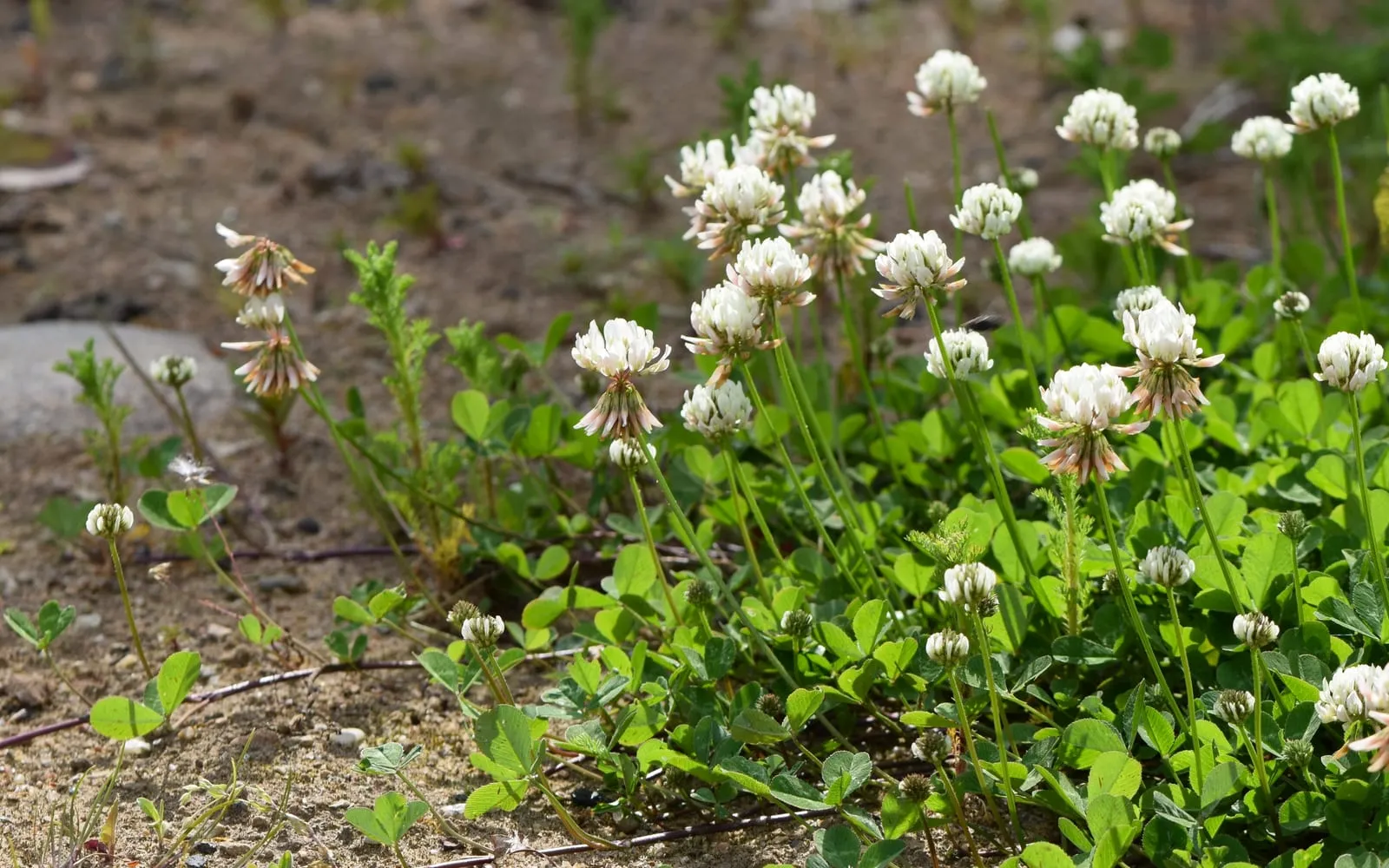
Round white flowerheads open through summer, worked constantly by bees, and the trifoliate leaf, three leaflets radiating from a single point, is familiar enough to be a cultural shorthand for luck long before anyone thought to sow it as a lawn on purpose.
Appearance and character
Leaves are compound, almost always divided into three oval leaflets, each often marked with a pale chevron near the base, held on stalks that radiate from a low, creeping stem. A four-leaflet leaf occurs as a rare genetic variant, traditionally at odds of roughly one in several thousand, which is the origin of the four-leaf clover as a luck symbol.
Flowerheads are white, sometimes faintly tinged pink, rounded, 1.5 to 2 cm across, made up of many small pea-family flowers packed together, appearing from late spring through to the first frosts in a mild autumn.
Stems run along the ground as stolons, rooting at nodes as they spread, rather than standing upright, which keeps the whole plant low even without mowing and is part of why it tolerates a mower blade better than most broad-leaved plants.
The leaves show a subtle daily movement, folding upward along their midrib at night and reopening by morning, a response to light called nyctinasty that is easy to miss unless specifically watched for.
Where it is from
Trifolium repens is native across Europe, western Asia and north Africa, and it has naturalised so widely elsewhere, through deliberate agricultural sowing as much as by accident, that it now grows on every inhabited continent.
Its long agricultural history predates its recent garden rehabilitation by centuries. Farmers have sown white clover into pasture for its nitrogen-fixing benefit to the soil and its value as livestock forage since well before the chemistry behind either was understood, and it remains a standard component of grazing and cover-crop mixes worldwide.
Its recent reappraisal as a lawn plant runs directly counter to mid-twentieth-century turf management, which bred clover out of grass seed mixes and targeted it with broadleaf herbicide as an unwanted weed. The current move back toward deliberately sown clover lawns, sometimes pure clover and sometimes a clover-grass blend, is explicitly a reaction against that period, valuing the same traits, low input needs and steady green cover, that once got it classed as a nuisance.
How it grows
Spread happens two ways at once: surface stolons root at their nodes and extend the existing plant outward, while seed sets from the summer flowerheads and can establish new plants some distance away, carried by mowing, foot traffic or simple gravity. This combination is why an established clover lawn tends to thicken and fill gaps on its own without needing reseeding.
Sow clover seed directly into prepared ground in spring or early autumn, either alone for a pure clover lawn or mixed at a modest rate, often around five to ten per cent by weight, into a grass seed blend for a lower-input mixed lawn. Germination is quick in warm soil, and a newly sown area fills in within a season under reasonable conditions.
An established patch spreads readily into adjoining thin turf on its own, which is the mechanism behind the old complaint about clover invading a lawn uninvited and the same mechanism now used deliberately to thicken a new clover planting from a modest initial sowing.
Through the seasons
Spring brings fresh growth and is the best sowing window, along with the strongest stolon extension of the year as the plant fills bare patches before summer flowering begins.
Summer is the main flowering period, from around June through August, when the round white flowerheads are at their most abundant and most valuable to foraging bees.
Autumn is a second good sowing window in a mild climate, and mowing can generally be reduced compared with a grass lawn, since clover holds a neat, low profile without regular cutting.
Winter sees growth slow considerably and the foliage stay low and green through all but the hardest frosts, holding colour through a season when an unfed grass lawn often looks tired and brown.
Care difficulty
Easy, and markedly less demanding than the conventional grass lawn it increasingly replaces or supplements. No regular fertiliser is needed, since the plant supplies its own nitrogen, and mowing can be less frequent because clover naturally stays lower than most turf grasses.
The one counter-intuitive rule is about feeding. Applying a nitrogen lawn fertiliser to encourage a thicker clover lawn does the opposite, favouring the grass sharing the space and suppressing the clover that does not need the nitrogen in the first place. Leave a clover or clover-grass lawn unfed if clover is the plant being encouraged.
Drought tolerance is a genuine strength. An established clover lawn stays visibly green through a dry summer that leaves neighbouring grass lawns brown and dormant.
Watering
Rarely necessary once established. White clover’s deeper, more extensive root system compared with shallow-rooted grass gives it noticeably better drought tolerance, and a mature clover lawn typically needs no supplementary watering through an ordinary temperate summer.
New sowings need watering to establish, kept consistently moist until germination and through the first few weeks of growth, after which watering can be reduced substantially.
In a genuine prolonged drought, an occasional deep soak keeps the lawn green rather than allowing it to go dormant, though clover tolerates drought dormancy and recovers from it well if watering is skipped entirely.
Warning signs, diseases and pests
Clover mites can build up in large numbers on foliage in spring and autumn, more of a nuisance where they wander into a house near foundations than a serious threat to the lawn itself.
Powdery mildew occasionally whitens leaves in humid, still conditions, generally cosmetic and self-limiting once drier weather returns.
Slugs and snails graze young seedlings, mattering most on a newly sown area before plants have toughened up.
Leaf spot can appear after prolonged wet weather, usually minor on an established lawn and not worth treating beyond removing badly affected patches if they are visually troublesome.
Growing environment
Full sun to light shade both suit it, with the densest growth and heaviest flowering in full sun. It tolerates more shade than most turf grasses without thinning as badly.
Soil tolerance is wide, including poor, compacted and infertile ground where grass alone struggles, since the plant’s nitrogen-fixing root nodules let it thrive on nutrient-poor soil that would leave grass pale and thin.
It is not particular about pH within the normal garden range and takes moderate foot traffic well, recovering from light wear faster than many turf grasses because of its low, creeping growth habit.
Feeding
None, and this is worth stating plainly because it runs against the instinct most gardeners bring from feeding a conventional lawn. Nitrogen fertiliser favours competing grass over the clover, which fixes its own nitrogen supply and needs no help from a bag.
If a mixed clover-grass lawn is wanted with grass as the dominant component, feeding nitrogen shifts the balance toward grass; if clover dominance is wanted, withholding fertiliser is the more effective lever than anything applied directly to the clover.
A struggling patch on poor soil more often needs better light or less competition from taller weeds than it needs feeding, since poor soil is close to the condition this plant is adapted to thrive in.
Troubleshooting
Clover has taken over parts of my grass lawn I did not sow it in. Likely spread from an existing patch by stolons and seed, encouraged by low soil fertility that favours clover over nitrogen-hungry grass. Fertilising with nitrogen will shift the balance back toward grass if that is the outcome wanted.
I sowed a clover lawn and grass is taking over instead. The reverse situation, usually caused by feeding nitrogen fertiliser, which favours grass at clover’s expense. Stop feeding, and the balance should shift back toward clover over a season or two.
Are the flowers safe for bees and are they safe to mow off? Both are fine. Bees work the flowers heavily, and mowing removes spent flowerheads without harming the plant, which regrows and reflowers readily through summer.
Can I eat it? Yes, leaves and flowers are edible in salads and teas in ordinary garden quantities, and it is non-toxic to dogs, cats and horses according to the ASPCA. Do not confuse it with alsike clover, Trifolium hybridum, a related but different species with a documented risk to horses.
Small red or brown specks are crawling on the foliage. Likely clover mites, more of a household nuisance near foundations than a threat to the lawn. They rarely need treatment on an established planting.
Is it true a four-leaf clover is rare? rare, a spontaneous genetic variant estimated at roughly one in several thousand leaves, which is the basis of its folk reputation for luck.
My clover lawn looks patchy in a shaded corner. More shade than the plant fully tolerates is the likely cause. It manages light shade reasonably well but thins in deeper, more consistent shade the way most sun-loving lawn plants do.