
Outdoor plant
Mistletoe
Viscum album
Also known as European mistletoe, Common mistletoe
How to grow mistletoe, Viscum album. Squeezing berries into apple bark in February, why bought sprigs never take, the trees it will accept and how toxic the berries are.
At a glance
- Difficulty
- Difficult
- Water
- None, since it draws water from the host tree
- Light
- Full sun, high in the canopy of an open-grown tree
- Temperature
- Fully hardy, to about -20 deg C
- Hardiness
- USDA 5-8, RHS H6, hardy to -20 C
- Type
- Evergreen perennial, semi-parasitic and very slow to establish
- Height
- Up to 1 m across, and larger on an old host
- Native to
- Europe and western Asia, and native to southern Britain
- Best month
- December in the Northern Hemisphere, June in the Southern Hemisphere
It needs a host tree rather than soil, and apple is much the best. The name lands on a different plant in North America, where mistletoe means Phoradendron, a related genus with a different toxin and a different pet-safety profile, so the ASPCA listing most people find refers to that one. European mistletoe was introduced to California around 1900 and has naturalised there.
Hardiness zones describe winter cold alone. Summer heat, humidity, rainfall and the length of the growing season decide as much, so treat the range as the outer limit rather than as a recommendation.
Every month named in this guide is for the temperate Northern Hemisphere. If you garden in the Southern Hemisphere, shift each one by six months, so December becomes June. Closer to the equator the wet and dry seasons matter more than the calendar, and the shift stops being a useful guide.
Toxic if eaten
- Do not eat
- The berries and the leaves
- Harm from
- Eating it
- Affects
- People, cats and dogs
Mistletoe is listed by the RHS as harmful if eaten and by the ASPCA as toxic to cats and dogs, and its reputation is somewhat worse than the evidence. The plant contains viscotoxins and lectins, and eating berries or leaves typically produces stomach pain, nausea, vomiting and diarrhoea. Reviews of large numbers of reported cases in which children swallowed a few berries have found serious effects to be uncommon, and most cases resolve with no treatment. That is a reason not to panic rather than a reason to be casual. Larger quantities, particularly of leaves, and teas or extracts made from the plant, have caused more significant illness including slowed heart rate and low blood pressure. In pets the usual presentation is drooling, vomiting and diarrhoea, and it is dose-related. The practical risk peaks at Christmas, when a bunch of berried mistletoe hangs in a doorway and drops berries onto the floor where a toddler or a dog finds them. Hang it out of reach, sweep up dropped berries, and get medical or veterinary advice if a quantity has been eaten. The American species, Phoradendron, is a different plant and is generally considered more toxic.
Sources: RHS potentially harmful garden plants, ASPCA toxic and non-toxic plants
About
Mistletoe is the only plant most people buy once a year and never think of growing.
It can be grown, and the method is simple enough to do in ten minutes. It is also slow, unreliable, and fails far more often than it succeeds, which is why so few people have it.
The plant is a hemiparasite. It photosynthesises with its own green leaves and takes water and minerals from a host tree through a modified root that penetrates the bark. It cannot live in soil and it cannot be rooted as a cutting.
That last point is the reason most attempts fail before they start. A sprig bought at a market in December cannot be made to grow. Only a fresh seed pressed into living bark will do, and the timing is February rather than Christmas.
In Britain it is concentrated in the south-west Midlands, particularly Herefordshire, Worcestershire, Gloucestershire and Somerset, where old apple orchards gave it several centuries of ideal habitat.
Appearance and character
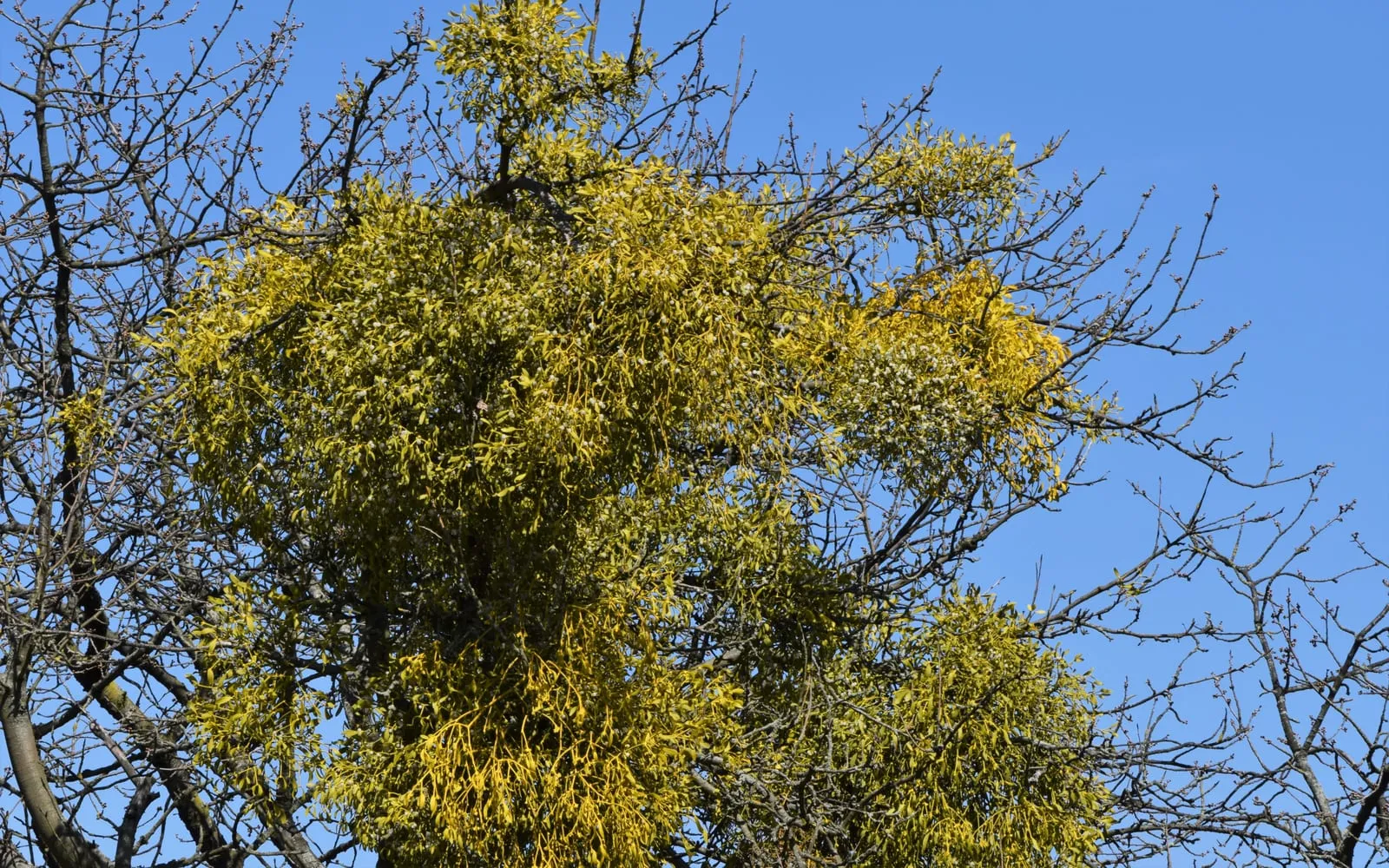
An evergreen perennial forming a dense hanging ball of stems on a host branch, reaching a metre or so across and occasionally much more.
Stems fork repeatedly and regularly, dividing in two at each joint, which gives the plant its distinctive symmetrical structure. Each fork represents one year of growth, so the branching can be counted to age it.
Leaves are held in opposite pairs at the stem tips, leathery, oval to strap-shaped, 5 to 8 cm long, and a dull yellowish-green.
Flowers are tiny, green and easily missed, opening in February and March. The plant is dioecious, so male and female flowers are on separate plants and only females carry berries.
Berries ripen from November through winter, white and translucent, about 6 to 10 mm across, each containing one seed in an extraordinarily sticky pulp called viscin.
That stickiness is the whole dispersal mechanism. A bird eating the fruit wipes the seed off its beak onto a branch, or passes it through and leaves it glued in place.
The whole plant is most visible in winter, when a bare host tree shows the green balls clearly from a distance.
Where it is from
Europe and western Asia, and native to southern Britain, with its stronghold in the counties along the Welsh border.
Its favourite hosts in Britain are cultivated apple by a long way, then lime, poplar, hawthorn, false acacia, willow and maple. Old traditional orchards suit it because the trees are open-grown, long-lived and rarely sprayed.
Oak is an exception worth mentioning because of its cultural weight. Mistletoe on oak was sacred to the druids according to Pliny, and it is rare, which is probably why it mattered.
The decline of traditional orchards through the twentieth century reduced British mistletoe considerably, and the interest in growing it has followed from that.
The kissing custom is English and comparatively recent, well documented from the eighteenth century, and originally involved removing one berry for each kiss until the sprig was bare.
How it grows
The method is straightforward and the patience required is not.
Use fresh berries from mistletoe growing on the same kind of tree you are planting onto. Mistletoe forms host races, and seed from an apple tree takes far better on apple than seed from a poplar will.
Wait until February. Berries need after-ripening over winter and seed sown in December mostly fails.
Choose a host branch 2 to 10 cm in diameter, on a healthy open-grown tree, high enough to get good light. Young smooth bark works better than old cracked bark.
Squash the berry and wipe the sticky seed directly onto the upper surface of the branch. Do not bury it, do not cut the bark, and do not cover it with anything airtight. The seed needs light to germinate.
Use plenty. Sow twenty or thirty seeds rather than two, because birds take many of them and most of the rest fail. A success rate around one in ten is normal.
Mark the branches so you can find them again, and tie a small piece of hessian loosely over some to test whether protecting them from birds helps.
Then wait. Germination shows as a small green shoot in spring, the first year produces almost nothing visible, the first pair of true leaves appears in year two, and a recognisable plant takes four or five years. Berries take five or six years and only appear if the plant is female, which you cannot know in advance.
Do not let it take over. A heavy infestation drains a tree, and old apple trees can be killed by it. Thin the balls out on a host that is carrying many.
Through the seasons
Winter is when the plant is most visible and when berries are ripe. It is also when the branch structure of the host is clear enough to choose a site.
Spring is the sowing month at the start of it, February, and germination follows in April and May.
Summer is slow, almost invisible growth. There is nothing to do.
Autumn ripens berries on established female plants from November.
Care difficulty
Difficult, and honestly so. This is one of the few plants where a first attempt very likely fails.
Nothing about the technique is hard. The difficulty is the low success rate, the long wait to find out, and the fact that you cannot correct a mistake for several years.
The plant needs no aftercare once established. It has no pests worth naming and no diseases, and it is fully hardy.
Managing it later is the other half of the job, since a successful colony eventually needs thinning to protect the host.
Watering
None. The plant takes water from its host through the haustorium, the modified root that grows into the branch.
This is also why a bought sprig cannot be kept alive. Cut mistletoe has no water supply and dries out over a few weeks whatever you stand it in.
To keep Christmas mistletoe fresh for longer, keep it cool, out of direct heat, and mist it occasionally.
Warning signs, diseases and pests
The plant is remarkably free of problems. The warnings are about the host and about people.
Birds take most sown seed. This is the commonest reason an attempt fails, and sowing in quantity is the answer.
A host tree carrying many mistletoe balls loses vigour, and old apple trees do die from heavy infestation. Signs are dieback in the crown and reduced fruiting. Thin the mistletoe by cutting balls out, which is easiest in winter.
Cutting a host branch that carries mistletoe removes that plant permanently, since it cannot regrow from the wood below.
For people, the berries are the practical issue and mostly at Christmas. Hang berried mistletoe out of reach of small children and dogs, and sweep up berries that drop.
Eating a few berries usually causes stomach upset rather than anything worse. Get medical advice if a child has eaten several, and a vet if a dog has.
Growing environment
Mistletoe needs a host tree rather than a position.
Apple is the best host in Britain by a wide margin, and old traditional orchard trees are ideal. Lime, hawthorn, poplar, false acacia and willow all work.
Choose a tree in the open with good light. Mistletoe in deep shade grows poorly.
Pick a branch you are happy to lose eventually, since the mistletoe will thicken it and the branch may need removing one day.
Do not sow onto a young or already stressed tree. A vigorous mature host handles the drain far better.
Growing it in a garden works well where there is an established apple tree. There is no way to grow it without one.
Feeding
None. Mistletoe takes what it needs from the host, and feeding the host tree normally is all that applies.
An over-infested host benefits from having some mistletoe removed rather than from being fed.
Troubleshooting
Can I root the sprig I bought at Christmas? No. Mistletoe cannot be grown from cuttings and it cannot live in soil. Only a fresh seed pressed onto living bark will grow.
When should I sow the seed? February. Berries need to after-ripen over winter, and December sowings mostly fail.
Which trees will it grow on? Apple is much the best in Britain, then lime, hawthorn, poplar, false acacia and willow. Use seed taken from mistletoe growing on the same kind of tree.
Nothing happened. That is the usual outcome. Birds eat much of the seed and most of the rest fails, so sow twenty or thirty and expect one or two. Give it until the following spring before deciding.
How long until I get berries? Four or five years for a recognisable plant and five or six for berries, and only if the plant is female, which cannot be known when you sow.
Will it kill my apple tree? A few balls will not. A heavy infestation drains the tree and can kill an old one, so thin them out in winter if the tree is carrying many.
My child ate a berry. Get medical advice. A few berries usually cause stomach upset rather than serious harm, though it is worth checking.
How do I keep a cut bunch fresh? Keep it cool and away from direct heat and mist it occasionally. It has no water supply and will dry out within a few weeks whatever you do.