
Outdoor plant
Hedge bindweed
Calystegia sepium
Also known as Bellbind, Larger bindweed, Granny-pop-out-of-bed
How to identify and control hedge bindweed, Calystegia sepium. Why digging makes it worse, the glyphosate cane trick, and telling it from field bindweed.
At a glance
- Difficulty
- Difficult
- Water
- Not applicable
- Light
- Full sun to partial shade
- Temperature
- Fully hardy, to about -35 deg C
- Hardiness
- USDA 3-9, RHS H7, hardy to -35 C
- Type
- Herbaceous perennial, spreading by deep brittle white rhizomes
- Height
- 3-5 m in a season
- Native to
- Europe, Asia and North America, and native throughout Britain
- Best month
- July in the Northern Hemisphere, January in the Southern Hemisphere
Nothing about the weather limits it. The rhizome runs to two metres down, regrows from a fragment a centimetre long, and survives drought, waterlogging and any winter a temperate garden produces. Its close relative field bindweed, Convolvulus arvensis, is the one with legal weight, listed as a noxious weed across most of the United States, most Australian states and New Zealand, so check which of the two you have before assuming there is no duty attached.
Hardiness zones describe winter cold alone. Summer heat, humidity, rainfall and the length of the growing season decide as much, so treat the range as the outer limit rather than as a recommendation.
Every month named in this guide is for the temperate Northern Hemisphere. If you garden in the Southern Hemisphere, shift each one by six months, so July becomes January. Closer to the equator the wet and dry seasons matter more than the calendar, and the shift stops being a useful guide.
Harmful if eaten
- Do not eat
- All parts, and the roots most of all
- Harm from
- Eating it
- Affects
- People, cats, dogs and horses
Bindweed contains tropane alkaloids and resin glycosides, with the roots carrying the highest concentration, and it has a long history as a purgative for exactly that reason. Eating any part causes abdominal pain, nausea and diarrhoea, which is unpleasant rather than dangerous in the quantities anybody would consume by accident. The RHS does not list Calystegia in its harmful plants list and the ASPCA does not list it either, so no specific hazard is recorded rather than one being ruled out. Livestock poisoning is documented for the related field bindweed, Convolvulus arvensis, where horses eating large amounts over time have developed colic and digestive problems, so bindweed cleared from a paddock boundary should not be thrown where a horse can reach it. The practical caution when controlling it is about the herbicide rather than the plant. Read and follow the label on any glyphosate product, keep children and pets off treated ground until it has dried, and never apply it where it can reach a pond or a watercourse.
Sources: RHS potentially harmful garden plants, ASPCA toxic and non-toxic plants
About
Bindweed is the hardest perennial weed to get out of a temperate garden because underground.
The white brittle rhizomes run horizontally through the soil and vertically down to two metres and more, well below anything a spade reaches. Every fragment left behind, down to a couple of centimetres, grows into a new plant. Digging a bed over chops the root system into hundreds of pieces and multiplies it.
Above ground it grows several metres in a season, twines anticlockwise around whatever it meets, and smothers shrubs, hedges and borders. The flowers are large white trumpets, 5 to 7 cm across, and they are handsome enough that people who do not have it in their garden sometimes admire it.
Two things work. Persistent removal of every scrap of top growth, week after week, over two or three seasons, starves the root system. Or a glyphosate treatment applied to actively growing foliage that has been trained onto a cane, so the chemical travels down into the rhizomes without touching anything else.
Anything less than that is temporary. Cutting it off at ground level once a month makes no lasting difference at all.
Appearance and character
A herbaceous perennial climber reaching 3 to 5 m in a season, dying back in winter and regrowing from the rhizomes.
Stems are slender, twining, and they wind anticlockwise around a support, which is the opposite direction from honeysuckle and hops.
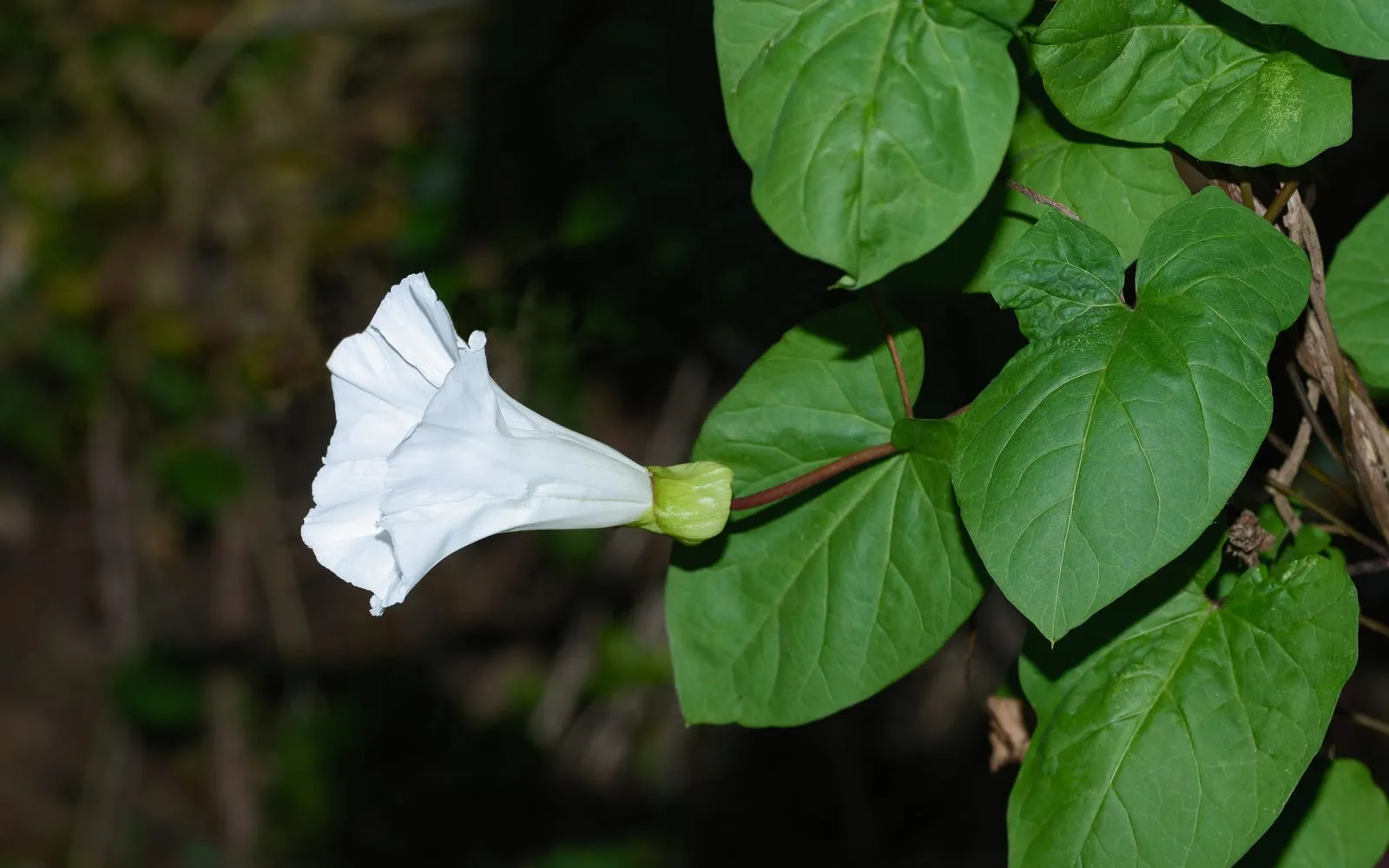
Leaves are arrow-shaped or shield-shaped, 5 to 10 cm long, with two pointed backward lobes at the base, bright mid-green, held alternately.
Flowers open from June to September, 5 to 7 cm across, pure white and occasionally pink-striped, a single unbroken trumpet with no separate petals.
Two large green bracts sit at the base of each flower and completely enclose the sepals, which is the feature that separates Calystegia from Convolvulus.
Rhizomes are white, brittle, round in section and up to 1 cm thick, running horizontally near the surface and vertically to great depth.
Field bindweed, Convolvulus arvensis, is the smaller relative with flowers 1.5 to 2.5 cm across in pink and white, narrower leaves and stems that scramble along the ground as much as climb. It is equally hard to control and needs the same approach.
Where it is from
Europe, Asia and North America, and native throughout Britain and Ireland.
It grows in hedgerows, on riverbanks, in ditches, on waste ground and in gardens, on any soil and particularly well on rich moist ground.
The plant is native and belongs in a hedgerow, where it is part of the flora and supports a range of insects, and the problem is entirely one of position.
Hawkmoths pollinate the flowers, which open before dawn and close by the afternoon, and the convolvulus hawkmoth is a migrant to Britain that feeds on it.
The rhizome system is what makes it formidable. It stores carbohydrate at depth, regrows from tiny fragments, and can lie dormant for a year or more if the top growth is removed.
Bindweed arrived in North America with European settlers and is a serious agricultural weed there.
The country name granny-pop-out-of-bed refers to a children’s game of squeezing the base of the flower so the corolla shoots out of its green bracts.
How it spreads
By rhizome, overwhelmingly. Seed plays a minor role and the root system does nearly all the work.
Horizontal rhizomes run just below the surface and send up shoots at intervals, so a single plant occupies several square metres within a couple of years.
Vertical roots reach two metres and more, below the reach of any cultivation.
Every fragment of rhizome regenerates. Rotavating an infested bed is the most effective way of multiplying it that exists.
It travels in imported topsoil, in manure, in compost that has had bindweed roots in it, and in the rootballs of plants bought or given from an infested garden. Check the rootball of anything coming into your garden.
It comes under fences and through hedges from neighbouring ground, which is why control is often a shared problem rather than an individual one.
Above ground the twining stems reach anything within a few metres and pull themselves up it.
Through the seasons
Winter it is dormant, with no top growth, and the rhizomes are at their lowest food reserve towards the end of the winter.
Spring shoots appear from April, growing fast, and this is when to start removing top growth.
Summer is the main growth and flowering period, from June to September, and the ideal window for a glyphosate treatment is late summer when the plant is moving sugars back down into the roots.
Autumn the top growth dies back, and the last chance for chemical treatment is while the leaves are still green and actively growing.
Control without chemicals
Remove every piece of top growth, every week, for two or three seasons. This is the method that works without herbicide and it works by starvation. Each time the plant pushes a shoot it spends reserves, and taking the shoot before it makes new leaves stops it replacing them.
Missing a fortnight in midsummer undoes a great deal of the progress.
Pull the stems rather than cutting them where you can, unwinding them from whatever they are climbing.
Do not dig an infested bed over. Every chopped fragment becomes a plant.
Dig carefully rather than not at all when clearing new ground, tracing and lifting whole rhizomes by hand, working slowly, and accepting that you will not get all of it.
Mulch with a light-excluding sheet for two full growing seasons where the ground can be taken out of use. Cardboard is not enough. Use heavy black polythene or a woven membrane, overlap the edges generously, and leave it down for at least eighteen months.
Bag and bin the rhizomes or burn them. Do not compost them and do not put them in a green waste bin unless your council composts at temperatures that kill them.
Grow ground cover once an area is clear, since bare soil lets any survivor re-establish unnoticed.
Talk to the neighbour if it is coming under the fence, because clearing one side alone is endless work.
Control with glyphosate
Glyphosate is systemic, moving from the leaves down into the root system, and it is the only chemical that reaches bindweed rhizomes at depth.
Use the cane method to treat bindweed growing among plants you want to keep. Push a bamboo cane into the ground beside the bindweed in early summer, untwine the bindweed stems from your plants and wind them up the cane instead, and let them grow up it undisturbed for a few weeks.
Once there is a good amount of leaf on the cane, treat it. Either lay the cane down on a sheet of plastic and spray it, or paint the leaves with gel, keeping the chemical off everything else.
Treat in late summer, from August into September, when the plant is moving sugars down into the roots and will carry the herbicide with them.
Expect to repeat it. A single treatment rarely clears an established stand, and two or three seasons is normal.
Read and follow the product label. Keep children and pets off treated ground until it is dry, and never let it reach a pond, a ditch or a watercourse.
Do not spray in windy weather, and do not spray onto foliage you want to keep, since glyphosate kills anything green it lands on.
Cut back and let it regrow before treating if the growth is old and tough, since young actively growing leaves take it up best.
Telling it apart
Hedge bindweed has flowers 5 to 7 cm across, pure white, with two large green bracts completely enclosing the base of the flower. Leaves are large and arrow-shaped and the stems climb strongly.
Field bindweed, Convolvulus arvensis, has flowers 1.5 to 2.5 cm across, usually pink with white stripes, with two tiny bracts set well below the flower rather than enclosing it. Leaves are narrower and the plant scrambles along the ground as much as it climbs. It is equally persistent and responds to the same treatment.
Sea bindweed, Calystegia soldanella, grows on dunes with kidney-shaped fleshy leaves and pink flowers. It is a protected coastal native and not a garden weed.
Black bindweed, Fallopia convolvulus, is an annual with insignificant greenish flowers and is easily pulled.
Morning glory, Ipomoea, is the annual garden climber with blue or purple flowers, and it dies at the first frost.
Living with it
Total eradication is achievable in a small garden with persistence and often unrealistic in a large one bordered by infested ground.
The reasonable target in that case is suppression. Keep it out of the beds you care about, keep it off shrubs and hedges, and accept a boundary strip where it exists.
Weekly removal in the growing season is the whole of it. A garden walked over once a week with bindweed pulled as it appears stays manageable, and one left for a month in July does not.
Keep new ground clean. Check every plant coming into the garden for rhizomes in the rootball, and be careful about imported topsoil and manure.
Its value in a hedgerow is real. The flowers feed hawkmoths and other night-flying insects, and where a wild boundary can be left alone it belongs there.
Troubleshooting
Why does digging make it worse? Every fragment of rhizome down to a couple of centimetres regrows into a new plant. Digging or rotavating an infested bed chops the root system into hundreds of pieces and multiplies it.
How deep do the roots go? Two metres and more, well below anything you can dig out. That is why removal by digging alone rarely succeeds.
What is the cane method? Push a bamboo cane in beside the bindweed, untwine it from your plants and wind it up the cane instead, let it grow for a few weeks, then treat the leaves on the cane with glyphosate. It gets the chemical into the roots without touching anything you want to keep.
When should I treat it? Late summer, from August into September, when the plant is moving sugars down into the roots and carries the herbicide with them.
Can I get rid of it without chemicals? Yes, by starvation. Remove every piece of top growth every week through the growing season for two or three years. Missing a fortnight in July undoes a lot of it.
Can I compost the roots? No. Bag and bin them or burn them. A domestic compost heap does not get hot enough to kill bindweed rhizomes.
It keeps coming under the fence from next door. Talk to the neighbour, because clearing one side alone is endless. Sinking a vertical barrier is impractical at the depth bindweed roots reach.
Is this hedge bindweed or field bindweed? Hedge bindweed has white trumpets 5 to 7 cm across with two large green bracts enclosing the flower base. Field bindweed has pink and white flowers under 2.5 cm with tiny bracts set below the flower.
Will a membrane kill it? Heavy black polythene or a woven membrane left down for at least eighteen months will, provided the edges are overlapped and no light gets in. Cardboard alone is not enough.