
Outdoor plant
Ground Morning-Glory
Convolvulus sabatius
Also known as Blue Rock Bindweed, Convolvulus mauritanicus
How to grow ground morning-glory, Convolvulus sabatius, a tender Mediterranean trailer with blue funnel flowers for a hot dry bank or a hanging container.
At a glance
- Difficulty
- Moderate
- Water
- Moderate; allow the surface to dry between waterings
- Light
- Full sun
- Temperature
- Tender; damaged below about -5 deg C, killed by a hard frost
- Hardiness
- USDA 8-11, RHS H3, hardy to -5 C
- Type
- Tender evergreen subshrub, grown as a perennial or an annual depending on climate
- Height
- 15-20 cm tall, trailing to 50 cm
- Native to
- North Africa, Italy
This is the one plant in the group that a zone number protects a gardener from disappointment over. It survives outdoors year-round only in a mild, largely frost-free climate; everywhere colder it is grown as a summer bedding and container plant, lifted or replaced each year, or overwintered under glass.
Hardiness zones describe winter cold alone. Summer heat, humidity, rainfall and the length of the growing season decide as much, so treat the range as the outer limit rather than as a recommendation.
Harmful if eaten
- Do not eat
- Seeds
- Harm from
- Eating it
- Affects
- People
Convolvulus sabatius has no toxicity listing from the RHS or the ASPCA and no record of poisoning from the foliage or flowers in ordinary garden contact. The seeds are the exception worth knowing about. Several plants in the bindweed family, Convolvulaceae, including some Convolvulus and Ipomoea species, produce seeds containing ergoline alkaloids capable of causing illness if eaten in quantity, and general caution against eating the seeds of this genus is standard advice even though no specific poisoning case involving Convolvulus sabatius seed is documented. Treat the seed as off-limits and the rest of the plant as low risk.
Sources: RHS (Convolvulus sabatius), RHS potentially harmful garden plants
About
Ground morning-glory carries a family name with a bad reputation it does not deserve. Field bindweed and hedge bindweed, both Convolvulaceae relatives, spread by deep, brittle, near-indestructible roots and are among the most persistent weeds a gardener will fight. This species shares the funnel-shaped flower and the family name and almost none of the behaviour: it does not root as it trails, it builds no invasive root system, and a plant that dies over a hard winter leaves nothing behind to regrow from.
What it does share with its weedy relatives is the flower shape and the daily rhythm behind it. Each sky-blue, funnel-shaped bloom opens fresh in the morning and lasts a single day, closing by evening never to reopen, with the plant replacing yesterday’s spent flowers with new ones for weeks on end through summer.
It is a plant for heat and poor soil rather than for a typical border, suited to a hot dry bank, gravel garden or hanging container where its trailing habit and long flowering season earn a place that its lack of hardiness would otherwise rule out in most of Britain.
Appearance and character
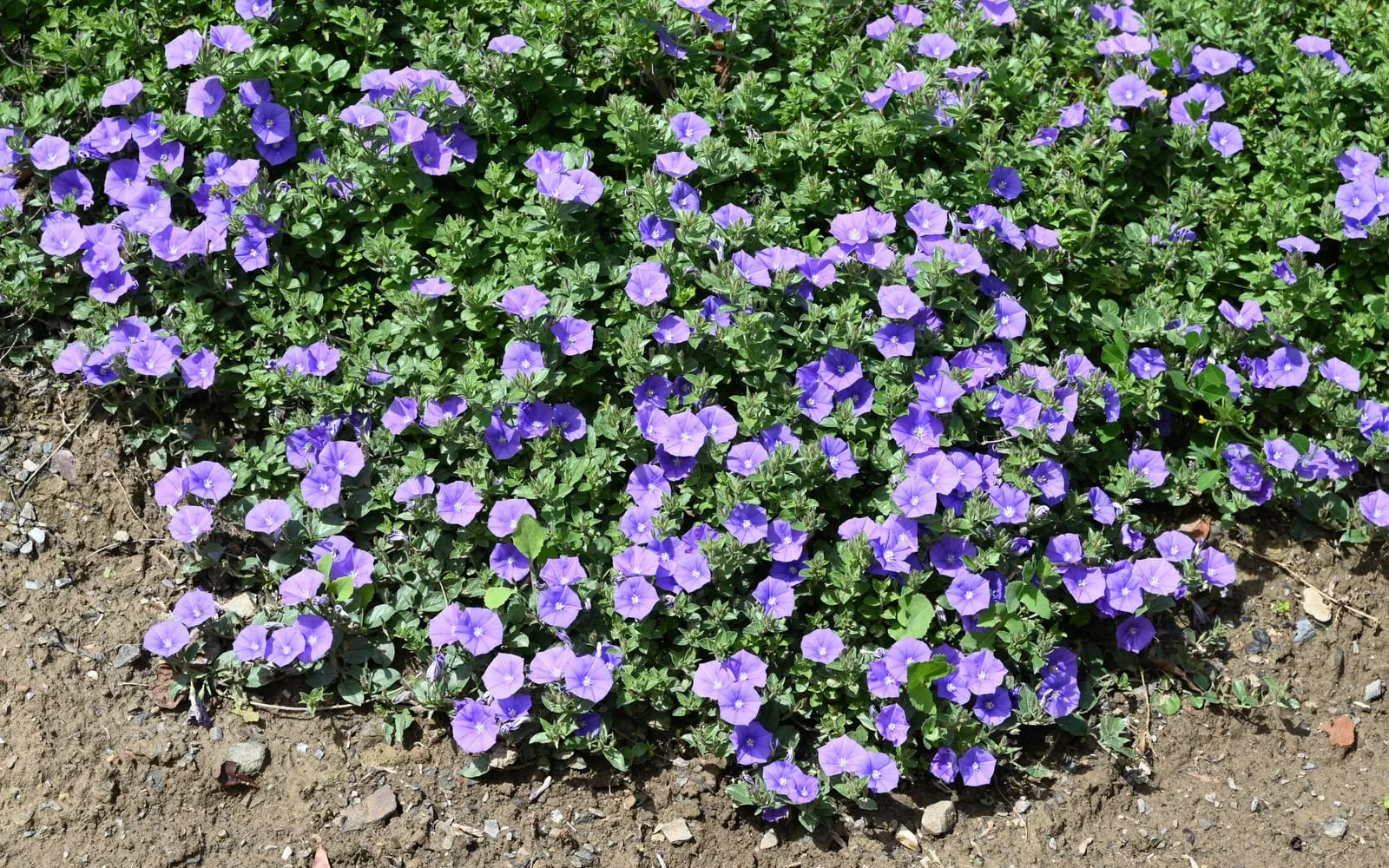
Stems are slender, trailing rather than climbing or twining, forming a loose, low mound in open ground or cascading attractively over the edge of a raised bed, wall or container. Unlike several other groundcover species, the stems do not root where they touch soil, so the plant stays roughly the size it was planted rather than spreading outward indefinitely.
Leaves are narrow, greyish-green, softly hairy, 2 to 4 cm long, held alternately along the stems and giving the whole plant a slightly silvery cast that suits its preference for hot, dry, sun-baked positions.
Flowers are funnel-shaped, 3 to 4 cm across, a clear sky blue with a white and yellow throat, opening in full sun and closing in shade, overcast weather or evening, each individual bloom lasting only a single day. A well-grown plant produces flowers continuously from early summer into autumn, so the display reads as constant even though no individual flower persists.
The plant carries the RHS Award of Garden Merit, reflecting reliable performance in the container and bedding role it is most often grown for.
Where it is from
Convolvulus sabatius is native to a narrow range spanning the Ligurian coast of Italy and parts of North Africa, including Morocco, growing on dry, rocky, sun-exposed slopes near the sea where the soil is thin and free-draining and summers are long, hot and largely rainless.
That narrow Mediterranean range explains both its qualities and its limits in a British garden. Full sun, sharp drainage and a tolerance for drought all come directly from a native habitat with none of Britain’s reliable summer rain, and the same origin explains why frost, rather than any pest or disease, is the main threat to it here.
It was long sold and grown under the synonym Convolvulus mauritanicus, and both names still appear in nurseries and reference books, referring to the same plant.
How it grows
Growth is compact and non-invasive by the standards of this group. A young plant fills out into a mound or trailing cascade within a single season, and because the stems do not root as they spread, the ultimate size stays close to what the position and container allow rather than extending indefinitely the way a rooting groundcover does.
Propagate from softwood cuttings taken in late spring or early summer, which root readily in a free-draining compost, or from seed sown under glass in early spring for flowering plants by summer. Division is not a practical method, since the plant does not form the spreading rhizome or stolon network that makes division easy on several other species in this group.
In a climate too cold for it to survive outdoors year-round, treat it as either a summer bedding plant discarded at the end of the season, or take cuttings in late summer to overwinter young plants under glass, avoiding the risk of losing an established specimen to the first hard frost.
Through the seasons
Spring is for planting out once the risk of frost has passed, or for taking cuttings and sowing seed under glass while the parent plants, if kept over winter, are just starting into growth.
Summer is the main flowering season, continuous from around June into September, with each individual flower lasting a single day and the plant producing a steady daily supply of new ones.
Autumn brings a decision point in a cold climate: take cuttings to overwinter under glass, or accept that the display will end with the first frost and treat the season’s planting as finished.
Winter kills the plant outright wherever frost reaches it, unless it is in a mild, largely frost-free garden or has been brought under glass, where it continues growing slowly through the darker months.
Care difficulty
Moderate, and the difficulty is entirely about climate rather than about the plant’s day-to-day needs, which are modest. Where the climate suits it, in a mild coastal or Mediterranean-type garden, it needs very little beyond sun and sharp drainage.
Where frost is a yearly certainty, the plant demands a decision every autumn: treat it as an annual and replace it, or commit to taking cuttings and keeping young plants under glass through winter, which adds a task most of the other plants in this group do not require at all.
Overwatering and rich soil cause more trouble than underwatering does. This is a plant that thrives on relative neglect in the right conditions and struggles when treated like a typical thirsty container annual.
Watering
Water moderately, letting the surface of the soil or compost dry out between waterings rather than keeping it constantly moist, which suits its drought-adapted Mediterranean origin.
Container plants need more frequent watering through hot summer weather than plants in open, well-drained ground, since a pot dries out faster, though the same rule against waterlogging still applies. Standing water in a saucer under a pot is a reliable way to lose this plant to root rot.
In open ground on well-drained soil, an established plant tolerates real drought once its root system is in, needing supplementary water only in an extended dry spell.
Warning signs, diseases and pests
Aphids can cluster on soft new growth tips, particularly on a plant fed too generously, and are usually manageable with a strong jet of water or by encouraging predatory insects rather than needing a spray.
Powdery mildew occasionally appears in humid, still conditions, more likely late in the season as nights cool, and is generally cosmetic rather than seriously damaging on a plant that will not survive winter outdoors regardless.
Vine weevil grubs can attack roots in containers, where the confined compost gives them an easy target, showing as sudden collapse of an otherwise healthy-looking plant.
Root rot follows overwatering or poor drainage more often than any disease specific to the plant. Outside of frost, it is the most common way a gardener loses this species.
Growing environment
Full sun is essential, and this plant performs poorly in anything less, flowering sparsely and growing leggy in shade compared with the compact, floriferous habit it shows in full sun.
Soil should be sharply drained above all else, poor to moderately fertile, and on the dry side. Rich, moisture-retentive soil produces soft, lush growth more prone to rot and less free-flowering than growth on lean, gritty ground.
A hot dry bank, the top of a wall, a gravel garden or a hanging basket or container with a free-draining compost all suit its needs closely, and a damp, shaded border is the position most likely to disappoint.
Feeding
Container plants benefit from a balanced liquid feed every two to four weeks through summer, since compost in a pot is exhausted within a season and the plant’s long continuous flowering draws on nutrients steadily.
In open ground on reasonably fertile soil, feeding is largely unnecessary, and on poor soil a light feed once or twice through summer is enough rather than a regular schedule.
Avoid heavy or nitrogen-rich feeding, which produces lush foliage at the expense of flowers and softens growth in a way that reduces its tolerance of both drought and the cool damp conditions that arrive with autumn.
Troubleshooting
It died over winter even though I brought the pot indoors. Likely too cold, too wet, or both. This plant needs a frost-free spot over winter and drier compost than it takes in summer, since cool, damp conditions rot it as reliably as frost kills it.
It is not flowering much. Insufficient sun is the most common cause. This plant needs full sun to flower well, and even light shade for part of the day noticeably reduces the display.
The flowers close up during the day. Normal behaviour in shade, overcast weather or cooler temperatures. Each flower opens fully only in direct sun and closes in response to reduced light, reopening the following morning if conditions improve, though each individual bloom lasts only a single day regardless.
Is it the same plant as bindweed? Related but very different in behaviour. Both are in the Convolvulaceae family and share the funnel flower shape, but this species does not spread by invasive roots the way field or hedge bindweed does, and it dies rather than regrows after a hard frost.
Can I grow it outdoors year-round without frost protection? Only where winters stay reliably frost-free, such as a mild coastal or Mediterranean-type climate. Anywhere winter brings a hard frost, treat it as a summer plant, replaced annually or overwintered under glass from cuttings.
The leaves have gone soft and the plant has collapsed suddenly. Likely root rot from overwatering or poor drainage, particularly in a container that has sat in a wet saucer. There is usually no recovering an affected plant; take cuttings from any remaining healthy growth if possible.
How do I keep it going from year to year in a cold climate? Take softwood cuttings in late summer, root them under glass, and overwinter the young plants somewhere frost-free and on the dry side, rather than trying to keep the original, larger plant alive outdoors.