
Houseplant
California Fan Palm
Washingtonia filifera
Also known as Desert Fan Palm, Washingtonia filifera
How to grow Washingtonia filifera, the California fan palm, a desert-tough palm with large thread-fringed fans and a petticoat of dead fronds.
At a glance
- Difficulty
- Easy
- Water
- When the top of the mix dries; drought-tolerant once established
- Light
- Full sun to bright light
- Temperature
- Warm to cool; tolerates light frost, keep well drained
- Humidity
- Low to average
- Hardiness
- USDA 8-11, RHS H4, hardy to -8 C
- Type
- Evergreen single-stemmed fan palm
- Height
- Up to 15 m outdoors; a young plant indoors
- Native to
- Southwestern United States, Mexico
A large desert fan palm from the oases and canyons of the southwestern United States and northern Mexico, where it grows near water in otherwise arid country. It needs full sun and free-draining soil, tolerates light frost to about minus 8 deg C when established, and takes both heat and drought. It grows faster than most fan palms and rots only in cold, waterlogged ground.
Hardiness zones describe winter cold alone. Summer heat, humidity, rainfall and the length of the growing season decide as much, so treat the range as the outer limit rather than as a recommendation.
Not known to be toxic
- Safe to eat
- The ripe fruit, traditionally eaten
This is a safe plant to keep around pets and children. The California fan palm is not listed as toxic by the ASPCA or the RHS, and no harmful compound is recorded in it. Its small fruits were an important food for Indigenous peoples of its range. A pet or child is not at risk of poisoning from it. The caution is physical: the leaf stalks are edged with hooked teeth, so handle the fronds with care.
Sources: ASPCA toxic and non-toxic plants, RHS potentially harmful garden plants
About
Washingtonia filifera is a large palm of desert oases, with a thick grey column topped by a broad head of grey-green blades. The species name filifera, thread-bearing, points to its clearest feature: long white fibres that peel from the edges of the leaf segments and hang between them like loose stitching, heaviest on younger leaves. As the fans age and die they fold down flat against the trunk instead of dropping, and the piled thatch forms the shaggy brown “petticoat” that gives the palm its other common name.
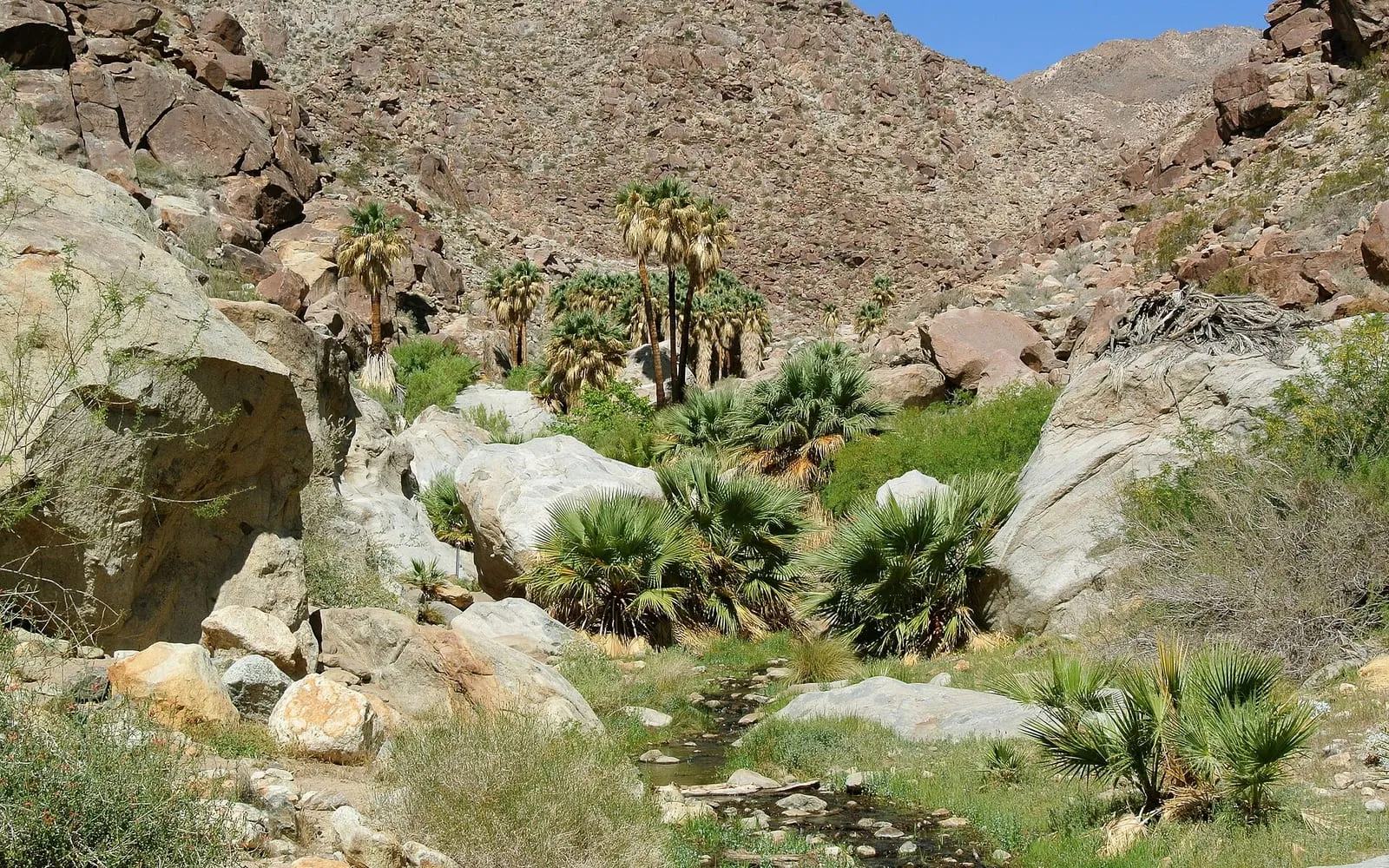
It grows where water surfaces in otherwise bone-dry country, at desert springs, canyon seeps and streamsides across the American southwest and into Baja California. That pairing of fierce heat and a reliable supply of root moisture explains its habits. Given water within reach it grows fast, and once its roots run deep it withstands long dry spells. Among fan palms it is one of the quicker to build a trunk, so an indoor plant is a bold short-term specimen that will outgrow a room within a few years.
Give it sun and drainage and it needs little else. A young plant makes a broad, architectural fountain of thread-fringed fans, and an outdoor specimen in a warm climate becomes a tall tree, producing arching sprays of cream flowers followed by small blue-black fruit. Those fruit fed the Indigenous peoples of its range, dried and ground or eaten fresh from the tree.
Appearance and character
The fans are large and grey-green, split into many stiff radiating segments, and their trademark is the mass of white curling threads that fray from the segment edges and drape between them. Young, vigorous leaves carry the most, and the fibres thin as a leaf ages.
Dead fronds do not fall. They collapse against the stem and hang there as a dense brown skirt, sometimes cloaking the trunk from crown to ground, unless a grower cuts them off to expose the smooth grey column beneath.
The trunk is stout and thickens quickly for a palm, and all height comes from a single growing point at its summit, so the plant can be neither topped nor branched, and cutting that point out kills it. Seed is the only means of increase, and it sprouts readily.
Flowering and fruiting belong to large outdoor plants, which send out long branched sprays of cream bloom followed by pea-sized dark fruit; a potted specimen almost never reaches that stage.
Where it is from
Washingtonia filifera is native to the desert springs, palm canyons and seep-fed washes of southern California, western Arizona and neighbouring Baja California, where groundwater reaches the surface in otherwise arid ground. The palm stands in blazing sun with its roots in reach of permanent moisture, and it endures both searing summer heat and the occasional light winter frost.
For care, give it full sun and soil that drains well. It takes drought once settled, grows faster with water at the root, and tolerates cold to about minus 8 deg C when established. Cold, waterlogged roots and a stuffy, airless position cause the most trouble.
How it grows
For a palm it grows quickly through the warm months, unfurling several large fans a year, then rests over winter. Heat and strong sun produce the fastest growth, poor light slows it, and cold, sodden soil rots it. Planted in the ground in a suitable climate, it can become a tall tree in a few years.
Grow a young plant in a sandy or gritty free-draining compost in a deep pot, watering once the surface dries and keeping it moister in summer than in winter. It tolerates drought once its roots are down, though a steady summer water supply gives faster growth, as it would have near an oasis.
Stand it in the strongest sun available. Outdoors in a mild-winter region it takes a light frost once established. Leave the crown bud alone, and cut away dead fronds and the petticoat as taste determines, minding the toothed stalks as you work.
Through the seasons
Spring Warmth returns and growth increases, making this the moment to move a crowded plant into a bigger pot and to begin the feeding year.
Summer Fast growth runs now. Water freely as the surface dries, feed each month, and stand it in unshaded sun to keep it growing strongly.
Autumn The plant slows. Pull back on feed and water as the light fades.
Winter is a resting spell. An established plant takes a light frost if its roots stay unwaterlogged, so keep it bright, dryish and away from cold wet soil.
Care difficulty
Easy and vigorous, provided the plant gets full sun and sharp drainage. It handles heat, drought and, once settled, a light frost, and needs little beyond light and roots that do not stay wet. Its main drawbacks are its speed and eventual bulk, which soon overwhelm a pot or a small garden, along with a dislike of cold, sodden ground. The hooked teeth on its leaf stalks call for gloves at pruning time.
Watering
Water once the top of the compost has dried, keeping a summer plant reliably moist because it grows faster with water within reach, as it would at a desert spring. It tolerates drought when it must, but it is not a dry-baking cactus and grows poorly if kept parched through active growth.
Cut right back over winter, when cold, saturated compost encourages rot. Where the tap water is hard, its lime and fluoride collect at the leaf tips and brown them, so rainwater or filtered water helps prevent tip burn.
Warning signs, diseases and pests
Cold, waterlogged compost rots the roots and is the most common way a potted plant is lost, shown by a crown or base that softens and slumps. Sharpen the drainage, keep it drier through winter, and return it to full sun.
Indoors in warm dry air, red spider mite mottles and webs the fans; raise the humidity a little, wipe the blades and treat at the first sign. Brown leaf tips more often mean hard water or dry air than any pathogen.
Never cut the single growing point, whose loss is fatal, and handle the fronds with respect for the hooked teeth running along each stalk.
Growing environment
Full sun gives the strongest, fastest growth, and anything less leaves the plant weaker and slower, so choose a bright, open position first. It needs all the direct light a site can offer.
Because an established plant takes a light frost and thrives on heat and drought, it will live outdoors in a warm, mild-winter climate or under glass in a hot, airy conservatory. It dislikes damp, unventilated rooms and cold, wet soil.
Set a young plant in a sandy or gritty free-draining compost in a deep pot in full sun, allow for the size it will reach, and place it where its toothed fans cannot catch anyone passing.
Feeding
Through the warm months a monthly liquid feed supports the fast growth, using a palm formula or a general balanced product at a weak dilution. Rich feeding produces soft, floppy leaves, so keep the strength down.
Stop feeding as autumn cools and give none in winter. A newly potted plant lives off fresh compost for its first months.
Troubleshooting
The crown or base has softened. Root rot from cold, waterlogged compost. Open up the drainage, hold it drier through winter, and return it to full sun.
The leaf tips are browning. Hard water or dry air. Switch to rainwater or filtered water, and cut away only the dead brown tissue.
Should I strip off the skirt of dead fronds? You may. The brown petticoat of collapsed old leaves can come off for a tidier trunk or stay in place; mind the toothed stalks either way.
Will it outgrow my space? In time, yes, since it makes a tall tree and grows faster than most fan palms. Indoors it gives you a few good years before it needs an outdoor home in a warm climate.
Is it safe around pets? Chemically yes, as nothing toxic is recorded in it and its fruit was a human food. The one caution is the hooked teeth along the leaf stalks.
California Fan Palm problem guides
Not sure what is wrong? See the common houseplant pests guide.