
Houseplant
Vampire Orchid
Dracula vampira
Also known as Dracula vampira
How to grow Dracula vampira, the vampire orchid, with dark, long-tailed flowers on downward spikes and a need for cold cloud-forest conditions.
At a glance
- Difficulty
- Difficult
- Water
- Keep evenly moist to wet at all times with pure water
- Light
- Low, shaded light
- Temperature
- Cold to cool; dislikes warmth
- Humidity
- Very high
- Hardiness
- USDA 10-11, RHS H1c, hardy to 8 C
- Type
- Evergreen epiphytic orchid
- Height
- 20 to 40 cm; flowers hang below
- Native to
- Ecuador
A cool cloud-forest orchid from the misty mountains of Ecuador, growing in deep shade in constantly cold, wet, humid air. It needs cold to cool temperatures, very high humidity, constant moisture and pure, low-mineral water, with low, shaded light. It cannot take warmth, dry air or hard water, and is best above about 8 deg C. Heat is a bigger risk than cool conditions.
Hardiness zones describe winter cold alone. Summer heat, humidity, rainfall and the length of the growing season decide as much, so treat the range as the outer limit rather than as a recommendation.
Not known to be toxic
A safe plant to keep around pets and children. Orchids, including Dracula, are not listed as toxic by the ASPCA or the RHS, and are not known to contain harmful compounds. A pet or child that chewed a leaf may get an upset stomach, but poisoning is not expected. The name vampira refers to its dark flowers, not to any danger, and its difficulty lies in its cold, humid needs.
Sources: ASPCA toxic and non-toxic plants, RHS potentially harmful garden plants
About
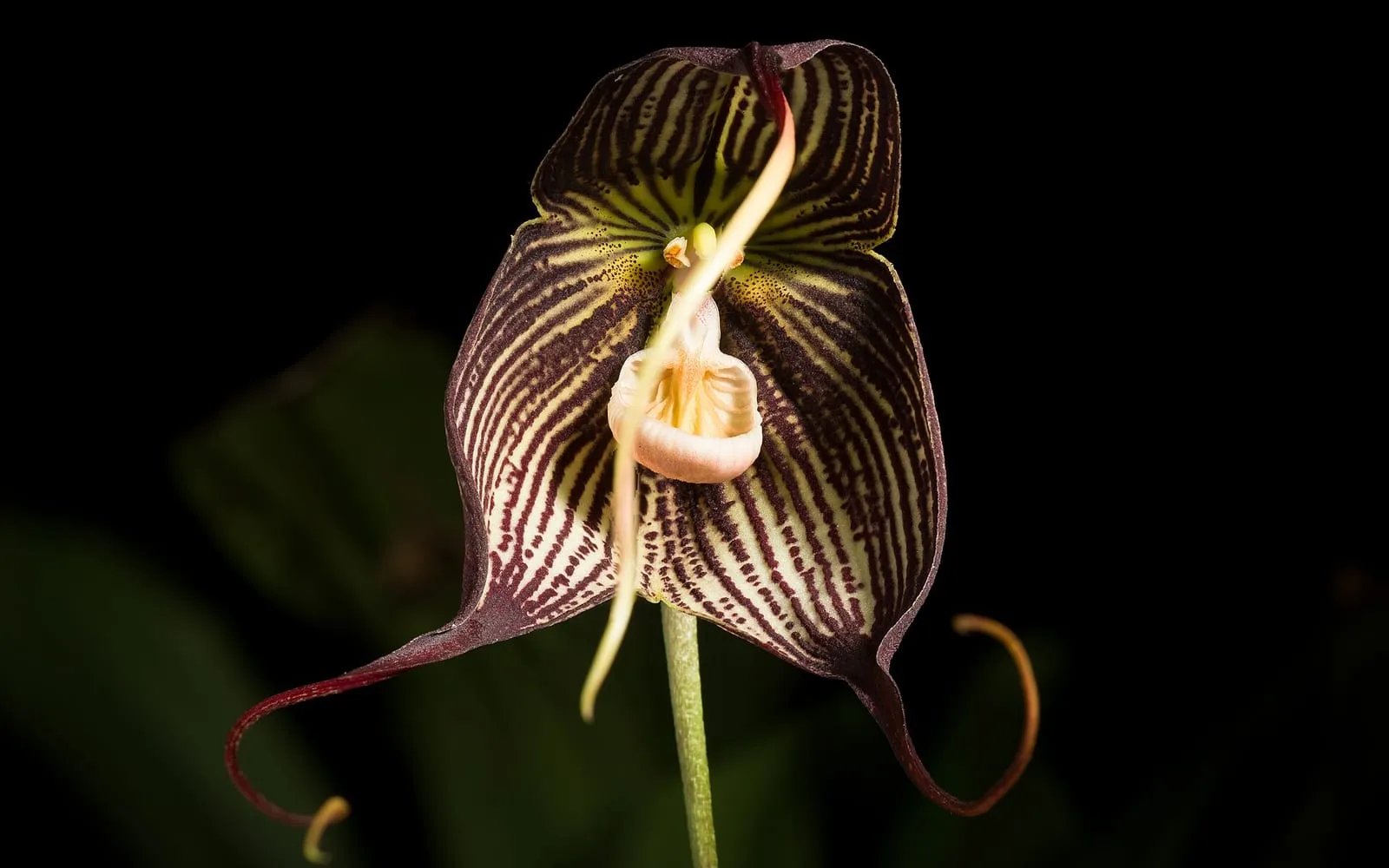
Dracula orchid is grown for its dark, long-tailed flowers. Its large blooms are smoky grey-white, heavily veined and washed with deep maroon to near-black, with three long, slender tails. The name, from the Latin for little dragon, and the species name vampira, both refer to that dark look.
It comes from the misty cloud forests of a single mountain in Ecuador, growing in deep shade in constantly cold, wet, humid air. It needs cold to cool temperatures, very high humidity, constant moisture and pure, low-mineral water, in low, shaded light. Warmth, dry air and hard water can kill it, and heat is a bigger problem than cool conditions.
Its flower spikes grow downward, often through the bottom of the pot, so growers use an open net or slatted basket that lets the blooms hang below. It is a specialist’s orchid for a cold, very humid, shaded case or greenhouse, not a windowsill plant, but for the grower who can give it cold, wet, misty conditions it is one of the most striking orchids to grow.
Appearance and character
The flowers are large, smoky grey-white, and veined and washed with deep maroon to near-black. Each bloom has three long, slender tails.
The flower spikes grow downward, often through the base of the pot, so the plant is grown in an open net or slatted basket that lets the blooms hang below where they can be seen.
The leaves are soft and tufted, without pseudobulbs, so the plant has little water store and cannot tolerate drying out.
It is an evergreen orchid for cool, deep shade, with constant moisture and very high humidity instead of any dry rest.
Where it is from
Dracula vampira grows in the cloud forest of a single mountain in Ecuador, in deep shade in constantly cold, wet, misty, humid air. It is adapted to cool, shaded, humid conditions, not warmth or bright light.
Give it cold to cool temperatures, very high humidity, constant moisture, pure low-mineral water and low, shaded light. It cannot take warmth, dry air or hard water, and heat is a bigger risk than cool conditions.
How it grows
It grows more or less year round in cold, wet, shaded conditions, without pseudobulbs to store water and without a dry rest, so it depends on constant moisture and humidity. Warmth or dry air can make the plant collapse quickly.
Grow it in an open, bark-based mix in a net or slatted basket, or mounted, so the downward flower spikes can emerge, and keep it evenly moist to wet at all times with pure rainwater. It must never dry out, nor sit warm and stagnant.
Give it low, shaded light, cold to cool temperatures, and very high humidity with gentle air movement, in a cold, humid case or greenhouse. Keep it above about 8 deg C, but keep it cool.
Propagation is by careful division of a large plant, keeping several growths to a piece.
Through the seasons
Spring and summer are the risky warm seasons. Keep it as cold as you can, very humid, shaded and constantly moist, with good air movement, and guard against heat above all.
Autumn and winter are easier because conditions are cooler. Keep it cold to cool, very humid and evenly moist to wet with pure water, above about 8 deg C.
The plant grows and can flower at any season given cold, wet, humid conditions, without a marked rest.
Care difficulty
Difficult, and a specialist’s plant. It needs cold to cool temperatures, very high humidity, constant moisture, pure water and deep shade. It cannot take warmth, dry air or hard water, and its downward flower spikes need an open basket. Heat is its worst enemy. Given a cold, very humid, shaded case or greenhouse and a rainwater supply, it can be grown and flowered, but it is not a windowsill orchid.
Watering
Keep the plant evenly moist to wet at all times, using pure, low-mineral rainwater, since it has no pseudobulbs and no dry rest and cannot tolerate drying out. The open basket and mix must drain freely so it never sits stagnant.
Never let it dry out, even briefly, nor sit warm and stagnant, both of which it cannot survive. It needs pure water, since the salts and lime in tap water harm it, and it needs that constant moisture the year round.
Warning signs, diseases and pests
Warmth is the most common cause of collapse, with leaf loss, rot and fungal spotting. Keep it as cold as you can, very humid and airy.
Warm, stagnant conditions rot the roots, and warm, still, humid air causes fungal spotting on the leaves; keep it cold, airy and evenly moist. Dry air or a dry root run can make it collapse quickly, so never let it dry out.
Hard water causes decline through salt build-up, so use pure rainwater only.
Growing environment
Low, shaded light suits it, matching the deep shade of its cloud forest. Bright light and direct sun scorch and overheat it, so it needs a shaded case or a shaded corner of a cool greenhouse.
Cold to cool temperatures and very high humidity are essential, with gentle air movement. It is safest above about 8 deg C, but warmth is more dangerous than cool conditions.
Grow it in an open, bark-based mix in a net or slatted basket, or mounted, in a cold, very humid, shaded, airy case or greenhouse, watered with pure rainwater.
Feeding
Feed very sparingly in growth with a very dilute, low-salt orchid feed, since it is sensitive to salts. Too much feed, or hard water, harms it.
Flush regularly with pure rainwater to keep salts from building up, and feed little, since cold, wet, humid conditions are far more important than feeding.
Troubleshooting
It collapsed and dropped leaves. The usual causes are warmth or dry air. Keep it as cold as you can, very humid, shaded and constantly moist.
The flower spike has grown down through the pot. That is normal. Its spikes grow downward, so it must be grown in an open net or slatted basket that lets the blooms hang below.
The leaves are spotting. Fungal spotting from warm, still, humid air. Keep it cold and airy with gentle air movement, and evenly moist instead of stagnant.
Can I use tap water? No. It needs pure, low-mineral rainwater, since the salts and lime in tap water cause decline.
Is it safe around pets? Yes. Orchids, including Dracula, are not listed as toxic, so it is safe with cats and dogs; the name refers to its dark flowers, not to any danger.
Vampire Orchid problem guides
Not sure what is wrong? See the common houseplant pests guide.