
Houseplant
Masdevallia
Masdevallia coccinea
Also known as Kite Orchid, Scarlet Masdevallia
How to grow Masdevallia, Masdevallia coccinea, including its triangular waxy flowers, cool Andean cloud-forest origins, and the lack of any pseudobulb to store water.
At a glance
- Difficulty
- Difficult
- Water
- Keep the mix constantly moist year round, never allowing it to dry out
- Light
- Bright, shaded light, never direct sun
- Temperature
- 10-20 deg C, with cool nights essential
- Humidity
- 70-85 percent
- Hardiness
- USDA 9-10, RHS H1c, hardy to 7 C
- Type
- Evergreen epiphytic and lithophytic perennial orchid, no pseudobulbs
- Height
- 20-35 cm
- Native to
- Colombia, Peru, Bolivia
Native to Andean cloud forest at 2,500 to 3,500 metres, where altitude keeps daytime temperatures mild and nights consistently cool even close to the equator. A zone number built for sea-level frost risk cannot capture that; the species has no tolerance at all for warm nights, and a room that never cools below about 20 deg C after dark is a bigger threat to it than any figure on a hardiness scale.
Hardiness zones describe winter cold alone. Summer heat, humidity, rainfall and the length of the growing season decide as much, so treat the range as the outer limit rather than as a recommendation.
Not known to be toxic
Masdevallia has no toxicity listing from the RHS or the ASPCA, and orchids of this kind carry an unusually clean safety record among houseplants generally. No part of the plant is documented as harmful to cats, dogs or people if chewed. As with most orchids sourced from cloud forest habitat, buy only nursery-propagated plants, since wild collection has damaged populations of several related species.
Source: ASPCA
About
Masdevallia coccinea flowers without the storage organs many orchids rely on. It has no pseudobulb, no swollen stem and no reserve organ to see it through a dry week, only a single leathery leaf rising straight from a creeping rhizome. Its leaves hold the plant’s limited water reserve, which is the reason this species tolerates drying out far worse than almost any other orchid commonly grown indoors.
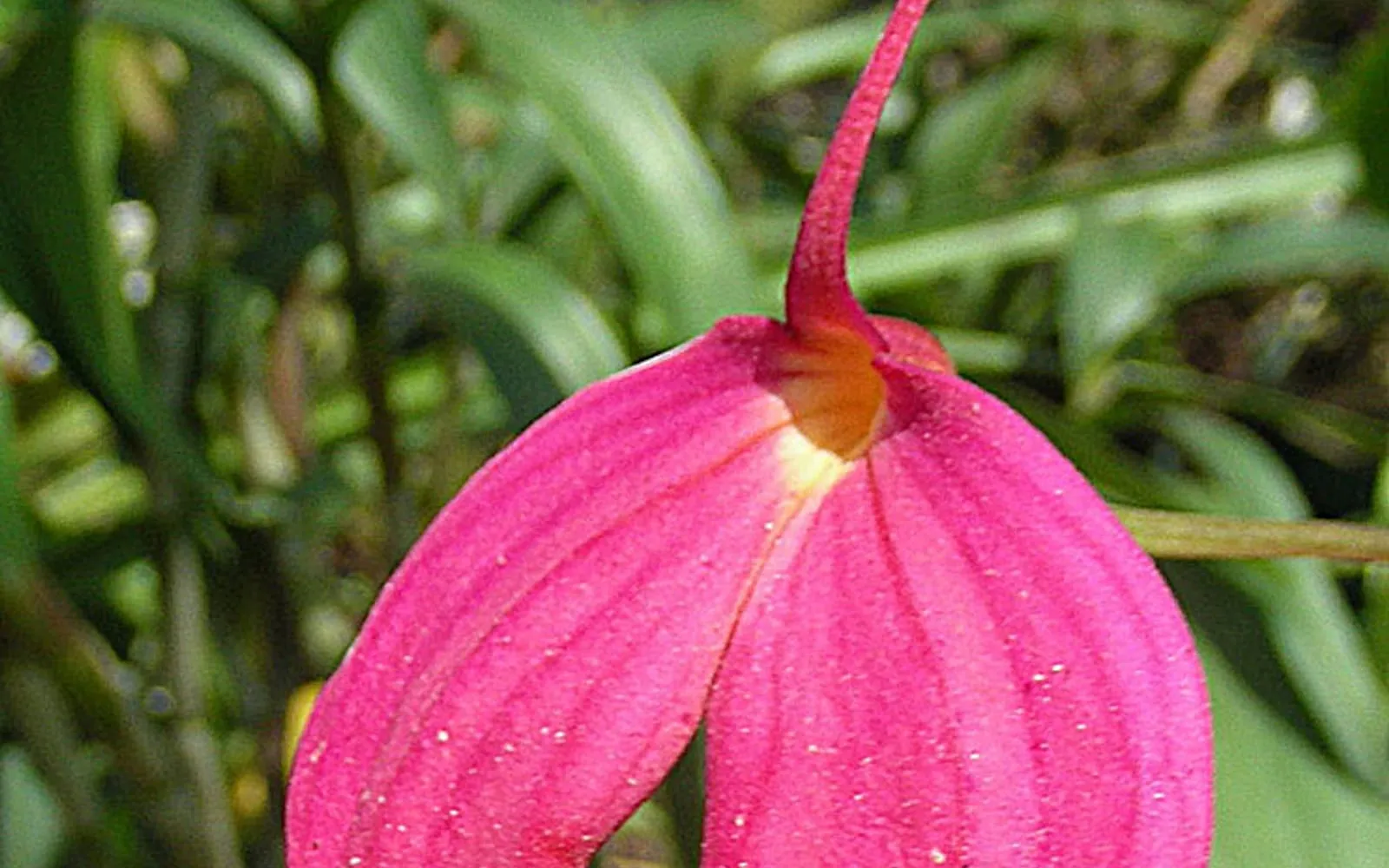
The flowers are large for such a small plant. Three broad, waxy sepals fuse at the base into a triangular, kite-shaped bloom, often 6 cm or more across, in shades running from scarlet through orange to a deep rose-purple depending on the individual plant, held well clear of the foliage on a slender upright stem. Few orchids produce a flower this striking from a plant carrying no pseudobulb at all.
The genus is named for Jose Masdevall, physician and botanist at the court of King Charles III of Spain in the late eighteenth century, and it was formally described in 1794.
Appearance and character
Growth is a dense clump of narrow, upright, leathery leaves, each one rising directly from a short creeping rhizome instead of from a bulbous storage structure. New leaves emerge continuously from the growing tips of the rhizome, gradually thickening the clump over several seasons rather than adding discrete new growths the way a pseudobulb-forming orchid does.
Each flower stem carries a single bloom, its three sepals fused near the base into a distinctive triangular shape with a slender, tail-like point extending from each corner. The colour in this species runs strongly toward scarlet and orange, brighter and warmer than many of its cooler- toned relatives in the same genus, and the waxy texture gives the flower a strong gloss in good light.
Where it is from
This species grows in the cloud forest of the northern Andes, spanning Colombia, Ecuador, Peru and Bolivia, typically between 2,500 and 3,500 metres above sea level. At that altitude, air stays cool and consistently saturated with moisture even close to the equator, and cloud cover keeps direct sun from reaching plants growing on mossy branches and rock faces in the understorey.
Night temperatures at that elevation regularly drop into the low teens or lower, whatever the calendar month, because altitude instead of season drives the cooling. That regular drop in night temperature, repeated through the entire year instead of confined to one season, is the condition a Masdevallia grower has to reproduce. It is the hardest part of keeping this species well outside a naturally cool climate.
How it grows
Pot it in a fine-graded bark mix, sometimes blended with sphagnum, chosen for its ability to hold moisture instead of to dry out quickly the way a Cattleya-style chunky bark mix is meant to. Because there is no pseudobulb behind each leaf, a Masdevallia has almost no buffer against a mix that dries out, and even a short lapse shows up as shrivelled, limp foliage within days.
Warm daytime temperatures are tolerated reasonably well provided nights cool down; it is a warm night, not a warm day, that causes the most damage, typically showing as poor flowering and a general decline over several months instead of sudden collapse. Growers without a naturally cool spot often rely on a fan, an unheated room, or active cooling to hold night temperatures down through summer.
Repot only when necessary, since the fine roots resent disturbance, and handle the clump gently when it is done, keeping the rhizome intact rather than dividing it more than needed.
Through the seasons
Spring brings new leaf growth from the rhizome tips. Keep the mix constantly moist as growth picks up, and watch for the first flower stems of the year.
Summer is the season where cool nights matter most and are hardest to provide without help. Use shade, ventilation or active cooling to keep night temperatures down, since a hot summer night does more harm here than almost anything else in this guide.
Autumn growth continues at a similar pace to summer, with no distinct dry rest built into this species’ cycle. Maintain even moisture and watch for flower stems as temperatures begin to ease.
Winter flowering often peaks in this cooler part of the year for plants grown indoors, where room temperatures more naturally match the species’ cool-night preference. Keep the mix from drying out even while growth slows.
Care difficulty
Difficult. This species is not suited to an average heated home unless a properly cool spot, such as an unheated room or a shaded, well- ventilated position, is available through the warmer months. With no pseudobulb to fall back on, both a missed watering and a warm night show up as damage far faster than with almost any other commonly grown orchid.
Watering
Keep the mix constantly moist, watering lightly and frequently instead of soaking heavily and then leaving a gap. Because the plant has no water reserve beyond its leaves, a fully dry mix for even a day or two can cause visible wilting that takes weeks to reverse, if it reverses at all.
Water quality matters more here than for most orchids. Rainwater or filtered water, instead of mineral-heavy tap water, suits the fine roots better and reduces the salt build-up that a constantly damp mix is otherwise prone to.
Warning signs, diseases and pests
Aphids target soft, developing flower buds, distorting or aborting them before they open; check buds regularly through spring and summer, since early treatment prevents most of the damage. Spider mites can appear despite this species’ preference for humidity, particularly if a spell of warm, dry air interrupts otherwise good conditions.
Fungus gnats breed readily in a mix that stays constantly moist, and while the adults are mostly a nuisance, their larvae can damage fine young roots in large numbers; a layer of coarse grit or sand on the mix surface discourages egg-laying. Slugs and snails are drawn to the same damp conditions and can strip soft new leaf growth overnight if a plant is kept outdoors or on an exposed patio.
Limp, shrivelled leaves usually mean this species has dried out, and they should prompt an immediate increase in watering instead of a wait-and-see approach, since there is no pseudobulb buffering the plant against the shortfall. Soft, translucent leaf tissue points the other way, to rot from a mix kept too wet without enough air movement; improve ventilation and trim away any affected tissue with a clean blade.
Growing environment
Bright, shaded light suits this species, closer to what a shaded woodland floor receives than to a sunny windowsill; direct sun scorches the leaves within hours. A north-facing window or a spot well back from brighter light usually works.
Cool nights, ideally below 18 deg C, are the main requirement, and a plant kept warm around the clock is unlikely to thrive for long even with everything else right. High humidity, in the 70 to 85 percent range, matches the cloud forest conditions it comes from and is best supported with a humidifier or a densely planted, humid growing area instead of a single pebble tray.
Feeding
Feed at every watering through active growth, but always at a weak dilution, around quarter strength of a balanced orchid fertiliser. The fine roots of this species are easily damaged by a build-up of fertiliser salts, and a constantly moist mix concentrates that risk compared with a mix allowed to dry between waterings.
Flush the mix with plain water every few weeks to clear any accumulated salts, and continue feeding at a reduced rate through winter instead of stopping outright, since this species has no strong dormant period.
Troubleshooting
The leaves look limp and slightly shrivelled. Almost always drying out. Water immediately and check that the mix is not being allowed to approach dryness between waterings, since this species has no pseudobulb reserve to draw on.
The plant grows well but rarely flowers. Usually a night temperature that is too warm. Check that the growing area cools noticeably after dark, ideally below 18 deg C, since a consistently warm night is the most common reason flowering fails on an otherwise healthy plant.
A flower bud turned brown and dropped before opening. Often aphid damage or a sudden swing in temperature or humidity while the bud was developing. Check closely for aphids on any remaining buds, and try to keep the plant in a stable position once buds appear.
Small flies are hovering around the pot. Fungus gnats, drawn to the constantly moist mix this species needs. A layer of coarse grit on the surface discourages egg-laying, and the adults themselves do little direct harm to a healthy plant.
Can this orchid be grown on a normal warm windowsill? Not reliably. Without a properly cool spot for the plant, particularly through summer nights, expect poor flowering and a gradual decline over time even if the leaves look healthy for a while.
The leaf tissue has gone soft and slightly translucent. Rot, usually from a mix kept wet without enough air movement around the roots. Improve ventilation, trim away any affected tissue with a clean blade, and ease back on watering slightly while new growth establishes.
Masdevallia problem guides
Not sure what is wrong? See the common houseplant pests guide.