
Outdoor plant
Tape Grass
Vallisneria americana
Also known as Wild celery, Water celery
How to grow tape grass, Vallisneria americana, a ribbon-leaved oxygenator whose male flowers detach and float up to pollinate the female.
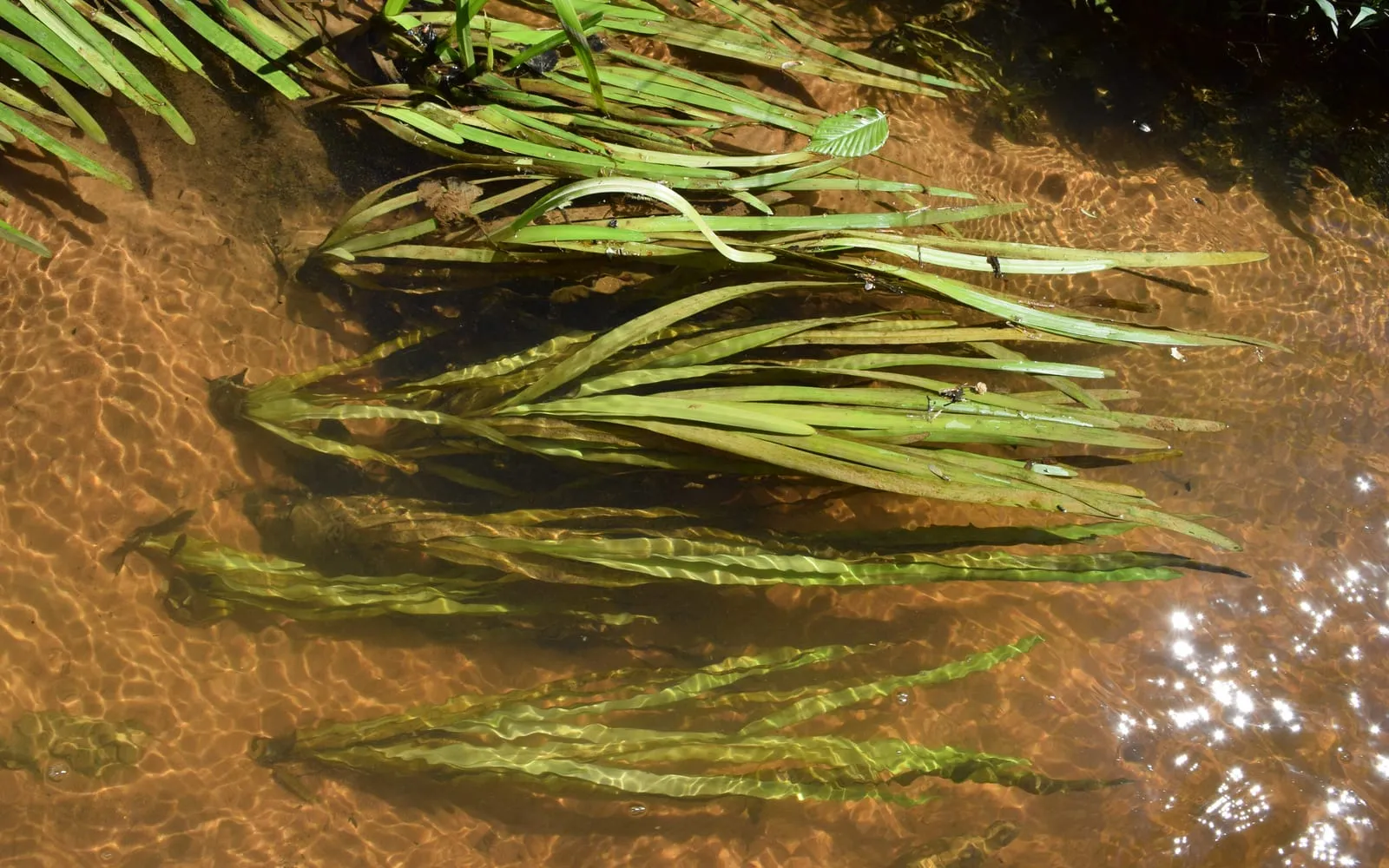
At a glance
- Difficulty
- Moderate
- Water
- Fully submerged, rooted in the substrate
- Light
- Full sun to moderate shade
- Hardiness
- USDA 4-10, RHS H5, hardy to -15 C
- Type
- Hardy submerged perennial
- Height
- Leaves 30 cm-1.5 m depending on water depth
- Native to
- North America, Central America
Winter-hardy over most of its range because it survives cold as a dormant tuber below the mud instead of as standing leaf growth, in the same way a bulb outlasts frost that would kill its foliage. Reliable outdoor survival still depends on planting deep enough that the tubers sit below any depth the pond freezes to; a shallow pond in a cold climate can lose a shallow-rooted planting even within its stated zone range.
Hardiness zones describe winter cold alone. Summer heat, humidity, rainfall and the length of the growing season decide as much, so treat the range as the outer limit rather than as a recommendation.
Not known to be toxic
Tape grass has no toxicity listing from the RHS or the ASPCA, and it is among the most widely fed submerged plants in the reptile and aquarium trade specifically because it is safe to eat. Waterfowl, muskrats, grass carp and pet turtles all graze it readily with no ill effect, giving it a strong practical safety record as an aquatic plant.
Source: RHS
About
Tape grass grows entirely underwater as long, ribbon-like leaves rising from a rooted crown, forming dense underwater meadows that sway with the current. It is a familiar plant to freshwater aquarium keepers, but also makes a hardy addition to an outdoor pond deep enough to protect its roots through winter, where its meadow-forming habit gives fish cover and open water a softened, naturalistic look from below the surface.
The plant has an unusual pollination mechanism for a garden pond. The species is dioecious, meaning individual plants are either male or female, and male flowers physically detach from the parent plant, float to the surface and drift until they encounter a female flower waiting in a small dimple in the water’s surface tension, where fertilisation takes place in open air instead of underwater.
Appearance and character
Leaves are long, flat and ribbon-like, typically 1 to 2cm wide and capable of reaching well over a metre in deep water, arranged in a loose rosette around a short central crown. They are supple instead of rigid, bending readily with water movement instead of standing stiffly the way many marginal grasses do, which is part of what gives a stand of tape grass its underwater movement.
Female flowers are borne on long, coiling stalks that extend to the surface, small and easy to overlook individually. Male flowers form in much greater numbers in a submerged cluster and, once mature, detach and rise as tiny air-bubble-filled rafts that float freely until pollination occurs, after which the fertilised female flower’s stalk coils back down, drawing the developing seed capsule underwater to mature.
Where it is from
Tape grass grows across a wide range of North and Central America, in lakes, slow rivers and sheltered coastal estuaries with fresh to slightly brackish water. It tolerates a broad range of water clarity and substrate type, from fine sand to soft organic mud, which is part of why it has remained a common native plant across such a wide geographic range rather than being confined to a narrow habitat type.
Populations at the northern end of its range experience cold winters and survive them as dormant tubers, while more southerly populations in warmer water can behave almost as an evergreen perennial with little seasonal die-back at all, a range of behaviour that reflects how broad the species’ native climate is.
How it grows
A rooted crown sends out horizontal runners that establish new plantlets at intervals, similar in principle to how a strawberry spreads above ground but carried out entirely underwater, gradually building a dense meadow from a single original planting. Established colonies also store energy in small tubers formed at the base of the plant towards the end of the growing season, the reserve that carries the plant through winter dormancy and fuels vigorous new growth the following spring.
The floating-flower pollination mechanism described above, formally called epihydrophily, is unusual even among aquatic plants, most of which either pollinate entirely underwater or send flowers above the surface on a fixed stalk instead of releasing them to drift freely. It works reliably enough in a garden pond that a mixed planting of male and female plants will set seed most seasons, though most garden colonies spread by runners long before seed becomes an important part of their increase.
Through the seasons
Spring dormant tubers sprout as the water warms, typically from March or April, rebuilding the leaf rosette ahead of summer growth.
Summer is the main growing season, with runners extending steadily and flowering, where both sexes are present, occurring through the warmest months.
Autumn growth slows and the plant puts energy into forming new tubers at the base instead of into further leaf growth, and foliage begins to die back.
Winter the leaves largely disappear, and the plant survives as energy-rich tubers resting in the substrate, protected from freezing by sufficient planting depth.
Care difficulty
Moderate. Establishment can be slow and a newly planted crown sometimes takes a full season to settle in before producing strong runners, which can look like failure to a gardener expecting the rapid spread of a plant like hornwort. Once established, an outdoor colony in water of adequate depth needs little further attention, though achieving that depth, and choosing a spot with enough light reaching the substrate, matters more for this species than for most other submerged plants on this list.
Watering
Plant rooted directly into mud, sand or fine aquatic gravel at a depth of roughly 30cm to 1.5m, deep enough in a cold climate that the tubers forming each autumn sit below any level the pond is likely to freeze to. Clear, reasonably clean water that lets enough light reach the substrate matters more here than for many other submerged plants, since dense algae or heavy silt can shade out young plantings before they establish.
Warning signs, diseases and pests
Snails graze the leaves occasionally without causing serious harm to an established stand. Where herbivorous fish such as grass carp, or aquatic turtles, share the pond, grazing pressure can be heavy enough to strip a young planting faster than it can regrow, and new colonies often need protecting behind mesh until they are well established if either is present in numbers.
Leaves that turn brown and translucent from the tip inward, without any visible pest, most often indicate too little light reaching the plant, commonly from murky water, heavy algae, or planting too deep for the available clarity, not disease.
Growing environment
Full sun to moderate shade both work, though strong, clear light reaching the substrate produces noticeably denser, healthier growth than a shaded or turbid pond. Still to gently flowing water suits it well, mirroring the lakes and slow rivers it grows in naturally, and it tolerates a wide range of substrate types provided roots can establish and tubers can form without being disturbed.
Depth is the detail most likely to decide whether an outdoor planting succeeds in a cold climate, since a colony rooted too shallowly can have its tubers killed by a hard freeze even in a location that otherwise sits within the species’ stated hardiness range.
Feeding
An aquatic fertiliser tablet worked into the substrate at planting supports strong root and runner development in the first season, and a further tablet during the growing season benefits a colony still building up its coverage. Well-established stands in a nutrient-rich pond often need little additional feeding once they have filled their allotted space.
Troubleshooting
A new planting seems to be doing nothing after several weeks. Slow to establish is normal for this species. Give it a full growing season before judging whether it has failed, provided the leaves are not visibly dying back.
Leaves are turning brown and translucent from the tip. Usually too little light reaching the plant, often from murky water or planting too deep for the available clarity. Improve water clarity or move the planting to a shallower, brighter spot.
Fish or turtles are stripping the leaves faster than they regrow. Expected where herbivorous species share the pond in numbers. Protect a young colony behind mesh until it is established enough to withstand regular grazing.
Little tiny green rafts are floating on the surface in summer. These are the detached male flowers on their way to pollinate female flowers elsewhere on the surface, a normal and harmless part of the plant’s life cycle instead of any kind of debris or algae.
The colony died back hard over a cold winter and has not returned. Check the planting depth. Tubers rooted too shallowly can be killed by a freeze that would not otherwise threaten the species, and replanting deeper usually solves the problem going forward.
Growth has stalled in a pond that otherwise looks healthy. Check whether enough light is reaching the substrate. Dense floating cover from other plants, or persistent algae, can starve tape grass of the light it needs even when water quality is otherwise fine.