
Outdoor plant
Himalayan balsam
Impatiens glandulifera
Also known as Indian balsam, Policeman's helmet, Kiss-me-on-the-mountain
How to recognise Impatiens glandulifera, why it takes over riverbanks, pulling it before it seeds, and the legal duties that come with having it on your land.
At a glance
- Difficulty
- Moderate
- Water
- Never water it. This is a plant to remove rather than grow
- Light
- Full sun to partial shade
- Temperature
- Fully hardy as seed. The plant dies at the first frost
- Hardiness
- USDA 4-9, RHS H7, hardy to -25 C
- Type
- Annual, completing the whole cycle in a single season
- Height
- 2-3 m
- Native to
- The western Himalayas
- Best month
- July in the Northern Hemisphere, January in the Southern Hemisphere
It is an annual killed by the first frost, which is what makes it beatable, since a season stopped before the seed sets removes that year entirely. The seed capsules fire to seven metres and float, so a river carries it downstream and control has to run from the top of a catchment down. It is invasive across Europe, in British Columbia and Ontario, and in New Zealand, and it is banned from sale across the European Union and in Britain.
Hardiness zones describe winter cold alone. Summer heat, humidity, rainfall and the length of the growing season decide as much, so treat the range as the outer limit rather than as a recommendation.
Every month named in this guide is for the temperate Northern Hemisphere. If you garden in the Southern Hemisphere, shift each one by six months, so July becomes January. Closer to the equator the wet and dry seasons matter more than the calendar, and the shift stops being a useful guide.
Not known to be toxic
- Safe to eat
- The seeds, and the young shoots after cooking
Non-toxic, which sets it apart from the other two plants in the British invasive trio. The ASPCA does not list Impatiens glandulifera among plants harmful to cats, dogs or horses, and the RHS does not include it in its list of potentially harmful garden plants. The ripe seeds are edible and taste faintly of walnut, and the young shoots are eaten cooked in parts of the Himalayas, though they are high in calcium oxalate and mineral salts and are unpleasant raw. None of that is a reason to gather it. Harvesting risks moving seed to new ground, and the seed is the whole problem with this plant. Livestock graze balsam without harm and grazing is in fact one of the control methods used on riverbanks. What makes this species dangerous is ecological rather than chemical. It grows faster than anything native, shades out the ground flora, produces so much nectar that pollinators abandon native flowers for it, and then dies at the first frost leaving bare soil on a riverbank through the winter storms, which is a significant cause of erosion and siltation.
Sources: RHS potentially harmful garden plants, ASPCA toxic and non-toxic plants
About
Himalayan balsam completes the trio of plants that have most changed the British countryside, alongside Japanese knotweed and giant hogweed, and it is the only one of the three that is harmless to touch and straightforward to pull up.
It is an annual. Everything it does happens in one season, which means that killing the plants before they set seed works, and a determined group can clear a river catchment in a few years. That is why balsam bashing is a summer fixture for conservation volunteers across the country.
The catch is the seed. A single plant produces up to 2,500 seeds in explosive pods that fling them up to seven metres, the seeds float, and a river carries them downstream all winter. Clearing your stretch achieves nothing if the stretch above you is untouched.
Appearance and character
A tall annual, 2 to 3 m by midsummer, growing from seed each spring and dying completely at the first frost.
Stems are hollow, smooth, brittle, jointed and often flushed red or purple, thick as a thumb at the base and easy to snap.
Leaves are lance-shaped, 6 to 15 cm long, with a finely and sharply toothed edge, carried in opposite pairs or whorls of three, often on red stalks.
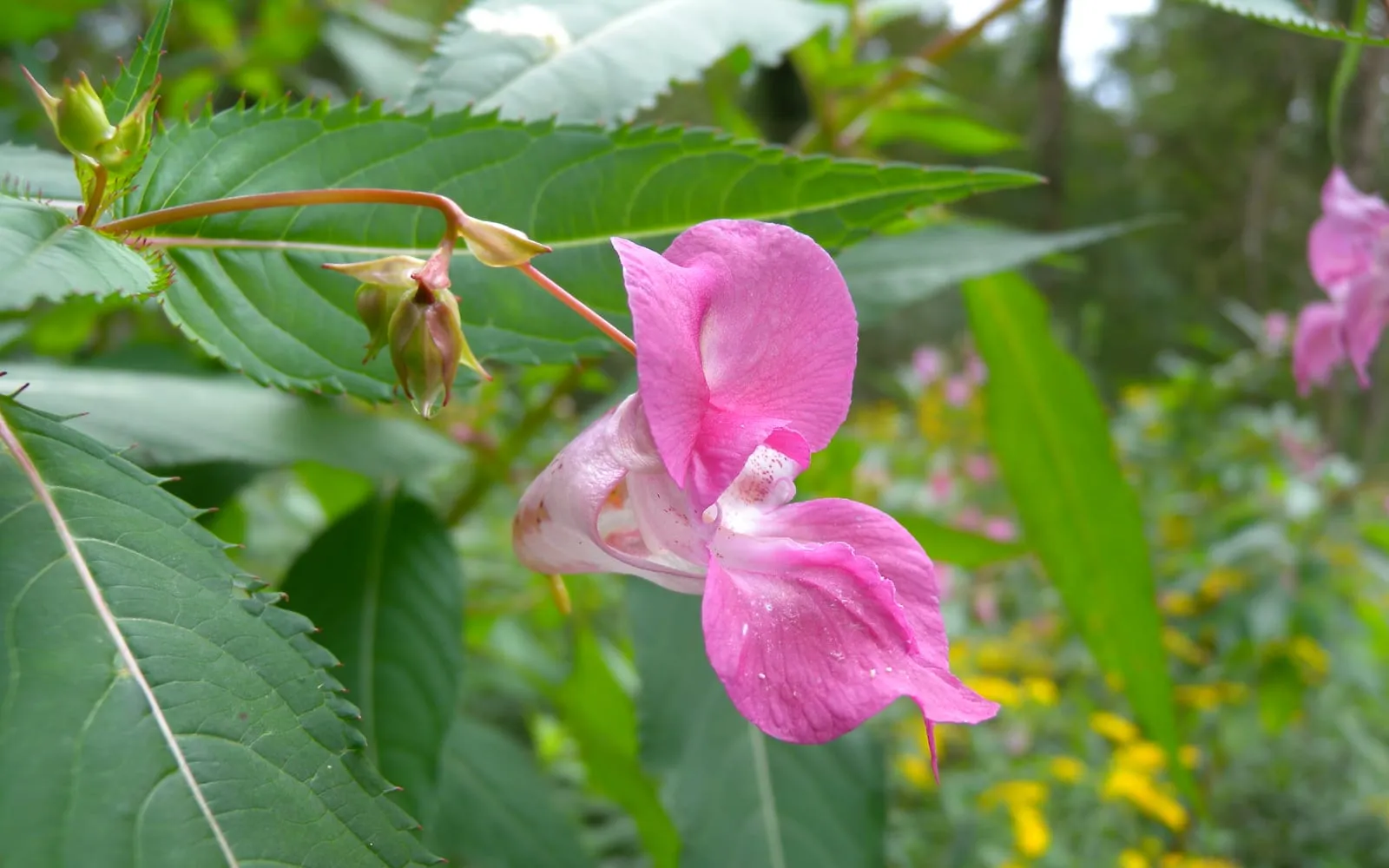
Flowers open from June to October, 3 to 4 cm long, in shades of pink and purple from near-white to deep magenta, occasionally called the policeman’s helmet from the hooded shape.
The flower structure is the giveaway. A large hooded upper petal, two broad wings and a short curved spur behind, hanging on a slender stalk.
Seed pods are club-shaped and green, 2 to 3 cm long, and when ripe they explode at a touch, coiling back on themselves and firing the seed several metres. Anyone who has walked through a stand in September knows the sound.
Roots are shallow, weak and reddish, which is what makes the plant so easy to pull.
Telling it apart is straightforward. Nothing else native in Britain combines that height, the hollow red-jointed stems, the paired toothed leaves and the hooded pink flower. Small balsam and orange balsam are relatives and both are far shorter with much smaller flowers.
Where it is from
The western Himalayas, in northern India, Pakistan and Nepal, where it grows along streams at 2,000 to 4,000 m as one plant among many and is kept in check by local insects and diseases.
It was introduced to Britain in 1839, sent to Kew alongside giant hogweed, and promoted as a hardy ornamental with the memorable selling line that it needed no care and grew anywhere. Both claims were true.
It escaped along waterways within a few decades and is now recorded in almost every part of Britain and Ireland.
Water is the whole story of its spread. Seeds float and stay viable, so a single plant on an upper tributary eventually seeds the entire river system below it.
It out-competes native riverside plants through sheer speed and height, and by producing far more nectar than anything around it, which pulls pollinators away from native species.
The winter die-back is the ecological sting. A bank that carried dense balsam all summer is bare mud in November, and it erodes.
How it grows
Understanding the life cycle is what makes control work, because everything hinges on the seed.
Seed germinates from February onward, earlier than most native competitors, and seedlings grow fast.
The plant reaches full height by June and flowers from late June to the first frost.
Seed sets from late July. This is the deadline that matters. Anything done after the pods ripen is next year’s problem rather than this year’s solution.
Seed stays viable in the soil for around two years, which is far shorter than knotweed or hogweed and is the reason this plant can be eradicated.
To remove it, pull the plants up by hand. The roots are shallow and the whole plant comes away easily, which is why balsam bashing works as a volunteer activity. Grip low on the stem and pull steadily.
Pull before the pods ripen, ideally in June and early July. Once a stand is podding in August, moving through it fires seed everywhere.
Break or crush the stem below the lowest node after pulling. A pulled plant left lying on damp ground can re-root at a node and go on to flower.
Cutting or strimming works only if done below the lowest node, since the plant regrows from any node left standing. Pulling is more reliable.
Work from the top of the catchment downstream. Clearing a lower stretch first is wasted effort while seed keeps arriving from above.
Repeat for at least three years, and keep checking for two more after that.
Grazing and mowing both work on accessible ground, and cattle and sheep eat it readily.
Compost pulled plants on site in a heap away from water, or leave them hung up off the ground. Balsam is not classed as controlled waste in the way knotweed and hogweed are, though moving material off site risks spreading seed.
Through the seasons
Late winter and spring is germination, from February. Seedlings are easy to hoe or pull at this stage and easy to overlook.
Early summer is the control window. Plants are full-sized, obvious and not yet seeding. June and July are when the work should be done.
Late summer is seeding, from late July onward. Walking through a stand now spreads it, so work becomes counterproductive.
Autumn and winter is the die-back. The first frost kills every plant, leaving bare eroding soil and a seed bank already in the ground.
Care difficulty
Moderate, and the difficulty is organisational rather than physical.
Pulling the plant is easy, which is why this is the invasive that volunteer groups tackle.
The timing is unforgiving. Miss the July deadline and the year is lost.
The catchment problem is the real obstacle. Individual effort on one garden or one field achieves little if the watercourse above is untreated, so control works best as a coordinated effort along a whole river.
Persistence over three to five years is what finishes it, and the short-lived seed bank makes that achievable.
Watering
Nothing here needs watering. Every section of this guide is about removal.
The plant favours damp fertile ground, so riverbanks, ditches, damp woodland and wet waste ground are where it establishes.
It tolerates shade better than most annuals of its size, which is how it gets into woodland.
Drier ground supports smaller plants and it still seeds successfully there.
Warning signs, diseases and pests
Exploding seed pods are the practical hazard. From late July a ripe pod fires at the lightest touch and throws seed up to seven metres, so working through a seeding stand actively spreads it. Cover a seeding plant with a bag before cutting it if you must deal with one late.
Re-rooting from pulled plants catches people out. A stem left lying on damp ground roots at a node and flowers as though nothing had happened. Snap the stem below the lowest node, or hang the plants off the ground.
Regrowth from strimmed stumps happens for the same reason. Cut below the lowest node or pull instead.
Reinfestation every spring on a cleared site usually means seed is arriving from upstream. Work down the catchment, and talk to neighbouring landowners.
Bare eroding banks after the first frost are the plant’s lasting damage. Reseed a cleared bank with grass or native riverside plants to hold the soil and to compete with any surviving seed.
Legal duties fall on the landowner. In Britain, Himalayan balsam is listed on Schedule 9 of the Wildlife and Countryside Act 1981, which makes it an offence to plant it or otherwise cause it to grow in the wild, and it is banned from sale across the European Union under the same invasive species regulation. It is also controlled in British Columbia, Ontario and New Zealand.
Growing environment
Knowing where it establishes helps you find it.
River banks, stream sides, ditches and canal edges are the classic habitat and where nearly all British infestations sit.
Damp woodland, wet waste ground, railway embankments and damp field margins also support it.
It grows in full sun and in surprisingly deep shade, on any fertile damp soil.
It rarely persists in closely grazed pasture or regularly mown grass, since it cannot set seed there.
Check any watercourse on your land in late June and July, when the plants are tall and in flower and impossible to miss.
Feeding
Nothing here needs feeding. The relevant point is the reverse, which is that nutrient-rich damp ground is exactly what suits it.
Restoring dense native cover after clearance is the most useful follow-up, since bare ground invites the surviving seed to germinate and erodes over winter.
Reseeding a cleared riverbank with grass serves both purposes at once.
Troubleshooting
How do I recognise it? Two to three metres tall, hollow reddish jointed stems, paired sharply toothed leaves, and hooded pink flowers with a short curved spur. Nothing native in Britain looks like it.
When should I pull it? June and early July, before the seed pods ripen. After late July, moving through a stand fires seed everywhere.
Do I need to dig up the roots? No. The roots are shallow and the whole plant pulls up easily, which is why hand-pulling is the standard method.
It regrew after I pulled it. A pulled plant left on damp ground re-roots at a node. Snap the stem below the lowest node, or hang the plants off the ground.
It comes back every year even though I clear it. Seed is arriving from upstream. Control works from the top of the catchment downward and needs neighbouring landowners involved.
How long until it is gone? Three to five years of pulling before seeding. The seed lasts about two years in the soil, which is far less than knotweed or hogweed.
Is it illegal to have it? In Britain, having it is not an offence, though planting it or causing it to grow in the wild is, under Schedule 9 of the Wildlife and Countryside Act 1981. Selling it is banned across the European Union, and several Canadian provinces regulate it.
Is it dangerous to touch? No. Unlike giant hogweed, it is completely harmless to handle, and unlike knotweed it does not need specialist disposal.