
Houseplant
Chalk Liveforever
Dudleya pulverulenta
Also known as Dudleya pulverulenta, Chalk Dudleya, Chalk Lettuce
How to grow Dudleya pulverulenta, the chalk liveforever, a brilliant-white chalky rosette with tall arching stalks of red hummingbird flowers.
At a glance
- Difficulty
- Moderate
- Water
- When the mix dries; more in cool winter growth, little in summer
- Light
- Bright light with some direct sun
- Temperature
- Warm to cool; keep above about 2 deg C
- Humidity
- Low
- Hardiness
- USDA 9-11, RHS H3, hardy to -3 C
- Type
- Evergreen rosette succulent, winter-growing
- Height
- Rosette to 40 to 50 cm; flower stalks to 1 m
- Native to
- California, Baja California
A large chalk-white rosette succulent from the dry slopes and canyon walls of southern California and Baja California, in a Mediterranean-type climate of mild, wet winters and hot, rainless summers. It grows through the cool, wet season and rests in the dry summer, wanting bright light and very sharp drainage. It takes a light frost, is safest above about minus 3 deg C, and rots in warm, wet summer compost.
Hardiness zones describe winter cold alone. Summer heat, humidity, rainfall and the length of the growing season decide as much, so treat the range as the outer limit rather than as a recommendation.
Not known to be toxic
This is a safe plant to keep around pets and children. Dudleya, a Californian relative of the echeverias, is not listed as toxic by the ASPCA or the RHS, and no harmful compound is recorded; its rosettes were eaten by Indigenous peoples of its range. A pet or child that bit a leaf would at worst have a watery, faintly sour mouthful and mild stomach upset.
Sources: ASPCA toxic and non-toxic plants, RHS potentially harmful garden plants
About
Few plants are as white as this one. The chalk liveforever builds a broad rosette, reaching half a metre across, whose thick pointed leaves carry a heavy coat of powdery bloom. The whole plant looks hard silver-white on the brown hillsides of southern California and Baja. That coat, a farina the leaves lay down as their own sunblock, is among the whitest surfaces in the plant world.
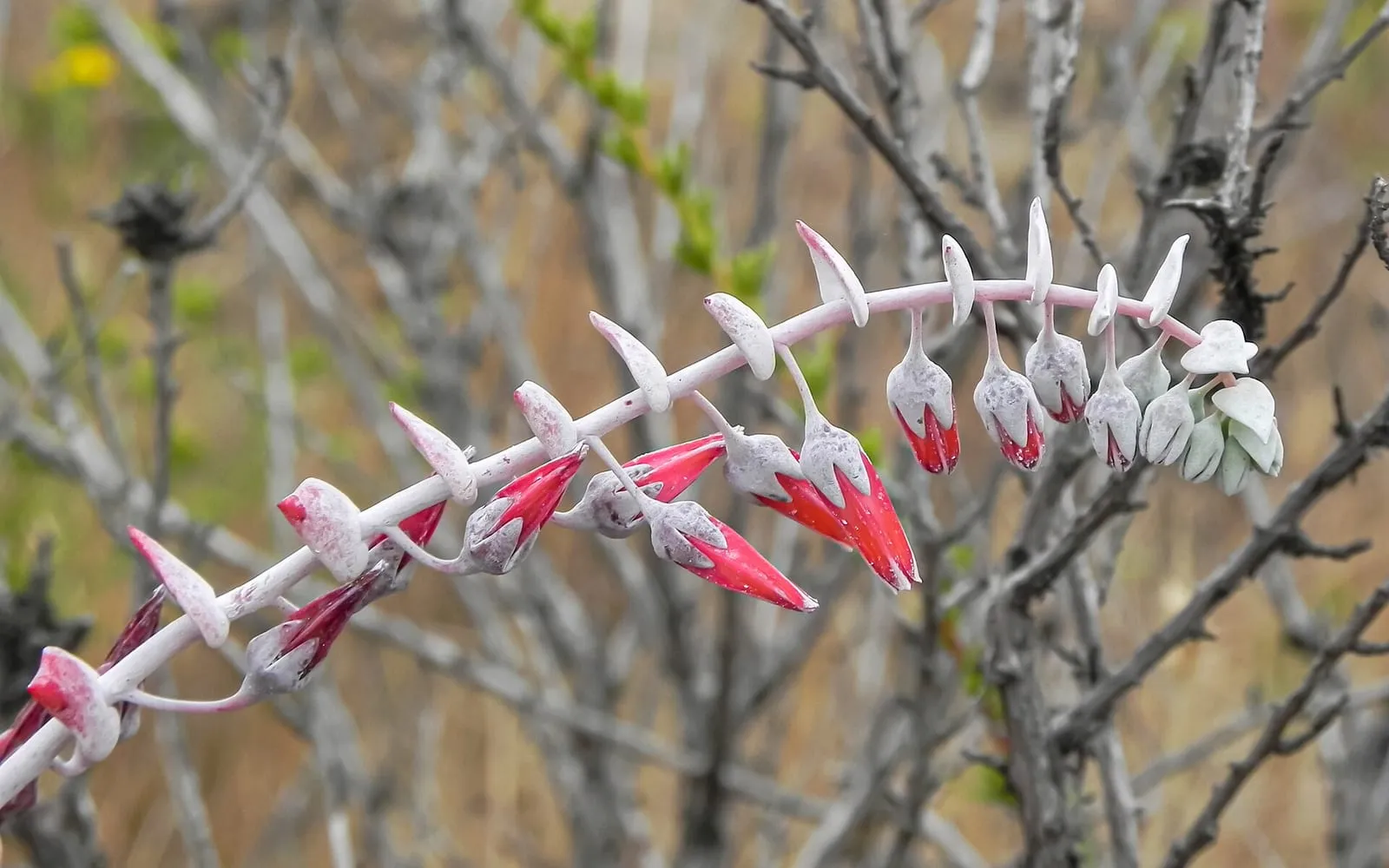
Its flowering helps tell it from the equally pale giant chalk dudleya. In late spring it produces red-stemmed stalks as much as a metre long, arching out and over, and carries nodding red-and-yellow tubes shaped for the bills of the hummingbirds that pollinate them. In full flower the rosette is conspicuous even from a distance.
One rule matters for the coat: do not touch it. Rub it and the bloom lifts away for good, leaving a green smudge that never fades, so move the plant by its pot and pour water at the soil, not over the leaves. Like its Californian relatives it turns the seasons around, growing through the wet winter and shutting down through the rainless summer, when a warm, sodden pot can kill it.
Appearance and character
A single rosette, held on a short stem that thickens with age, is the whole plant; it seldom throws pups, so new plants come from seed instead of division. At full size it spans around fifty centimetres.
The leaves are broad and drawn to a point, curving up a little, and buried under a dense white farina that makes this one of the palest of all succulents.
That coat is fragile as well as bright. A touch marks it permanently, so it is a plant to admire instead of handle, moved only by the rim of its pot.
Its flowers are the main display. Arching red stalks up to a metre carry red-and-yellow tubular flowers in late spring, held well clear of the rosette and visited by hummingbirds.
Where it is from
The chalk liveforever is a plant of the dry slopes, cliffs and canyon walls of southern California and Baja California, growing in strong sun through a Mediterranean-type run of mild, wet winters and hot, rainless summers. Its heavy bloom is the answer to that fierce light.
Its care follows from that habitat. It needs bright light, drainage that clears in seconds, and cool, dry-leaning conditions. It grows through the wet cool months and shuts down through the summer drought. It takes a touch of frost, but a warm and waterlogged pot in summer can rot it outright.
How it grows
Its active spell runs from autumn through spring, on the cool-season rains, when the rosette widens and the bloom is thickest. It then produces its tall flower stalks in late spring before shutting down for the dry summer. The calendar is the main thing to get right: water in the cool months and keep it close to dry in the heat. Summer watering kills most plants.
Set it in a gritty, mineral, very fast-draining mix in a pot that fits the wide rosette, and pour water at the soil, not over the leaves, once the mix has dried, and only through the cool growing season. Keep it nearly dry across summer.
Stand it in bright light with a little direct sun to hold the rosette tight and the coat thick, keep it between cool and warm and no colder than about minus 3 deg C, and give it moving air, which keeps the crown dry and rot at bay.
Raise new plants from seed, since it rarely offsets, and handle any seedling by its roots or pot so as not to spoil the young bloom.
Through the seasons
Autumn ends the summer shutdown as the cool, damp weather returns and the rosette starts into growth again. Begin watering at the soil once the mix dries.
Winter is its main growing spell. Keep it in bright light, water at the base as the mix dries, feed lightly, and hold it cool but clear of hard frost.
Spring continues growth and, late in the season, produces the tall arching flower stalks. Keep watering at the base until the heat sets in.
Summer is the shutdown. The rosette slows; keep it bright, as cool as you can manage, and close to dry, since a warm, wet pot now rots it.
Care difficulty
Moderate, for the two reasons that affect every chalky dudleya. Its seasons are inverted, so it drinks in the cool months and stays almost dry through the heat, and summer watering rots it. Its white coat is also ruined by a fingertip, so handle it by the pot and water at the soil. Give it fierce light and instant drainage, and it should produce its hummingbird-pollinated flower stalks.
Watering
Deliver the water to the soil, never across the leaves, and only once the gritty mix has dried, through the cool autumn-to-spring growing spell. Splashing the rosette both marks the coat and lets water settle in the crown, where it rots.
Keep it close to dry across the summer shutdown, wetting it just enough that the rosette does not shrivel away, because a warm, wet pot in the heat can kill it. Leaves thinning in summer are only resting; a crown gone soft and discoloured is rotting.
Warning signs, diseases and pests
A warm, wet pot through the summer rest rots roots and crown, and it is the usual cause of failure. Hold it dry and cool through the heat, water only in the cool months, and keep the crown dry. A soft, discoloured centre means the rot has taken the crown.
Mealybugs and aphids creep into the centre of the rosette, screened by the coat; float or wipe them off with as little disturbance to the bloom as you can manage. Green streaks across the leaves are coat rubbed away by a hand or a splash, and they will not come back.
Should the rosette slacken and the white grow thin, it is short of light. A move into brighter light with a little direct sun tightens it and rebuilds the coat.
Growing environment
It needs bright light with some direct sun, which holds the rosette firm and the coat dense and white. In poor light, the rosette loosens and the white thins. This is a plant for strong light.
Conditions between cool and warm, dry and airy, suit it, down to about minus 3 deg C. A light frost is within range; low humidity and moving air, which keep the crown dry, are what it prefers, and it cannot tolerate warm, stagnant damp.
Grow it in a gritty, mineral, fast-draining mix in a pot in bright light, water it at the soil, and move it only by the pot to spare the coat.
Feeding
A dilute, low-nitrogen feed once or twice across the cool growing spell is enough. Feed it richly and the growth turns soft and the rosette slackens.
Feed it nothing across the summer rest. After repotting, the fresh gritty mix supports it through its first season.
Troubleshooting
Green streaks have appeared on the white leaves. Coat rubbed off by a hand or a splash. It will not return, so move the plant only by its pot and water at the soil.
The crown has gone soft and discoloured. Crown rot, usually from watering through the summer rest or over the leaves. Water only at the soil in the cool months, and keep it dry and airy through the heat.
When should I water? Chiefly across the cool autumn-to-spring growing spell, at the soil, once the mix has dried. Keep it close to dry through the summer heat, which is its shutdown.
How is it different from the giant chalk dudleya? Both are big, brilliant-white chalky rosettes grown alike; this one is the mainland species famous for its metre-long arching hummingbird stalks, while the giant chalk dudleya comes from the Baja coast.
Is it safe around pets? Yes. Dudleya carries no listed toxin, so the chalky rosette is safe with cats, dogs and children.
Chalk Liveforever problem guides
Not sure what is wrong? See the common houseplant pests guide.