
Houseplant
Mexican Butterwort
Pinguicula moranensis
Also known as Mexican Pinguicula
How to grow Pinguicula moranensis indoors. Sticky summer leaves that catch gnats, and the completely different succulent rosette it grows each winter.
At a glance
- Difficulty
- Easy
- Water
- Keep constantly damp in summer; water sparingly in winter
- Light
- Bright light, including some direct sun; tolerates less light than most carnivorous plants
- Temperature
- 12-28 deg C; avoid prolonged cold below 5 deg C
- Humidity
- Moderate to high humidity is ideal, but ordinary room humidity is workable
- Hardiness
- USDA 9-11, RHS H1c, hardy to 5 C
- Type
- Tender evergreen perennial, forming a distinct succulent winter rosette
- Height
- 8-15 cm; flower stalks to 20 cm
- Native to
- Mexico
Native to cloud forest on limestone cliffs and mossy tree trunks in Hidalgo, Veracruz and neighbouring Mexican states, at an elevation high enough to keep temperatures mild year-round despite the tropical latitude. What matters through winter is not cold but drought: the plant swaps its sticky leaves for a tight, waxy rosette and needs a marked reduction in water rather than protection from frost, which it has essentially none of.
Hardiness zones describe winter cold alone. Summer heat, humidity, rainfall and the length of the growing season decide as much, so treat the range as the outer limit rather than as a recommendation.
Not known to be toxic
Mexican butterwort has no toxicity listing from the RHS or the ASPCA. The sticky mucilage on its leaves is a trap for gnats and small flies rather than a compound with any documented effect on people or pets, and there is no recorded case of it causing harm.
Source: RHS
About
Mexican butterwort spends half the year looking like a small, sticky lettuce and the other half looking like nothing carnivorous at all. That transformation, rather than the trap itself, is the plant’s most distinctive trick: through summer it grows broad, glistening leaves covered in mucilage that catch fungus gnats, and as autumn arrives it abandons them for a completely different set of leaves, compact and waxy, that catch nothing and sit tight through the dry months instead.
The trap on its summer leaves works without any of the moving parts a sundew or Venus flytrap relies on. Two kinds of gland cover the leaf surface: short-stalked ones that ooze mucilage continuously, catching insects the way flypaper does, and a separate set of flush, non-stalked glands that stay dormant until an insect lands on them, at which point they release digestive enzymes onto it. The leaf edge can curl slightly inward to bring more of that second set of glands into contact with larger prey, but nothing about the process looks dramatic to watch, which is part of why it gets overlooked next to flashier carnivorous plants.
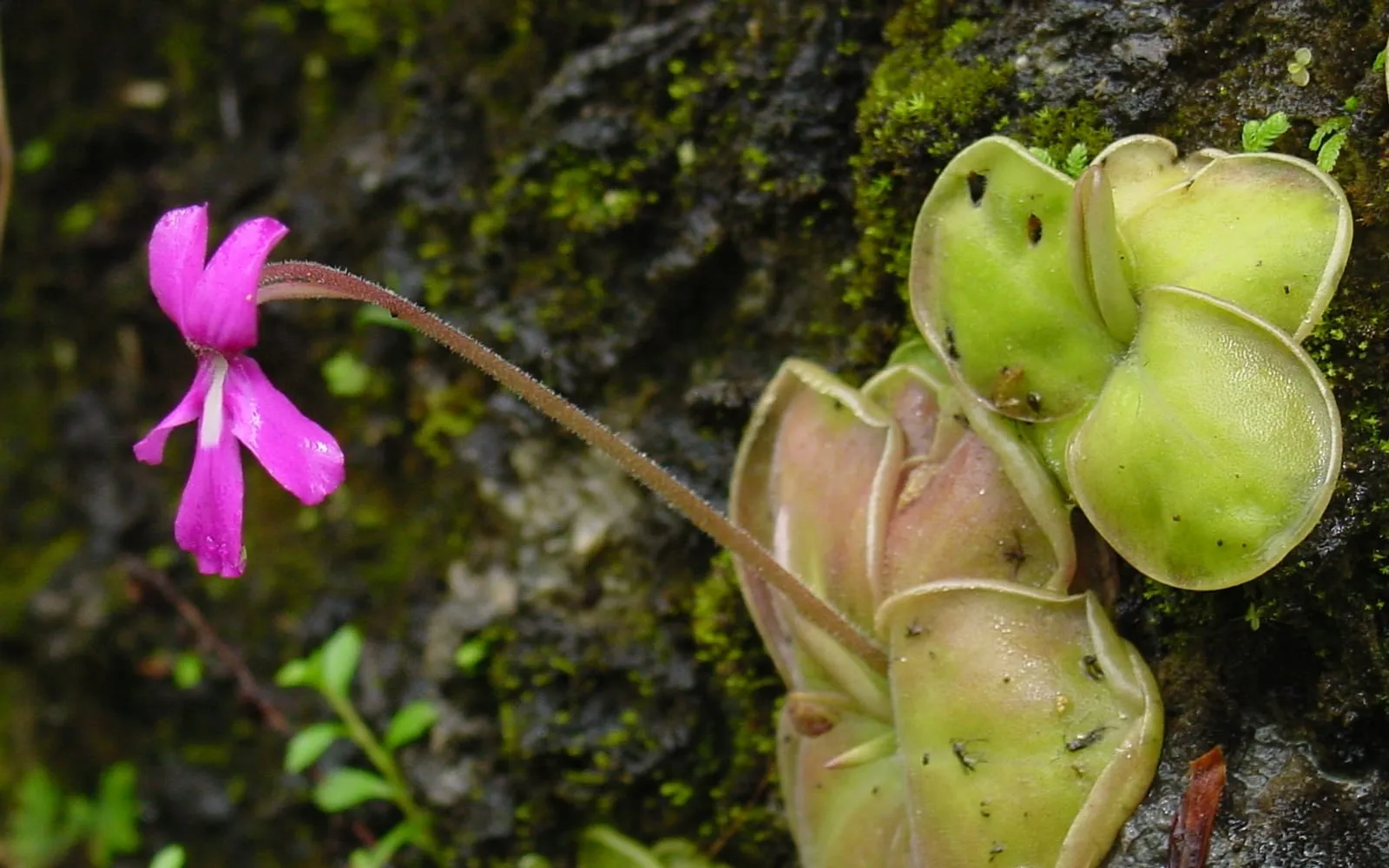
Large, showy violet flowers, closely resembling those of a garden violet, are the other reason it is so widely grown; few carnivorous plants flower this freely on a windowsill.
Appearance and character
The summer rosette is flat and open, made up of pale yellow-green, spoon-shaped leaves with a faintly greasy sheen from the mucilage covering their upper surface, which is where the common name “butterwort” comes from. A leaf that has recently caught prey often shows a slight inward curl along one edge, and the trapped insect is usually visible as a dark speck held fast near the centre.
By late autumn, the plant abandons those leaves entirely and produces a tight, low rosette of small, thick, waxy, non-sticky leaves instead, often tinged pink or red and packed closely enough to look almost like a small succulent. This winter form has no carnivorous function and exists purely to conserve moisture through the dry season.
Flowers appear on thin, upright stalks well clear of the foliage, usually a rich violet-purple with a pale throat and a backward-pointing spur, and a well-grown plant can produce several in succession through spring and summer.
Where it is from
Cloud forest in the Mexican states of Hidalgo, Veracruz and nearby areas, growing as an epiphyte on mossy branches or rooted in thin pockets of organic matter on limestone cliffs, at an elevation that keeps the climate mild and humid for much of the year despite sitting well within the tropics.
Rainfall there is heavily seasonal. Summer is warm, wet and humid, and it is followed by a markedly drier winter. That seasonal switch between wet and dry drives the plant’s dramatic change between its two leaf forms more than any swing in temperature. It is the detail most worth replicating in cultivation.
How it grows
The summer, carnivorous rosette expands through spring and reaches its fullest size in the height of the wet season, continually producing new sticky leaves from the centre while older ones, weighed down by digested prey, gradually die back at the margin. Flower stalks rise through this same period, often more than once per plant across a single summer.
As day length shortens and humidity drops in autumn, new growth switches over to the small, fleshy, non-sticky winter leaves, and the plant shrinks noticeably in size. It sits largely unchanging through winter before switching back to carnivorous growth again as conditions improve in spring.
Propagation is easiest by leaf pulling: a healthy leaf, ideally from the winter succulent rosette, gently removed with its base intact and laid on damp, low-mineral compost, will often produce a small plantlet at its base within a few weeks. Division of an established clump and seed are both possible as well.
Through the seasons
Spring triggers the switch back from the compact winter rosette to broad, sticky summer leaves as light and humidity increase. Resume regular watering and expect the first flower stalks within a few weeks.
Summer is the main growing and flowering season, with the plant at its largest and stickiest. Keep the compost constantly damp and the plant in bright light for the best trapping and the most flowers.
Autumn brings the transition to the small, waxy winter rosette as days shorten. Start reducing watering as this happens rather than waiting for the leaves to fully change first.
Winter is a dry rest built around drought rather than cold. Water only lightly, letting the compost approach dryness between waterings, and keep the plant somewhere it will not sit below about 5 deg C for any length of time, since it has little frost tolerance despite needing no true cold dormancy.
Care difficulty
Easy, and one of the more forgiving carnivorous plants for a beginner. It tolerates lower humidity and lower light than most sundews or pitcher plants, flowers readily, and its winter form is naturally suited to being left largely alone rather than needing careful management.
The one adjustment it does need, cutting back sharply on water once the succulent winter leaves appear, is easy to miss if the plant is being treated the same way all year round.
Watering
Through spring, summer and early autumn, keep the compost constantly damp, standing the pot in a shallow tray of rainwater or watering from above regularly with rainwater or distilled water. As the winter rosette forms, cut back sharply, watering only enough to keep the compost from turning fully dust-dry, and easing off further if the leaves start looking plump and healthy despite the reduced schedule.
Tap water is best avoided year-round, since the dissolved minerals build up in the compost, though this species tolerates a slightly less rigid regime than most carnivorous plants because its native limestone habitat already carries more minerals than a typical bog.
Warning signs, diseases and pests
Aphids sometimes target the flower stalks, which lack the sticky defence of the leaves. Remove them by hand or with a gentle rinse; established plants generally shrug off a light infestation.
Mealybugs occasionally settle in the crowded winter rosette, hidden between the tightly packed leaves. A cotton bud dipped in diluted washing-up water usually clears them, though repeat checks are worthwhile since they are easy to miss among the dense foliage.
Botrytis can develop on the winter rosette if it is kept too wet and too cool at the same time, showing as grey mould at the leaf bases. Ease off watering and improve airflow rather than treating it as a disease needing a fungicide.
A summer rosette that stays small and produces few sticky leaves, despite warmth and light, often means the plant has not been given enough of a dry winter rest the previous season to build up reserves.
Growing environment
Bright light suits it well, including some direct morning or evening sun, though this species tolerates noticeably less light than most sundews without losing vigour, which is part of why it succeeds further back from a window than many carnivorous plants. Moderate to high humidity produces the best summer leaves, but ordinary room humidity is workable, unlike the strict requirements of many tropical carnivorous plants.
Keep it within 12 to 28 deg C for most of the year, and avoid prolonged exposure below 5 deg C, since frost is not something it experiences in the wild. Use a free-draining, low-mineral mix with added perlite and a little limestone grit, reflecting its native habitat on calcareous cliffs, which sets it apart from the acidic peat most carnivorous plants need.
Feeding
No fertiliser applied to the compost. The sticky summer leaves catch fungus gnats and other small flies on their own, and a plant kept indoors where gnats are scarce can be given the occasional pinch of dried bloodworm or a small dead insect pressed gently onto a leaf.
Do not attempt to feed the winter succulent rosette; it has no digestive glands and cannot make use of anything placed on it.
Troubleshooting
The plant has shrunk into a tight, waxy rosette and stopped catching insects. Normal winter behaviour, not a decline. Reduce watering and wait for the sticky summer leaves to return in spring.
Leaves have gone soft and mouldy over winter. Overwatering during the dry rest. Cut back watering significantly and improve ventilation around the plant.
The summer rosette stays small and unproductive. Often too little light, or too little of a dry winter rest the season before. Check both before assuming a pest or disease.
Flower stalks are appearing but few flowers open. Usually a light or humidity issue rather than anything serious; established plants in good conditions flower far more freely.
Aphids are clustering on the flower stalk. Common, since the stalk lacks the sticky defence of the leaves. Remove them by hand or with a gentle rinse of water.
A leaf pulling has not produced a plantlet after several weeks. Leaf propagation is slow with this species; give it six to eight weeks in bright, humid conditions before assuming it has failed.
Can it be grown in a closed terrarium? Yes through summer, but the closed environment can encourage rot during the dry winter rest, so either open the terrarium up over winter or move the plant somewhere with more airflow for that period.
Mexican Butterwort problem guides
Not sure what is wrong? See the common houseplant pests guide.