
Outdoor plant
Common Bladderwort
Utricularia vulgaris
Also known as Greater Bladderwort
How to grow Utricularia vulgaris in a pond. The underwater bladder trap that fires in under a millisecond, and the winter buds that sink to survive ice.
At a glance
- Difficulty
- Moderate
- Water
- Not applicable; lives permanently submerged
- Light
- Full sun to light shade over the water surface
- Temperature
- Grows through spring, summer and autumn; overwinters dormant at the pond bottom
- Humidity
- Not applicable; a fully submerged aquatic plant
- Hardiness
- USDA 4-10, RHS H6, hardy to -15 C
- Type
- Hardy aquatic perennial
- Height
- Stems trail 30-100 cm below the surface; flower spikes stand 10-20 cm above it
- Native to
- Europe, Asia, North America
Found across ponds and ditches through most of Europe, temperate Asia and North America, including well up into Scandinavia and Canada. It is not harmed by a frozen pond surface, because it spends winter as a dense, dormant bud resting on the bottom, well below the ice. Soft, low-mineral water suits it far better than a mineral-rich or heavily chlorinated pond, and it will not tolerate tap water without first letting the chlorine dissipate.
Hardiness zones describe winter cold alone. Summer heat, humidity, rainfall and the length of the growing season decide as much, so treat the range as the outer limit rather than as a recommendation.
Not known to be toxic
Common bladderwort has no toxicity listing from the RHS or the ASPCA. It is a fully submerged pond plant with no foliage above the waterline beyond its flower spikes, and there is no documented case of it posing a risk to people, pets or pond wildlife.
Source: RHS
About
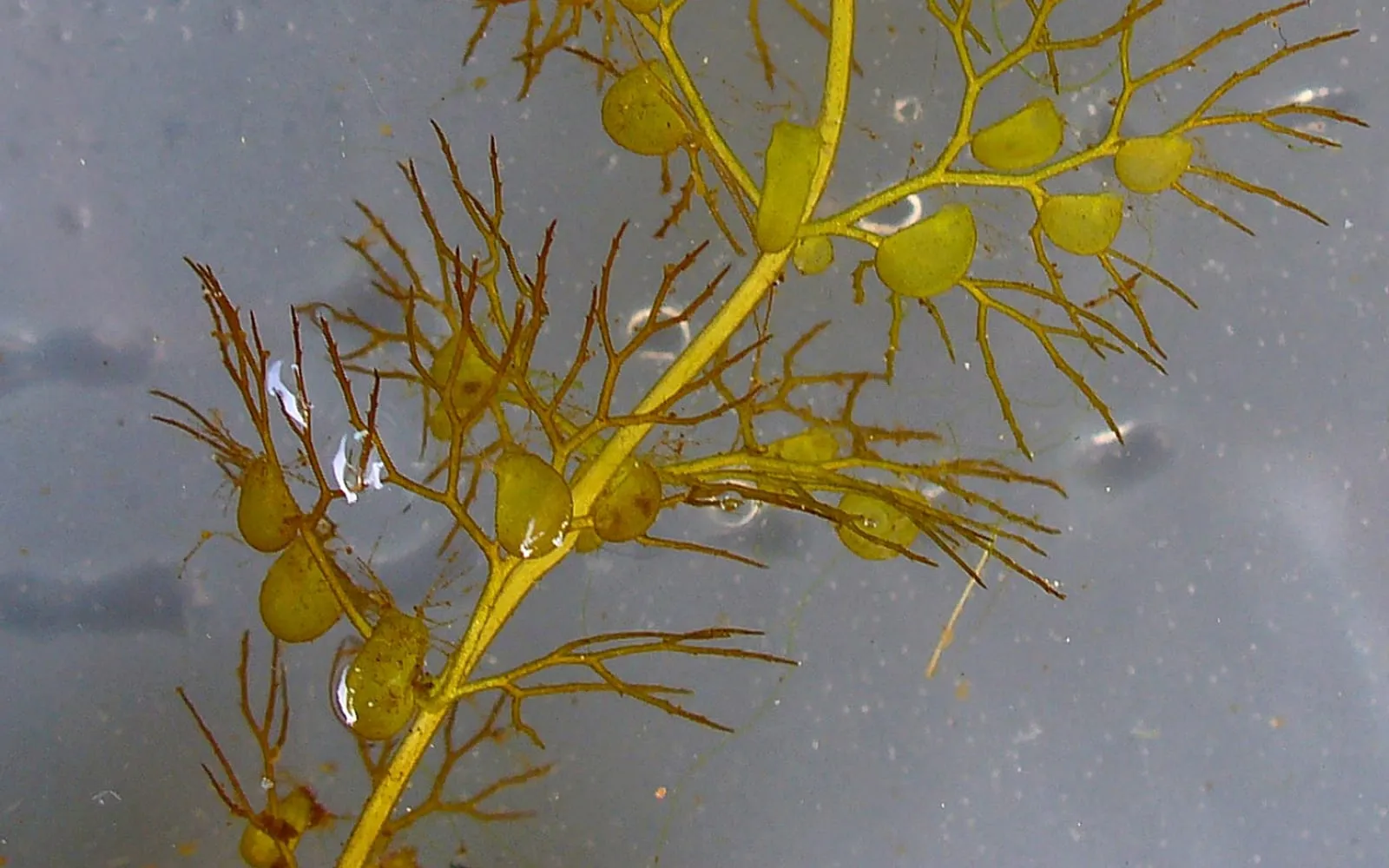
Common bladderwort has no roots at all, drifting freely just below the surface of ponds and ditches across three continents, and it carries what is very likely the fastest trap of any organism on Earth. Along its finely divided underwater leaves sit hundreds of tiny, hollow bladders, each held under negative pressure by a pump built into its wall. When a trigger hair on the bladder’s trapdoor is brushed by something small enough to matter, a water flea, a mosquito larva, a young tadpole, the door snaps open and the whole bladder sucks water and prey inward in well under a millisecond, an acceleration measured at around 600 times the force of gravity. It is faster than a Venus flytrap closing by roughly two orders of magnitude, and the whole event is over before most cameras can capture more than a single frame of it.
Resetting the trap after a catch is comparatively slow. The bladder pumps the water back out through its walls over the following fifteen to thirty minutes, restoring the negative pressure that will fire it again the next time something brushes the trigger hairs.
Above the water, in mid to late summer, it sends up short spikes of bright yellow, snapdragon-like flowers, the only part of the plant a casual observer standing at the pond’s edge is likely to notice at all.
Appearance and character
The plant itself is a tangle of thin, branching stems trailing just beneath the surface, bearing leaves so finely divided they look more like green threads or fine feathers than conventional foliage. Scattered along these divided leaves are the bladder traps, tiny translucent sacs a millimetre or two across, easy to overlook unless the plant is examined closely against the light.
There is no root system to speak of; the whole plant absorbs what little it needs directly from the water and from digested prey, and it moves through a pond largely at the mercy of currents and its own slow growth rather than anchoring itself anywhere.
The flower spikes stand a short distance above the waterline on bare stalks, each carrying a handful of hooded yellow blooms with a distinctive lower lip, closely resembling a small snapdragon, though flowering is irregular from year to year and many populations spread mostly by vegetative means instead.
Where it is from
Still or very slow-moving fresh water across a huge span of the northern hemisphere, from lowland ponds and ditches up to montane lakes over 600 m in parts of Scotland. It tolerates a wide range of climates, but always within nutrient-poor to moderately nutrient-poor water rather than the eutrophic, algae-choked ponds that plague many garden water features.
Because it takes up nutrients directly from the water column and from captured prey rather than from soil, water quality matters to this species in a way it does not for a rooted pond plant, and a pond dosed heavily with tap water or fertiliser-laden runoff will struggle to support it for long.
How it grows
Growth through spring and summer is by simple stem extension, branching repeatedly as it goes and adding new leaves and bladders continuously along its length. A single plant can spread across a substantial area of open water over a season, forming loose floating mats just beneath the surface rather than a fixed clump.
As autumn approaches and growth slows, the plant produces dense, compact winter buds called turions at the tips of its stems, tightly packed masses of unexpanded leaves that detach from the parent shoot as it decays. These turions are initially buoyant, but as the surrounding plant tissue breaks down they become denser than water and sink to the pond bottom, settling there for winter.
Propagation in cultivation is almost always by dividing a length of actively growing stem and allowing it to establish separately, since seed production is unreliable and turions are more easily collected than sown deliberately.
Through the seasons
Spring brings the turions back to the surface as the water warms and their stored tissue becomes buoyant again, unfurling into new growing stems over the following weeks.
Summer is the period of fastest growth and the only time flower spikes typically appear, rising briefly above the water before setting seed or withering back.
Autumn sees growth slow and the plant begin forming the dense, compact turions that will carry it through winter, drawing resources in from the rest of the stem as it does so.
Winter is spent as those dormant turions, resting on the pond floor beneath a surface that may freeze solid without harming them. A pond that never fully freezes is not a problem; the turions do not require ice, only the reduced light and temperature of the cold months to trigger their spring return.
Care difficulty
Moderate. It needs no soil, no feeding and very little in the way of maintenance once established, but it depends on water chemistry that an ordinary garden pond does not automatically have: low in dissolved minerals, free of heavy tap water chlorination, and not overloaded with the nutrients that trigger algae blooms and outcompete it.
Most difficulty in cultivation comes from pond water rather than from the plant itself, which is otherwise close to self-sufficient.
Watering
There is no watering in the usual sense; the plant lives permanently submerged. What matters is the water it lives in. Rainwater-fed ponds, or ponds topped up with dechlorinated, low-mineral water, suit it far better than a pond regularly refilled straight from the tap, since accumulated chlorine and dissolved minerals both work against it over time.
Maintain a reasonably stable water level rather than letting the pond dry down and refill repeatedly, since the sudden changes in temperature and chemistry that come with a fluctuating water level stress the plant more than steady, if imperfect, conditions.
Warning signs, diseases and pests
Algae competing for light and nutrients is the most common problem in cultivation, particularly filamentous algae that can smother the fine, thread-like leaves and starve the plant of light. Reducing nutrient input to the pond, shading part of the surface, and physically removing algae mats by hand all help more than any chemical treatment.
Snails occasionally graze on the softer new growth, though damage is rarely severe enough to threaten an established colony, and most pond snail populations do little more than cosmetic harm.
A bladderwort that has stopped producing new growth and appears to be disintegrating in summer, rather than in its expected fall dormancy, is usually responding to poor water quality, most often excess nutrients or heavy chlorination, rather than any pest.
Growing environment
Full sun to light shade over the water surface produces the strongest growth and the best chance of flowering; deep shade slows it considerably. It needs no soil or substrate of any kind, floating freely in the water column, and does best in a pond, tub pond or slow ditch with still or gently moving water rather than a fast-flowing stream.
Water chemistry matters more than temperature for this species, and soft, low-mineral water, ideally rainwater-fed, suits it far better than hard tap water. It tolerates the full range of temperate seasonal temperatures described under hardiness without difficulty, provided the pond does not dry out completely.
Feeding
No fertiliser of any kind, and adding any to a pond containing this species tends to do more harm than good by fuelling the algae that compete with it. Nitrogen and other nutrients come instead from water fleas, mosquito larvae, small crustaceans and other tiny aquatic animals drawn into its bladder traps.
A healthy, established pond population needs no supplementary feeding at all; a mature colony of prey-rich water is generally self-sustaining.
Troubleshooting
The plant seems to have disappeared entirely by midwinter. Expected. It overwinters as dense turions resting on the pond bottom rather than as visible floating growth, and returns to the surface in spring.
Algae is smothering the fine foliage. Reduce nutrients entering the pond, add some shade over part of the surface, and remove algae mats by hand rather than reaching for a chemical algicide, which can harm the bladderwort as readily as the algae.
It has never flowered despite years of growth. Common; this species spreads mainly by vegetative growth and turions, and flowering is irregular even in thriving populations.
The stems are yellowing and falling apart in midsummer. Usually poor water quality, most often chlorinated tap water or nutrient overload from fertiliser or fish waste. Check what has been added to the pond recently.
Can it be kept in an indoor aquarium instead of a pond? Yes, provided the water is kept soft, low in dissolved minerals and free of tap chlorination, and the plant is given a period of cooler temperatures and reduced light over winter to trigger turion formation.
Will it take over the whole pond? It can spread significantly in a season under good conditions, though it rarely becomes as invasive as some non-native floating aquatics, and thinning excess growth by hand keeps it in check.
Is it safe for fish and tadpoles in the same pond? Established fish are in no danger, but the bladders are capable of trapping very small fry and tadpoles, which is a natural part of the plant’s role in a pond ecosystem rather than a reason to avoid it.