
Houseplant
Blue Hesper Palm
Brahea armata
Also known as Brahea armata, Mexican Blue Palm, Blue Fan Palm
How to grow Brahea armata, the blue hesper palm, a slow desert fan palm with steel-blue leaves, long arching flower plumes and drought and cold tolerance.
At a glance
- Difficulty
- Moderate
- Water
- When the mix has dried well; drought-hardy
- Light
- Full sun to bright light
- Temperature
- Warm to cool; tolerates light frost, keep dry when cold
- Humidity
- Low
- Hardiness
- USDA 8-11, RHS H4, hardy to -8 C
- Type
- Evergreen single-stemmed fan palm
- Height
- Up to 12 m outdoors; slow and small indoors
- Native to
- Baja California
A desert fan palm from the dry canyons of Baja California, growing on rocky slopes in fierce sun and low rainfall. It needs full sun, very sharp drainage and drought, tolerates light frost when dry, and is safest above about minus 8 deg C. It dislikes damp, humid or airless conditions and rots in wet, cold soil.
Hardiness zones describe winter cold alone. Summer heat, humidity, rainfall and the length of the growing season decide as much, so treat the range as the outer limit rather than as a recommendation.
Not known to be toxic
A safe plant to keep around pets and children. The blue hesper palm is not listed as toxic by the ASPCA or the RHS, and no harmful compound is recorded in it, so it is one of the safer large plants for a household with animals. The one caution is physical: the leaf stalks are edged with hooked teeth that can scratch, so handle the fronds with care.
Sources: ASPCA toxic and non-toxic plants, RHS potentially harmful garden plants
About
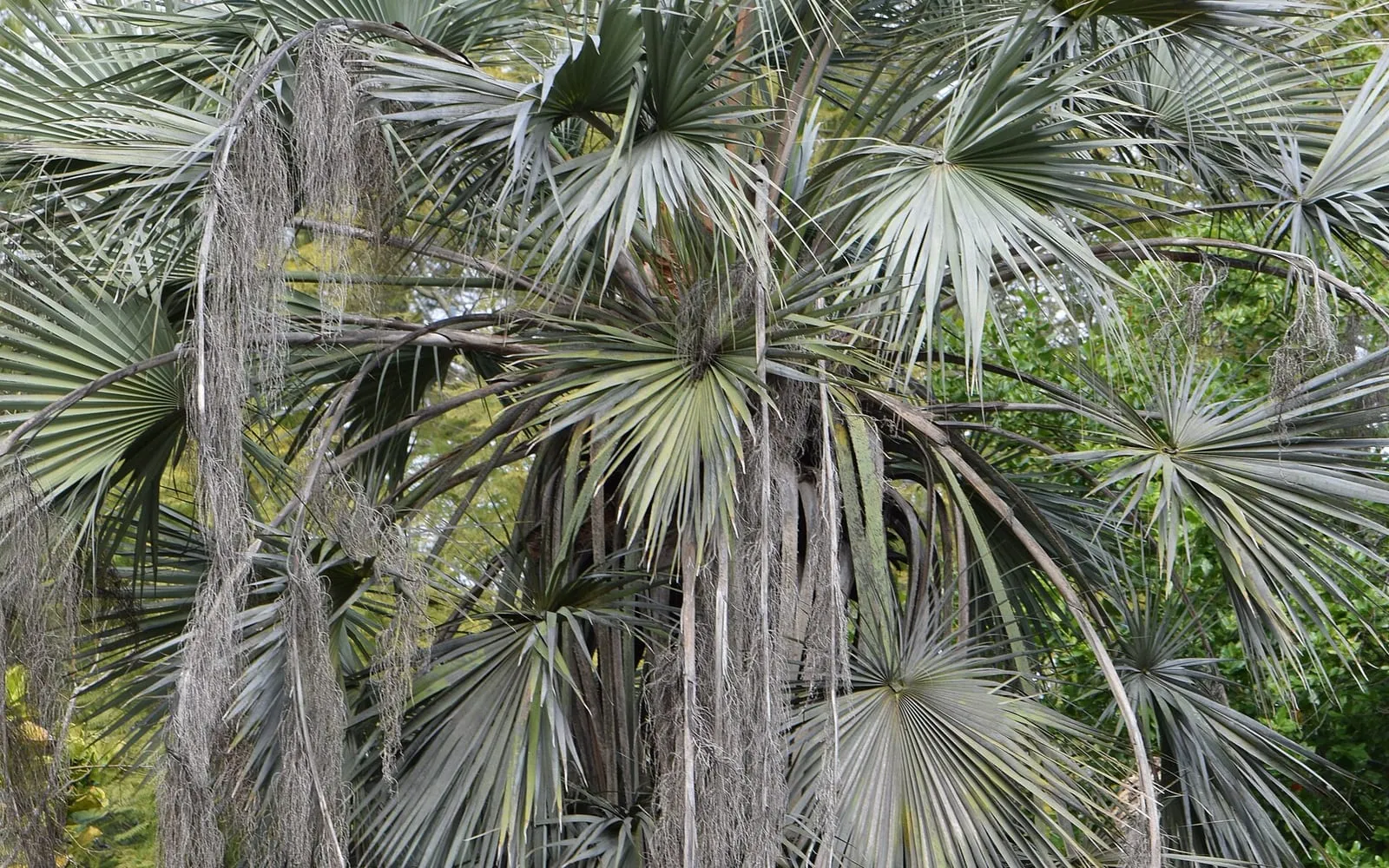
Among fan palms grown for their foliage, Brahea armata has one of the strongest blue colours, a chalky silver cast laid over stiff, near-circular blades that pleat like a folded paper lantern. Sunlight thickens that waxy bloom, so a plant grown in the open can look almost metallic, while one kept shaded fades toward a dull sea-green. Botanists file it among the costapalmate palms, meaning each blade bends along a short extension of the leaf stalk instead of spreading flat, and that gentle fold gives the crown a cupped, three-dimensional shape.
The species gets its garden name, Mexican blue palm, from the parched canyon walls of Baja California, where it grows among rock and gravel. Its care follows from that habitat: harsh light, thin dry soil and cold nights that occasionally dip below freezing. A specimen given those conditions becomes tough and long-lived; one kept damp, close and airless eventually rots at the base.
It is slow. The palm adds only a handful of new blades each year and may take a decade to build a metre of grey, fibre-wrapped trunk, but mature plants can live for a long time. They produce very long flowering stalks, arching out and down well past the reach of the leaves, with many small cream flowers.
Appearance and character
Each fan is held rigid on a long stalk armed down both edges with curved, backward-hooking teeth that will snag a sleeve or graze a knuckle, so wear gloves at repotting time. The blades are the main feature: rounded in outline, split about halfway into many stiff segments, and coated in the pale wax that gives the crown its frosted look.
Below the leaves sits a solid, columnar trunk that keeps a thatch of dead brown fronds hanging against it unless they are cut away. Left alone in the wild, this skirt sheaths the stem for years; in cultivation most growers strip it back to show the patterned trunk beneath.
A single bud at the very top produces all new growth, so nothing can be clipped to make the plant bushier or shorter, and removing that bud kills the palm outright. New plants come only from the large round seed, which germinates slowly.
The flower stalks are distinctive. On an established plant they extend two or three times the length of a leaf, curving in a long pale arc studded with tiny blooms, later followed by small brown-black fruit.
Where it is from
Brahea armata is a Baja California endemic, found on limestone bluffs, dry washes and canyon seeps across the peninsula’s arid interior. Rain there falls seldom, the sun is fierce for most of the year, and winter nights on higher ground can bring a short frost. Roots run through coarse rubble that never stays wet for long.
In a pot, the plant needs blazing light, gritty soil that drains within seconds, and long dry spells between drinks. Sodden compost, stagnant humid air and prolonged winter wet all rot the crown from below.
How it grows
Growth is slow, usually only a few blades a season, quicker in a hot summer and near a standstill in cool grey weather. Strong direct sun keeps the blue colour and stiffens the leaves; in weak light the plant loosens, greens and weakens. Of the blue-leaved fan palms this is the toughest against a cold snap, so long as its roots are dry.
Pot it into a deep container packed with a sharp, mineral-heavy mix, something closer to cactus compost than to houseplant soil, and let it run almost dry before watering again. Root disturbance slows it, and it fills a pot slowly, so shift it up a size only every third or fourth year.
Stand it in the brightest, airiest spot available and hold water back sharply once temperatures fall. A dry-rooted plant comes through a brief frost unharmed. Leave the crown bud untouched and cut only fronds that have died back completely.
Through the seasons
Spring As warmth and daylight lengthen the palm starts back into growth. This is the time to shift it up a pot if the roots have crowded the old one, and to begin feeding.
Summer The year’s growth happens now. Let the gritty mix bake dry between soakings, feed weakly on occasion, and give it every hour of sun for the deepest silver-blue.
Autumn Growth slows. Reduce watering and move the plant toward a dry, cool rest.
Winter is the dormant season. Held nearly dry it withstands a light frost, so keep it bright, cold and arid, with the roots shielded from any damp.
Care difficulty
Rated moderate, it is hardier and more sun-hungry than most of its relatives, and it needs conditions closer to desert than jungle. Given fierce light, drainage that never clogs, warmth in the growing months and air that moves, it becomes a durable, long-lived plant that takes the odd frost when its roots are dry. Cold wet compost, muggy still air and a permanently damp base are the main ways to lose it, and its slowness tests anyone in a hurry.
Watering
Hold off until the gritty mix has gone properly dry down to the roots, then water thoroughly and let every drop drain away. This is a plant adapted to drought, so err always on the parched side instead of the moist, and never let the pot stand in a saucer of water.
Through winter cut back hard, since cold sodden soil can kill it. Where the tap runs hard, the salts and lime can scorch the blade edges brown, so rainwater or filtered water suits it better, and any browning should be trimmed from dead tissue alone.
Warning signs, diseases and pests
A soft, darkening, collapsing crown or a mushy base points to rot, brought on by cold, wet or stuffy conditions, and it is the usual way the plant is lost. Sharpen the drainage, open up the air around it, hold back on water and move it into full sun.
Under warm dry indoor air, fine mottling and webbing on the blades point to red spider mite; lift the humidity slightly, sponge the leaves and act at the first sign. Browned blade edges more often come from lime-rich water or arid air than from disease.
Protect the single crown bud, which is fatal to cut, and mind the hooked teeth along every leaf stalk when handling the plant.
Growing environment
Full, unfiltered sun produces the stiffest leaves and the strongest blue. If it is grown dim it turns soft, green and sickly. Offer it as much direct daylight as the site allows.
Because it takes a light frost on dry roots, it will live outdoors in a Mediterranean or high-desert climate of dry summers and mild winters, or under glass in a hot, bright, well-ventilated conservatory. Damp, still, overheated rooms are wrong for it.
Plant it in a deep pot of coarse, free-draining compost, set it in full sun where the air moves, and keep it dry through the cold months.
Feeding
One or two weak feeds across the growing season are plenty, using a palm blend or a balanced general fertiliser well diluted. Rich feeding forces sappy, weak growth that ill suits a desert plant, so use a light dose.
Taper off as autumn arrives and give nothing while it rests. A freshly potted plant gets enough from new compost to last its first months without extra.
Troubleshooting
The crown or base has turned soft and dark. That points to rot from cold, wet or airless conditions. Sharpen the drainage, get air moving around it, water much less, above all in winter, and stand it in full sun.
The blade edges are going brown. Lime-rich water or parched air is the usual cause. Switch to rainwater or a filtered supply, raise the humidity a touch indoors, and cut away only the dead margin.
Can I prune it to stay compact? No. Every leaf comes from one crown bud, and cutting it kills the plant; a palm will not branch or shorten on command. Its slow pace is what holds it small.
How much cold will it take? More than any other blue fan palm, a light frost on dry roots, though it is safest above roughly minus 8 deg C and kept dry through the winter.
Is it dangerous to pets? Not chemically, as nothing toxic is recorded in it. The only hazard is mechanical, the hooked teeth on the leaf stalks, which can graze skin.
Blue Hesper Palm problem guides
Not sure what is wrong? See the common houseplant pests guide.