
Houseplant
Beaked Yucca
Yucca rostrata
Also known as Yucca rostrata, Blue Beaked Yucca
How to grow Yucca rostrata, the beaked yucca, a trunk-forming desert species with a powder-blue globe of fine leaves and hard frost tolerance.
At a glance
- Difficulty
- Easy
- Water
- When the mix has dried right through; very drought-hardy
- Light
- Full sun
- Temperature
- Hardy; tolerates hard frost, keep dry
- Humidity
- Low
- Hardiness
- USDA 5-10, RHS H5, hardy to -20 C
- Type
- Evergreen tree-like succulent
- Height
- Up to 3 to 4 m outdoors; slow in a pot
- Native to
- Texas, Mexico
A hardy tree yucca from the Chihuahuan Desert of Texas and northern Mexico, growing on dry, rocky slopes with hot summers and cold winters. It needs full sun, very sharp drainage and drought, tolerates hard frost well below minus 15 deg C when dry, and is safest kept from winter wet. It is among the hardiest tree yuccas.
Hardiness zones describe winter cold alone. Summer heat, humidity, rainfall and the length of the growing season decide as much, so treat the range as the outer limit rather than as a recommendation.
Harmful if eaten
- Do not eat
- The leaves and roots, which contain saponins
- Harm from
- Eating it
- Affects
- People, cats and dogs
Like all yuccas it holds saponins that irritate the gut, and the ASPCA lists Yucca as toxic to cats and dogs, which may vomit or drool after chewing the leaves. The saponins are only mildly harmful to people. Its fine leaves are flexible and less fiercely tipped than the daggers of some yuccas, so the physical hazard is milder, but it is still best kept from pets that chew.
Sources: ASPCA toxic and non-toxic plants, North Carolina Extension plant toxicity database
About
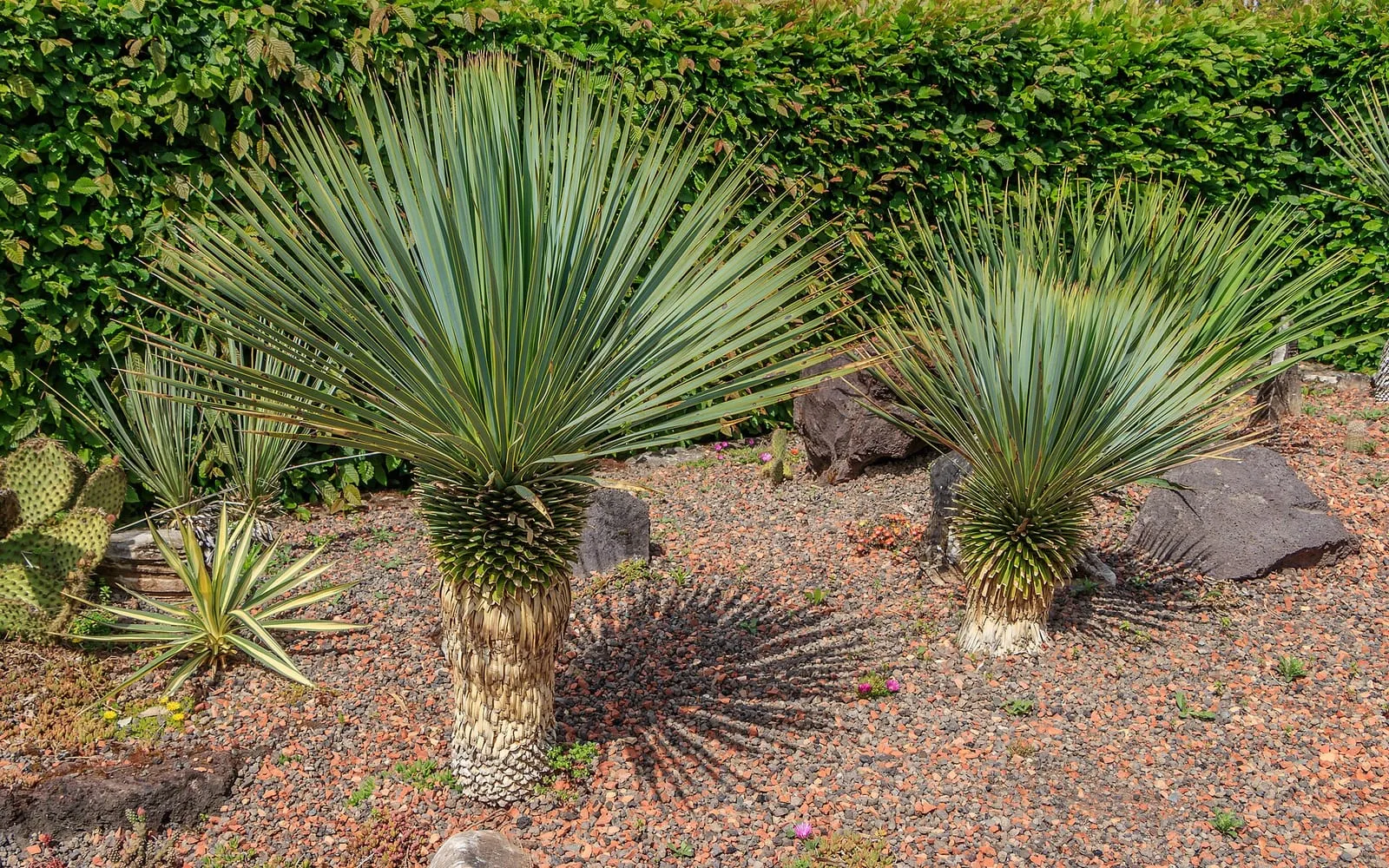
Few desert plants read as clearly across a garden as a mature Yucca rostrata. A single pale trunk lifts a rounded crown of several hundred thread-thin leaves, each barely a centimetre across, and the whole head holds the soft blue of weathered slate. Collectors prize the effect, and the species is often used in dry, sunny architectural planting.
The common name points at the fruit instead of the foliage. “Rostrata” means beaked, a nod to the tapering tip of the seed capsule that follows flowering. Growers know the plant instead for that spherical mop of narrow blades and for the ring of spent leaves that hangs down the stem like a straw petticoat until someone combs it away.
Two things make it easy to live with. It needs almost nothing beyond light and drainage, and it withstands a winter that would flatten a tender yucca, provided its roots are not sitting in cold water. The trade-off is pace. A seedling spends years as a low tuft before any trunk appears, so patience matters more than extra attention.
Appearance and character
Each leaf is stiff along its length yet yielding at the tip, flat instead of channelled, and edged with a fine pale rim that catches the light. A worn yellow thread often peels along that margin. The point at the end is firm but will bend against a hand, which sets this species apart from the rigid spears of its cousins.
The trunk thickens with the decades and stays clothed in a thatch of reflexed dead leaves. Left alone this skirt reaches the ground; trimmed back, it exposes a smooth grey column that many gardeners find handsomer still. Branching happens only on old specimens, usually after a flowering, so a young plant keeps to one neat sphere.
When it does bloom, a tall stalk pushes clear of the crown in early summer and opens into a broad plume of creamy bells. A potted plant rarely reaches that stage, and the foliage provides most of the display for most of its life.
Where it is from
The species grows wild across the Chihuahuan Desert, on limestone slopes and rocky benches of the Big Bend country in Texas and the neighbouring states of northern Mexico, at roughly a thousand to two thousand metres. Days there are hot and glaring, rainfall is thin and seasonal, and winter nights drop hard below freezing.
Give it unbroken sun and a substrate that sheds water within minutes, and it can tolerate a dry cold snap that would kill most succulents. Standing water at low temperatures is the one condition it is not adapted to handle, and that is what rots it in cultivation.
How it grows
Warmth drives growth. Through spring and summer the crown adds leaves and the trunk fattens by a small increment, then the plant idles through the cold months. Strong light keeps the head dense and the colour blue; shade thins the rosette and drains the pigment towards a dull green.
Pot it into a coarse, mineral-heavy blend with plenty of grit or pumice, using a deep container that suits a deep root system. Soak the mix only once it has gone bone dry, since the trunk and leaves store water and long spells without water do no harm.
Outdoors in a climate with sharp drainage it can stay in the ground the year round, and it makes a fine specimen for a hot, bright glasshouse where space allows. Increase is almost always from seed, as the plant seldom throws offsets, and germination is slow and uneven.
Through the seasons
Spring starts crown growth as light strengthens. Begin watering again lightly, and repot a pot-bound plant now if it needs the room.
Summer brings what growth there is. Water when the blend has dried through, and give the plant every hour of direct sun on offer.
Autumn signals the wind-down. Space the waterings further apart and let the mix stay dry for longer as temperatures fall.
Winter is a dormant, arid rest. The plant copes with hard frost while dry, so keep it barely moist and well away from cold rain, which harms it faster than any freeze.
Care difficulty
Straightforward, and among the toughest tree yuccas once sun and drainage are sorted. It tolerates drought and deep cold, and demands little handling. The main mistake that catches people is a wet, chilly root run, so err towards dryness through winter. Growth is unhurried, so anyone keeping it needs to enjoy the slow build, and the pliant leaves make it easier to brush past than the sharp-tipped species.
Watering
Let the gritty blend dry out completely, then drench it and allow every drop to run through. Reserves in the trunk and foliage mean the plant can wait far longer between drinks than a typical houseplant, and it fares better dry than damp.
Through the cold months give barely a trickle, because chilled, sodden compost is what kills established plants. If a decision is uncertain, leaving it dry is the safer error, since it is excess moisture instead of thirst that kills this yucca.
Warning signs, diseases and pests
Cold, waterlogged soil brings rot to the roots and crown, the usual cause of a lost plant, shown by soft browned tissue at the base or the centre of the head. Open up the drainage, hold back sharply on water, especially over winter, and keep it in full sun.
Scale can appear on the leaves as small brown discs; a horticultural oil clears them. A plant that has barely moved in a year is behaving normally and needs no intervention.
A crown that pales and loosens usually needs more light. Move it into the brightest position available to firm the head and restore its steel-blue tone.
Growing environment
Full, direct sun produces the tightest, bluest, most crowded crown. Under a roof of shade the head opens out, greens and weakens, so give it all the light a spot can offer.
Because it endures hard frost while dry, it suits year-round planting in a sharply drained bed in a cold-winter climate, or a bright, warm conservatory under glass. Damp air and a chilly wet root zone are the main risks.
Use a very open, gritty, low-fertility mix in a deep pot in full sun, or a fast-draining planting hole outdoors. The soft leaves mean it can sit near a path without the risk a dagger yucca would pose.
Feeding
Feed sparingly or skip it entirely. Poor ground suits the species, and rich feeding only encourages soft, floppy leaves. A single weak dose of a low-nitrogen cactus food across the growing months is enough.
Give nothing in winter. A refreshed gritty mix sustains a slow-growing plant for a long stretch, so repotting instead of feeding is usually the better option.
Troubleshooting
The base or centre of the head has turned soft. That is rot from a cold, wet root run. Improve drainage, cut water hard, above all in winter, and move it into full sun. A collapsed crown is seldom recoverable.
The crown is thinning and the blue is fading. Not enough light. Shift it to the sunniest place you have to tighten the head and bring back the powdery colour.
Will it survive a hard freeze? Yes, while dry. It comes from a cold-wintered desert and is one of the hardiest tree yuccas, so it lives outdoors in many cold gardens given fast drainage.
Is it a risk to pets? Its saponins are mildly toxic and the ASPCA lists Yucca among plants harmful to cats and dogs, so keep it from animals that chew. The bendy leaves are far gentler on skin than a dagger yucca’s.
How does it differ from a Spanish dagger? It carries a soft globe of fine, flexible blue leaves on one slim trunk, while the Spanish dagger bears rigid, needle-sharp blades in clustering rosettes.
Beaked Yucca problem guides
Not sure what is wrong? See the common houseplant pests guide.