
Outdoor plant
Belladonna Lily
Amaryllis belladonna
Also known as Naked lady, Jersey lily, Cape belladonna
How to grow belladonna lily, Amaryllis belladonna. Planting a true bulb that flowers on bare stems before its leaves appear, and untangling it from the Christmas Hippeastrum sold under its name.
At a glance
- Difficulty
- Moderate
- Water
- Regularly in spring while in leaf, none at all in summer dormancy
- Light
- Full sun, ideally against a warm, sheltered wall
- Temperature
- Needs a hot, dry summer rest to flower well
- Hardiness
- USDA 7-10, RHS H3, hardy to -10 C
- Type
- Bulbous perennial, flowering on bare stems before the leaves
- Height
- 45-75 cm
- Native to
- The Western Cape of South Africa
A borderline case in a temperate garden. The bulb survives short spells of frost once its neck is buried a little deeper than the South African convention and a dry mulch is applied, but it flowers reliably only where it also gets the hot, baked summer rest its native fynbos provides. A wet, cool British or Pacific Northwest summer, rather than an ordinary winter frost, is the more common reason a bulb that survives for years never flowers.
Hardiness zones describe winter cold alone. Summer heat, humidity, rainfall and the length of the growing season decide as much, so treat the range as the outer limit rather than as a recommendation.
Toxic if eaten
- Do not eat
- The bulb above all, and the leaves and stems to a lesser degree
- Harm from
- Eating it and handling it
- Affects
- People, cats and dogs
Belladonna lily contains lycorine along with related alkaloids including pancracine and amaryllidine, concentrated most heavily in the bulb. The ASPCA lists Amaryllis as toxic to cats and dogs, with effects generally more pronounced in pets than in people: vomiting, drooling, lethargy, tremors and abdominal pain follow a significant ingestion. In a person, eating a piece of bulb typically causes vomiting and diarrhoea rather than anything more severe. The bulb is planted with its neck close to the soil surface, which puts it within easier reach of a digging dog than a bulb buried deep, so a spot away from a garden a pet has access to is worth choosing. Handling the bulb causes contact dermatitis in some people, so gloves are worth wearing when planting or dividing a clump. The related genus Hippeastrum, sold at Christmas under the same common name, carries the same class of alkaloid, so confusion between the two plants does not change the advice either way.
Sources: ASPCA (Amaryllis), RHS potentially harmful garden plants
About
This is the true amaryllis, and almost nobody who has grown one has been sold it under that name. The bulb most people know as amaryllis, planted at Christmas for a scarlet trumpet by January, is a South American genus called Hippeastrum, sold under the wrong common name since the eighteenth century. Amaryllis belladonna is a completely different plant from a completely different continent. The two mainly share a trade name and a family of toxic alkaloids.
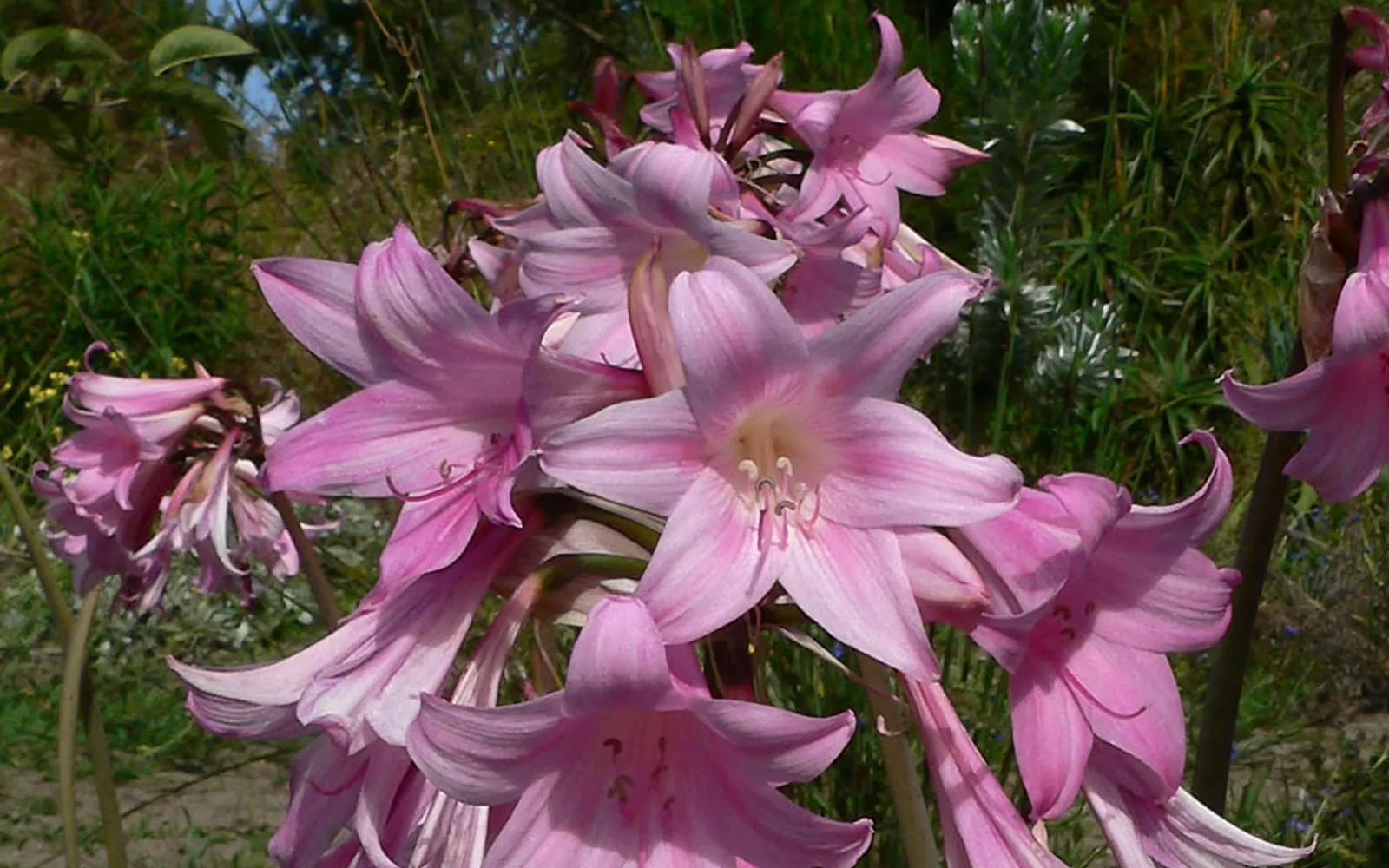
Timing separates the real thing in the garden. In late summer, a naked flower stem pushes straight up out of bare soil with no leaves in sight, topped by a cluster of large, fragrant, pink trumpets. The nickname naked lady describes exactly that: a flower with apparently nothing beneath it, since the strap-shaped leaves that fed the bulb have already died back months earlier and the new season’s leaves will not appear until after flowering finishes.
The species reached Europe among the earliest South African bulbs collected by Dutch traders in the late seventeenth century, and it naturalised successfully enough on the Channel Island of Jersey, in gardens with a mild microclimate close to the sea, that Jersey lily became one of its lasting common names.
Appearance and character
A stout bulb, typically 6 to 10 cm across, sends up a solid, purplish-red flower stem 45 to 75 cm tall in late summer, entirely without foliage, carrying a cluster of two to twelve large trumpet flowers at its tip.
Each flower is fragrant, funnel-shaped and typically a clear soft pink, occasionally deeper rose or white in named selections, opening 8 to 10 cm across. The scent is noticeable from several metres away on a still, warm evening.
Strap-shaped, dark green leaves appear only after flowering finishes, in autumn or the following spring depending on climate, persisting through winter and spring before dying back completely by early summer, well ahead of the next flower stem. At no point does the plant carry leaves and flowers together. That is the clearest way to separate it from almost any lookalike, including its Christmas namesake.
Where it is from
The Western Cape of South Africa, native to fynbos and scrubland with a distinctly Mediterranean-type climate: winter rain, and a long, hot, bone-dry summer that can run for months without meaningful rainfall.
Summer drought triggers flowering. The bulb sits completely dormant through the hottest, driest part of the year, then the first significant autumn rain pushes up the bare flower stem within days, well before any leaf growth resumes. Growing it well anywhere outside its native range means recreating that dry, baking summer as closely as the climate allows, since a cool or damp summer can leave you with a healthy bulb that never flowers.
Dutch East India Company ships carried the bulb to Europe among the first wave of Cape flora reaching cultivation, in the late 1600s, more than a century before the South American Hippeastrum species that would later borrow its name arrived on the same continent.
How it grows
A bulbous perennial with a strict annual rhythm: leaves through winter and spring, complete dormancy through summer, and a leafless flower spike triggered by the first substantial rain as summer ends.
Plant bulbs in late summer, with the neck at or just above soil level in a mild climate, or a few centimetres below the surface where any frost is likely, since a shallow-planted bulb is more exposed to cold than the South African convention assumes. Choose the warmest, most sheltered spot available, ideally against a south-facing wall that bakes through summer and holds a little extra heat into autumn.
A newly planted bulb often takes a full year or two to settle before it flowers, and disturbing an established clump sets it back in exactly the same way, so once planted it is best left entirely alone. Clumps thicken slowly over many years and flower more prolifically as they become congested, which is the opposite of what most bulbs prefer and a reason not to divide one out of habit.
Where the climate cannot provide a reliable hot, dry summer, growing the bulb in a large pot that can be moved to the hottest, most sheltered spot available for summer, and given real drought, is a workable substitute for open ground.
Through the seasons
Autumn is the flowering season, the bulb’s defining event. A leafless stem rises within days of the first good rain breaking the summer drought, carrying its cluster of fragrant pink trumpets for two to three weeks.
Winter brings the strap-shaped leaves through, appearing once flowering has finished and persisting through the cold months in a mild climate.
Spring continues the leaf growth that rebuilds the bulb’s reserves for the coming year. This is the period when feeding matters most.
Summer is complete dormancy. The leaves die back by early summer and the bulb needs total drought until the first autumn rain arrives, with no watering at all through this stretch in an established planting.
Care difficulty
Moderate, and the difficulty is less about keeping the bulb alive than about persuading it to flower. It is a tough bulb once established, tolerating poor soil and considerable neglect, and the plants that fail to flower for years are rarely dying; they are not getting the hot, dry summer rest that triggers the display.
Choosing the right spot at planting time does more for flowering than any amount of later care. Pick the warmest, most sheltered, most free-draining position available. An established clump left undisturbed for years usually gives a better display as it thickens.
Watering
Give the newly planted bulb one thorough soak to settle it in, and then water normally through the leaf-growing period in winter and spring in a climate with reasonable rainfall.
Stop watering completely once the leaves begin to die back in late spring or early summer, and give the bulb no water at all through its summer dormancy. This is not a minor preference; it is close to a requirement for flowering, since a bulb kept damp through summer in imitation of a temperate perennial routine will produce leaves indefinitely and no flower stem at all.
A single, sudden, thorough soak at the very end of summer, mimicking the autumn rain that triggers flowering in the wild, can bring a reluctant established clump into bloom in a climate where natural autumn rainfall is too gradual or too light to do the job on its own.
Warning signs, diseases and pests
A bulb that produces leaves reliably every year but has never flowered is a common complaint. It almost always comes from summer conditions rather than the bulb’s health: too cool, too damp, or too shaded through the months it needs to bake dry and dormant.
Narcissus bulb fly larvae occasionally hollow out the neck of the bulb, a risk shared with several other members of this plant family, showing as a bulb that produces weak, thin foliage or fails to grow at all. Check for a single fat grub inside a bulb that has failed unexpectedly.
Bulb rot follows planting too shallow in a wet climate, or watering through what should be a dry summer dormancy. There is no recovery for a bulb that has rotted at the base, so correct planting depth and a dry summer are the best protection.
Frost damage to the flower stem itself is rare, since flowering happens in autumn before hard frosts typically arrive, but an unusually early cold snap can blacken an open flower head. The bulb itself, dormant below ground at that point, is rarely harmed.
Growing environment
Full sun and real heat matter more for this bulb than for almost any other in this collection. A south-facing position against a wall, which reflects extra warmth back onto the soil and keeps it drier than open ground, is the classic and most reliable spot in a marginal climate.
Free-draining soil is essential, and the bulb prefers poor, lean ground over anything rich and moisture-retentive. This reflects its adaptation to thin fynbos soils in the wild.
Shelter from cold winds and hard frost extends the range in which the bulb can be grown outdoors, and a dry winter mulch over the dormant bulb offers useful extra protection at the cold edge of its range.
Plant in a generous group instead of singly for the strongest display, spacing bulbs about 20 to 30 cm apart to allow the clump room to thicken over the years without immediate crowding.
Feeding
Feed fortnightly with a high-potash liquid feed while the leaves are actively growing through winter and spring, which is when the bulb builds the reserves that produce the following autumn’s flower stem.
Do not feed at all through summer dormancy, and avoid feeding heavily while the flower stem itself is emerging in autumn, since by that point the flower is already fully formed inside the bulb and the feeding that matters came months earlier.
An annual autumn topdressing of well-rotted organic matter, worked lightly into the surface without disturbing the bulb, supports an established outdoor planting without the need for regular liquid feeding.
Troubleshooting
Is this the same plant as the amaryllis I grow at Christmas? No. The Christmas bulb sold as amaryllis is Hippeastrum, from South America. Amaryllis belladonna is the true amaryllis, native to South Africa, and it flowers outdoors in autumn on bare stems instead of indoors in winter with its leaves already showing.
It has healthy leaves every year but has never once flowered. Almost certainly the summer has not been hot and dry enough. Move it to the warmest, most sheltered, driest spot available, ideally against a south-facing wall, and withhold all water through summer.
Why are there flowers with no leaves at all? That is the plant’s normal and defining habit. The leaves from the previous growing season die back months before flowering, and the new leaves do not appear until after the flower stem has finished.
How deep should I plant the bulb? With the neck at or just above soil level in a mild climate, or a few centimetres below the surface for extra frost protection anywhere colder.
Should I divide an established clump? Generally no. This bulb flowers better as it becomes congested, and dividing it sets flowering back for several years while the pieces re-establish.
The bulb looked healthy but rotted at the base. Most likely planted too shallow for a wet climate, or watered during what should have been a dry summer rest. Improve drainage and withhold summer water before replanting.
Is it dangerous to pets? The ASPCA lists it as toxic to cats and dogs, with the bulb carrying the highest concentration of alkaloid. Since it is planted with its neck near the surface, it is more accessible to a digging dog than a deeply buried bulb, so keep it away from a garden a pet has free run of.