
Houseplant
Bear's-Foot Fern
Humata tyermanii
Also known as White rabbit's foot fern, Silver rabbit's foot fern
How to grow bear's-foot fern, Humata tyermanii. Rhizomes covered in silvery-white fur that creep over the pot rim, and how to tell it apart from Davallia.
At a glance
- Difficulty
- Easy
- Water
- Let the surface dry slightly between waterings
- Light
- Bright indirect light. Tolerates medium light
- Temperature
- 15-24 deg C. Protect from any cold below about 7 deg C
- Humidity
- Above 50 per cent is best. Dry air browns the frond tips
- Hardiness
- USDA 9-11, RHS H1c, hardy to 7 C
- Type
- Evergreen perennial epiphytic fern
- Height
- 15-30 cm fronds, rhizomes trailing further
- Native to
- Southern China, Taiwan and northern Myanmar
A subtropical epiphyte with almost no frost tolerance, grown outdoors year round only in the mildest, humid, near-tropical gardens. Everywhere else it is a houseplant or greenhouse subject. The zone number matters less indoors than steady warmth and enough humidity to keep the furry rhizomes from drying and shrivelling at the tips.
Hardiness zones describe winter cold alone. Summer heat, humidity, rainfall and the length of the growing season decide as much, so treat the range as the outer limit rather than as a recommendation.
Not known to be toxic
Non-toxic. Humata tyermanii does not appear on the RHS list of potentially harmful garden plants, and there is no ASPCA record of the genus as toxic to cats, dogs or horses. No irritant sap or documented toxin is associated with it. The furry, exposed rhizomes are more likely to attract a curious pet's attention than the fronds are, and while chewing them is not expected to cause poisoning, keeping the trailing rhizomes out of easy reach of a determined cat protects the plant as much as the animal.
Sources: RHS potentially harmful garden plants, ASPCA toxic and non-toxic plants
About
Several small epiphytic ferns are sold under near-identical common names, rabbit’s foot fern, hare’s foot fern, bear’s paw fern, and the fastest way to tell them apart is the colour of the fur. The rhizomes of this species are covered in a dense, pure silvery-white felt that catches the light almost like frost, distinct from the browner or rust-toned scales carried by the Davallia species more commonly sold under the rabbit’s foot name. Botanists have gone back and forth on where to place it, with some treating it as a Davallia and others keeping it in its own genus, Humata, and that uncertainty is part of why the common names overlap so thoroughly at the garden centre.
Whatever the label, the plant grows the same way. Thick, furry rhizomes creep steadily across the surface of the compost and spill over the rim of the pot, while finely divided, lacy green fronds rise from points along the rhizome. It is grown mainly for that visual contrast, in hanging baskets and terrariums where the trailing rhizomes can be seen at their best.
Appearance and character
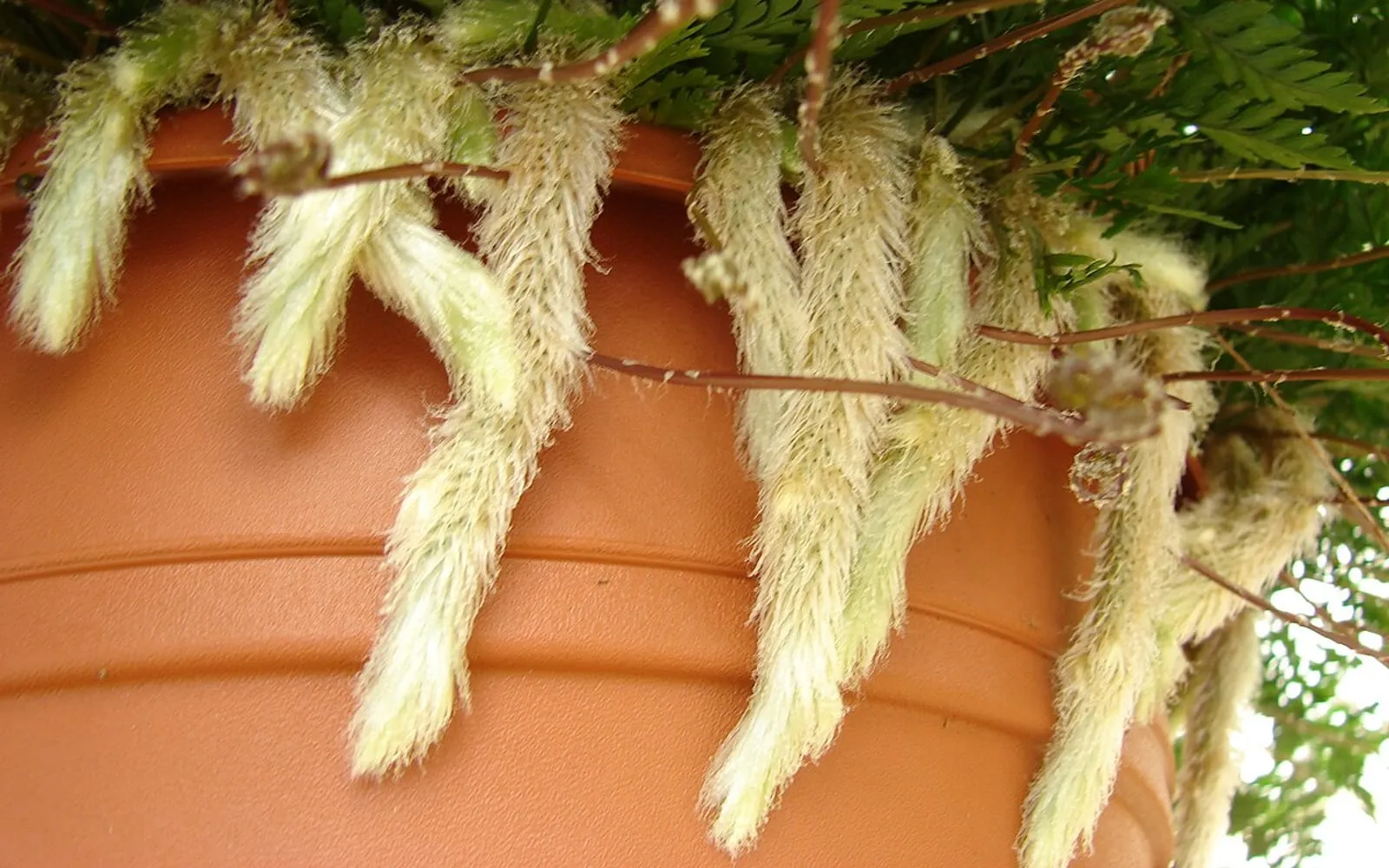
An evergreen epiphytic fern with two very different textures on the same plant. The rhizomes are thick, fleshy and completely covered in fine, silvery-white hair-like scales, creeping horizontally across the compost surface and over the edge of the pot as the plant matures.
Fronds rise from points along the rhizome, finely divided into narrow, lacy segments, mid to dark green, reaching 15 to 30 cm on an established plant.
New fronds unfurl from small fiddleheads at intervals along the rhizome instead of from a single central crown, giving the plant a spreading instead of clumping growth habit.
In the wild it grows as an epiphyte or lithophyte, rooting into moss, bark and leaf litter on tree trunks and rock faces instead of into soil in the ordinary sense, which is reflected in how open and free-draining its compost does best in cultivation.
The silvery rhizome fur is the plant’s most distinctive feature and the one worth checking before buying, since a pure white rhizome marks this species out from its browner-scaled relatives at a glance.
Where it is from
Subtropical forest across southern China, Taiwan and northern Myanmar, growing as an epiphyte high on tree trunks and branches or over mossy rocks, in humid, shaded to lightly sunlit conditions.
That epiphytic origin explains most of what the plant needs indoors. Its roots and rhizomes are adapted to gripping bark and absorbing moisture from humid air and rainfall instead of sitting in conventional soil, which is why an ordinary dense houseplant compost suits it so poorly compared with an open, chunky, bark-based mix.
Humidity in its native forest habitat stays consistently high year round, and the plant has little tolerance for the dry air of a centrally heated room, showing stress at the rhizome and frond tips well before anything else goes wrong.
It has been grown as an ornamental for a long time in parts of East Asia before becoming widely available in Western houseplant retail more recently, prized there as elsewhere for the contrast between the furred rhizome and the delicate foliage.
How it grows
Pot it into a very open, chunky mix, similar to an orchid bark blend, with plenty of perlite or coarse bark to keep air reaching the roots and rhizome.
Choose a wide, shallow container instead of a deep one, since the rhizome spreads across the surface instead of growing down, and a shallow pot lets it trail attractively over the rim sooner.
Give it bright indirect light, tolerating medium light reasonably well but scorching in direct sun through glass.
Water the compost thoroughly when the surface has dried slightly, taking care to water the growing medium instead of soaking the furry rhizome directly, since constant wetting encourages the fur to rot instead of only look damp.
Raise humidity around the plant with a pebble tray, regular misting, or by growing it in a terrarium or bathroom, particularly in a dry, heated home over winter.
Propagate by cutting a healthy section of rhizome with at least one growing point and a few roots attached, laying it on the surface of fresh compost instead of burying it, and keeping the cutting humid until new roots establish.
Repot every year or two into a slightly wider, shallow container as the rhizome spreads, instead of a deeper one.
Through the seasons
Spring brings the strongest new growth of both fronds and rhizome. Resume feeding, and this is the best time to take rhizome cuttings.
Summer is steady active growth, needing regular watering and higher humidity if the weather turns hot and dry.
Autumn slows growth. Reduce feeding toward the end of the season.
Winter is the hardest time indoors, when heating dries the air and the plant is most likely to show browning at the rhizome and frond tips. Keep it away from radiators and maintain humidity as best you can.
Care difficulty
Easy, provided humidity gets enough attention, which is the one thing most centrally heated homes are naturally short of.
The furry rhizomes are a reasonably clear sign of the plant’s condition. Plump and evenly coloured means it is happy; dry, shrivelled or browning tips mean the air is too dry or watering has lapsed.
Overwatering the rhizome directly, instead of the compost around it, is the commonest mistake. It looks like generous care but encourages rot in tissue adapted to absorbing moisture from humid air instead of standing water.
Beyond humidity and sensible watering, it is an undemanding plant that does well with fairly light-touch care.
Watering
Let the surface of the compost dry slightly between waterings, then water thoroughly and allow any excess to drain away completely.
Water the compost itself instead of pouring directly onto the furry rhizome, which is better served by ambient humidity than by direct soaking.
Reduce watering somewhat over winter, when growth slows and the compost stays damp for longer.
Use tepid, ideally rainwater or filtered water in a hard-water area, since mineral deposits show up visibly on the pale rhizome fur over time.
A hanging basket or shallow pot dries out faster than a standard deep pot and needs checking more frequently, particularly in a warm room.
Warning signs, diseases and pests
Dry, shrivelled, brown rhizome tips mean low humidity. Raise humidity around the plant with misting, a pebble tray, or relocation to a more humid room, and expect new growth to look better once conditions improve.
Blackened, soft, rotting sections of rhizome mean it has been kept too wet, usually from water sitting directly on the fur instead of draining away. Cut out the affected section and water more carefully in future, aiming at the compost instead of the rhizome.
Brown limpet-like bumps on the fronds, with sticky residue, are scale insects, wiped off with a cloth or cotton bud dipped in dilute alcohol.
White cottony fluff among the rhizome fur can be mealybugs, though it is easily confused with the plant’s own natural covering at first glance, so look closely and check for movement before treating.
Pale, washed-out fronds usually mean too much direct sun instead of a feeding issue.
Growing environment
Bright indirect light, tolerating medium light reasonably well, with direct sun through glass best avoided.
Warm, stable temperatures between 15 and 24 deg C, with no tolerance for cold below about 7 deg C.
Humidity above 50 per cent is the standard to aim for, and this is the factor most likely to limit success in an ordinary dry, heated room.
Very open, bark-based compost in a wide, shallow pot, or grown mounted on bark or in a hanging basket where the trailing rhizomes show to best effect.
It suits a bathroom, a kitchen with reasonable light, or a terrarium, and combines well with other epiphytic or humidity-loving houseplants such as orchids and other small ferns.
Feeding
A weak liquid houseplant or orchid feed, monthly from spring to early autumn, is enough for this species.
Feed the compost instead of the rhizome, since the plant takes up nutrients through its roots instead of through the fur-covered surface.
Stop feeding through autumn and winter, when growth slows considerably.
Overfeeding shows as soft, pale new growth that is more prone to collapse, so use a weaker feed less often rather than a strong one.
Troubleshooting
How do I tell this apart from a rabbit’s foot fern? Look at the colour of the rhizome fur. This species carries a pure silvery-white covering, while the Davallia species usually sold as rabbit’s foot fern have browner or rust-toned scales.
The rhizome tips have gone brown and shrivelled. Low humidity, the commonest issue with this plant indoors. Raise humidity with misting, a pebble tray or a more humid room, and future growth should improve.
Part of the rhizome has gone black and soft. Rot, usually from water sitting directly on the fur instead of draining into the compost. Cut away the affected section and water more carefully going forward.
Should I water the furry rhizome directly? No. Water the compost and let ambient humidity look after the exposed rhizome, since direct wetting encourages rot instead of helping the plant.
How do I make more plants? Cut a healthy section of rhizome with roots and a growing point attached, and lay it on the surface of fresh compost instead of burying it, keeping it humid until it roots in.
Can it grow outdoors? Only in a warm, humid, almost frost-free climate. Elsewhere it is a houseplant or greenhouse plant year round.
Is it safe with pets? Yes, so far as toxicity goes, though the furry trailing rhizomes are exactly the kind of texture that tempts a curious cat to chew, so keeping them out of easy reach protects the plant more than the animal.
Bear's-Foot Fern problem guides
Not sure what is wrong? See the common houseplant pests guide.