
Outdoor plant
Water Crowfoot
Ranunculus aquatilis
Also known as Lodewort, White water crowfoot
How to grow water crowfoot, Ranunculus aquatilis, a native aquatic buttercup with two leaf shapes and white flowers held above the water.
At a glance
- Difficulty
- Moderate
- Water
- Fully submerged, rooted or free-floating in moving or still water
- Light
- Full sun to light shade
- Hardiness
- USDA 4-9, RHS H5, hardy to -15 C
- Type
- Hardy, often short-lived aquatic perennial
- Height
- Stems trail 30 cm-2 m; floating leaf mats spread widely
- Native to
- Europe, Western Asia, North Africa
Hardy through a cold winter, dying back to overwintering buds resting in the silt at the bottom rather than trying to keep any leaf growth alive above freezing water. It grows equally well in still ponds and in flowing streams and rivers, an unusual flexibility that reflects how widely it is distributed across cool temperate fresh water.
Hardiness zones describe winter cold alone. Summer heat, humidity, rainfall and the length of the growing season decide as much, so treat the range as the outer limit rather than as a recommendation.
Harmful if eaten
- Do not eat
- The whole plant, particularly when bruised or chewed
- Harm from
- Eating it and handling it
- Affects
- People, dogs and horses
Water crowfoot contains ranunculin, which breaks down into the acrid, blistering compound protoanemonin when the plant's cells are crushed or chewed, the same defence chemistry found throughout the buttercup family. The RHS lists it as harmful if eaten and a skin irritant, and recommends gloves when handling large amounts. In practice the bitter taste and mouth irritation it causes discourage animals from eating more than a small amount, and serious poisoning is rare, but horses grazing an overgrown pond edge with little else available are occasionally affected, and the sap can irritate skin on contact during pond maintenance.
About
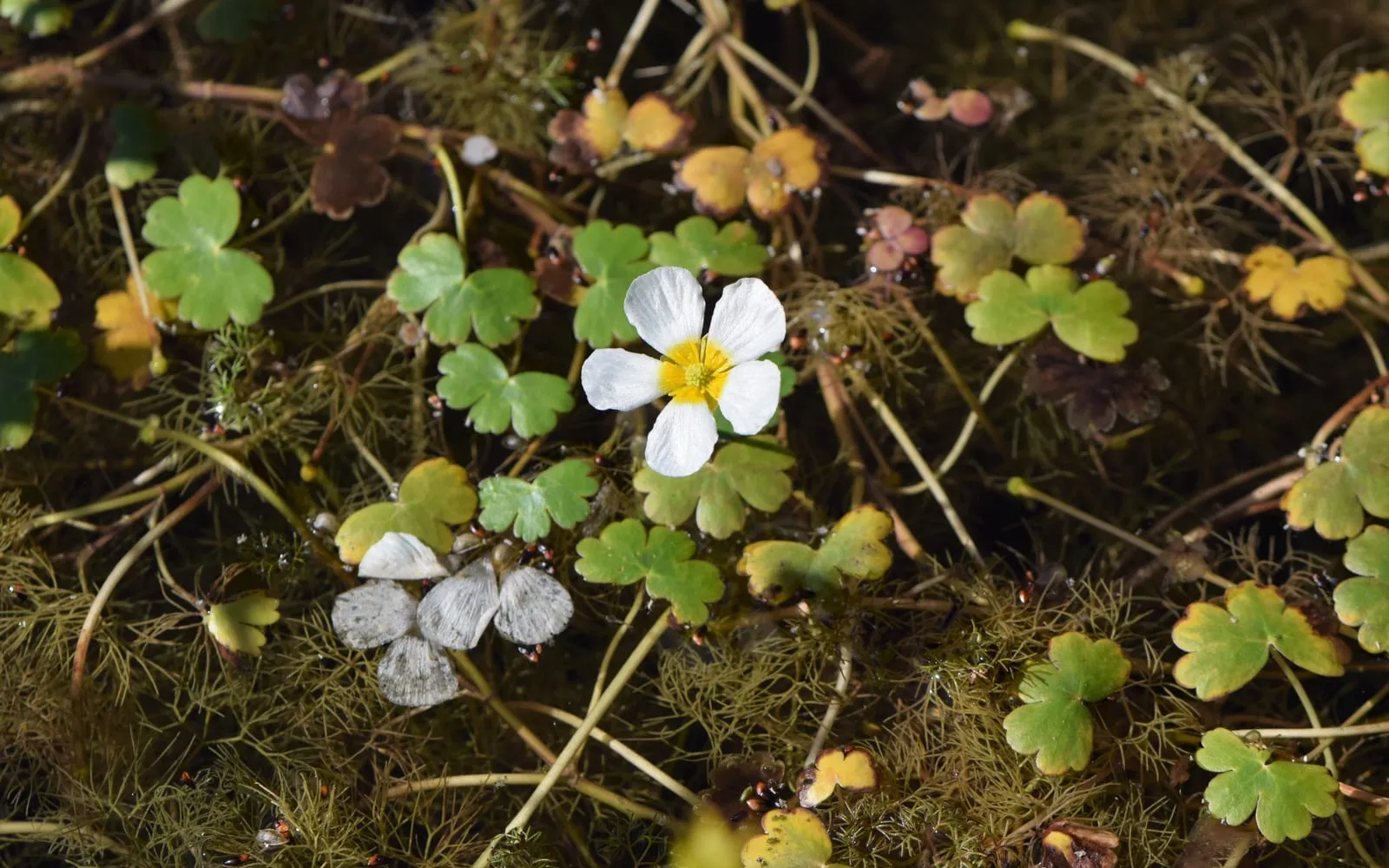
Water crowfoot is a native aquatic buttercup that carries the family’s familiar five-petalled white flowers, each with a yellow centre, held just above the surface through late spring and early summer, while below the waterline it grows an entirely different, thread-like foliage that looks nothing like a typical buttercup leaf. Few pond plants change their leaf shape as dramatically depending on whether that part of the stem is underwater or floating, which makes it as interesting to look at closely as it is decorative from a distance when in full flower.
It is widely found across British rivers, streams and ponds, sometimes in sheets dense enough to carpet a whole stretch of slow-flowing water with white blossom in May and June, and it is grown in garden ponds for exactly that display, provided the pond can offer the clean, reasonably open water it needs to thrive.
Appearance and character
The plant produces two distinct leaf forms on the same stem, a trait called heterophylly that few other garden plants show so clearly. Submerged leaves are finely divided into limp, thread-like segments that trail loosely in the water and offer little resistance to current; floating leaves, produced once a stem nears the surface, are flat, lobed and kidney-shaped, structurally similar to a shallow buttercup leaf and strong enough to sit on the surface tension rather than hang limp in the water below.
Flowers rise just clear of the floating leaves on short stalks, white with a yellow centre and typically about 2cm across, opening in profusion through late spring. Below the waterline, fine roots anchor loosely into silt, though stems readily break free and continue growing as free-floating fragments, particularly after flowering.
Identifying this species with confidence is harder than the flower alone suggests. Ranunculus aquatilis belongs to a group of closely related aquatic buttercups, sometimes called the batrachian crowfoots, that hybridise readily where more than one grows in the same stretch of water, and botanists still debate exactly how many distinct species the group contains. A gardener buying a labelled pond plant need not worry about the distinction, but a wild population identified from a riverbank is often best recorded as a water crowfoot rather than assigned to a single species with total confidence.
Where it is from
Water crowfoot grows across Europe, western Asia and North Africa, in ponds, ditches, slow rivers and chalk streams, tolerating both still and flowing fresh water more readily than most other submerged plants manage. It favours clear, moderately fertile water and is often used as an indicator of a healthy chalk stream, where dense flowering stands are considered a sign of good water quality and light penetration rather than a nuisance to be cleared.
Its tolerance for flowing water in particular sets it apart from many other plants on this site, most of which are adapted to the still water of a pond or lake rather than to the mechanical stress of a current strong enough to move gravel.
How it grows
Growth proceeds along trailing stems that root loosely where they touch silt and continue extending, producing the finely divided submerged foliage along their length until a stem nears the surface, at which point it switches to producing the broader floating leaf form instead. This shift between leaf types happens gradually along a single stem rather than all at once, so an established plant often shows both leaf forms simultaneously at different points along its length.
Many populations behave as short-lived perennials or, in some conditions, almost as annuals, dying back hard after a heavy flowering season and relying on regrowth from surviving root fragments or on self-sown seed the following year rather than persisting indefinitely from the same crown the way a longer-lived marginal would.
Through the seasons
Spring growth resumes as water warms, submerged foliage lengthens first, and floating leaves and flower buds develop as stems near the surface through April and May.
Summer is the main flowering period, typically peaking in May and June, after which many stands die back considerably once flowering has finished.
Autumn surviving growth continues quietly below the surface, often much reduced compared with the summer display, while root fragments and any seed set earlier in the year prepare the following year’s growth.
Winter the plant persists as dormant buds and root fragments resting in the silt, fully hardy through frost, ready to regrow the following spring.
Care difficulty
Moderate. The plant establishes readily where conditions suit it, but a dramatic die-back after flowering can look like failure to a gardener unfamiliar with its short-lived habit, and getting a strong flowering display again the following year sometimes depends on whether enough root fragments or seed survived the winter. Clean, reasonably clear water also matters more here than for some of the tougher submerged plants on this site, and growth is noticeably weaker in murky or heavily silted ponds.
Watering
Plant rooted loosely in silt, or introduce as free-floating fragments, at a depth of roughly 15 to 90cm in still or flowing water. It tolerates a genuine current far better than most submerged plants, making it a useful choice for a stream section of a garden pond system as well as for still water, though very fast, turbulent flow can still be too much for young, loosely rooted plantings.
Warning signs, diseases and pests
Snails graze the softer submerged foliage without generally causing serious harm to an established stand. Ducks readily eat the floating leaves and flowers, which can strip a planting back hard where waterfowl are frequent visitors, though regrowth from the roots usually follows once grazing pressure eases.
Given its mild toxicity, the most relevant warning sign to watch for is grazing by pets or livestock at the pond edge rather than damage to the plant itself. A dog or horse with regular access to a pond where water crowfoot grows in quantity should have other, safer forage readily available, since animals are more likely to eat an irritant plant in bulk when better options are scarce.
Growing environment
Full sun to light shade both suit water crowfoot, and it flowers most freely in a bright, open position. Clear, moderately fertile, well-oxygenated water gives the strongest growth, whether still or gently to moderately flowing, and it is a natural fit for a stream feature or the shallower, better-lit end of a larger pond rather than a deep, permanently shaded corner.
Handle established growth with gloves during thinning or removal, since the sap can irritate skin on contact, particularly for anyone who regularly does pond maintenance bare-handed.
Feeding
None needed. Water crowfoot grows well in nutrient-poor to moderately fertile water without any added fertiliser, and it is often found thriving in exactly the clean, relatively lean water that many other plants on this site would consider too sparse to grow in comfortably.
Troubleshooting
The plant has died back hard after a strong flowering display. Often normal behaviour for a short-lived species. Check for surviving root fragments or self-sown seedlings the following spring before assuming the planting has failed outright.
Flowering has been poor or patchy this year. Usually linked to water clarity or fertility. Improve light penetration by reducing floating cover from other plants, or check that the water is not unusually murky or silted.
Ducks have stripped the floating leaves and flowers. Expected where waterfowl are frequent visitors. An established stand generally regrows from the roots once grazing pressure eases.
A dog or horse has been chewing the plant at the pond edge. Treat as a mild poisoning risk rather than an emergency. Remove the animal from the area, offer water, and contact a vet if drooling, mouth irritation or vomiting develop, particularly in an animal with little other forage available.
Skin feels irritated after handling the plant. Consistent with its mild toxicity. Wash the affected area and wear gloves for any further handling, especially when thinning a large stand.
The stems have broken apart and are drifting loose in the pond. Common after flowering or heavy grazing. Loose fragments often root again where they settle, so this is not necessarily a sign of decline.