
Houseplant
Wiener Blaustern
Scilla vindobonensis
Also known as Scilla vindobonensis
How to grow wiener blaustern, Scilla vindobonensis, a hardy central European woodland squill with bright blue spring stars.
At a glance
- Difficulty
- Easy
- Water
- While in leaf and flower; dry when dormant
- Light
- Dappled shade, or full sun in spring before the canopy closes
- Temperature
- Fully hardy; needs winter cold
- Humidity
- Average
- Hardiness
- USDA 5-8, RHS H6, hardy to -20 C
- Type
- Perennial
- Height
- 10-20 cm
- Native to
- East Central Europe, Western Balkans
A hardy woodland bulb from East Central Europe and the Western Balkans, used to cold winters and needing them. The zone numbers say nothing about summer, when the bulb needs cool, leafy soil that is not baked dry. It struggles in a hot, dry bed and in mild climates with no winter chill.
Hardiness zones describe winter cold alone. Summer heat, humidity, rainfall and the length of the growing season decide as much, so treat the range as the outer limit rather than as a recommendation.
Toxic if eaten
- Do not eat
- Every part, and the bulb most of all
- Harm from
- Eating it
- Affects
- People, cats, dogs and horses
Scilla vindobonensis, the wiener blaustern, is toxic if eaten. Like other squills every part contains cardiac glycosides, and swallowing them can cause drooling, vomiting, diarrhoea and, in larger amounts, an irregular heartbeat. The bulb holds the most. The ASPCA lists Scilla as toxic to cats, dogs and horses, and NC State Extension lists the genus as poisonous to people. Keep bulbs and plants away from pets and children, and wash your hands after handling them.
Sources: ASPCA toxic and non-toxic plants, RHS potentially harmful garden plants, NC State Extension Scilla toxicity entry
About
The German name Wiener Blaustern means Vienna blue star, and the Latin echoes it, since vindobonensis marks the plant as belonging to Vindobona, the Roman name for Vienna. Scilla vindobonensis is a small spring squill of East Central Europe and the Western Balkans. It is closely tied to the better-known Scilla bifolia and is often confused with it. In early spring it carries loose sprays of bright blue starry flowers.
It is a woodland bulb, flowering in dappled shade before the trees leaf up, then dying back for a summer rest. It is hardy and quick to naturalise, seeding itself through leafy ground to form spreading colonies. It opens around the same time as the first anemones and gives the garden one of its earliest clear blue flowers.
Appearance and character
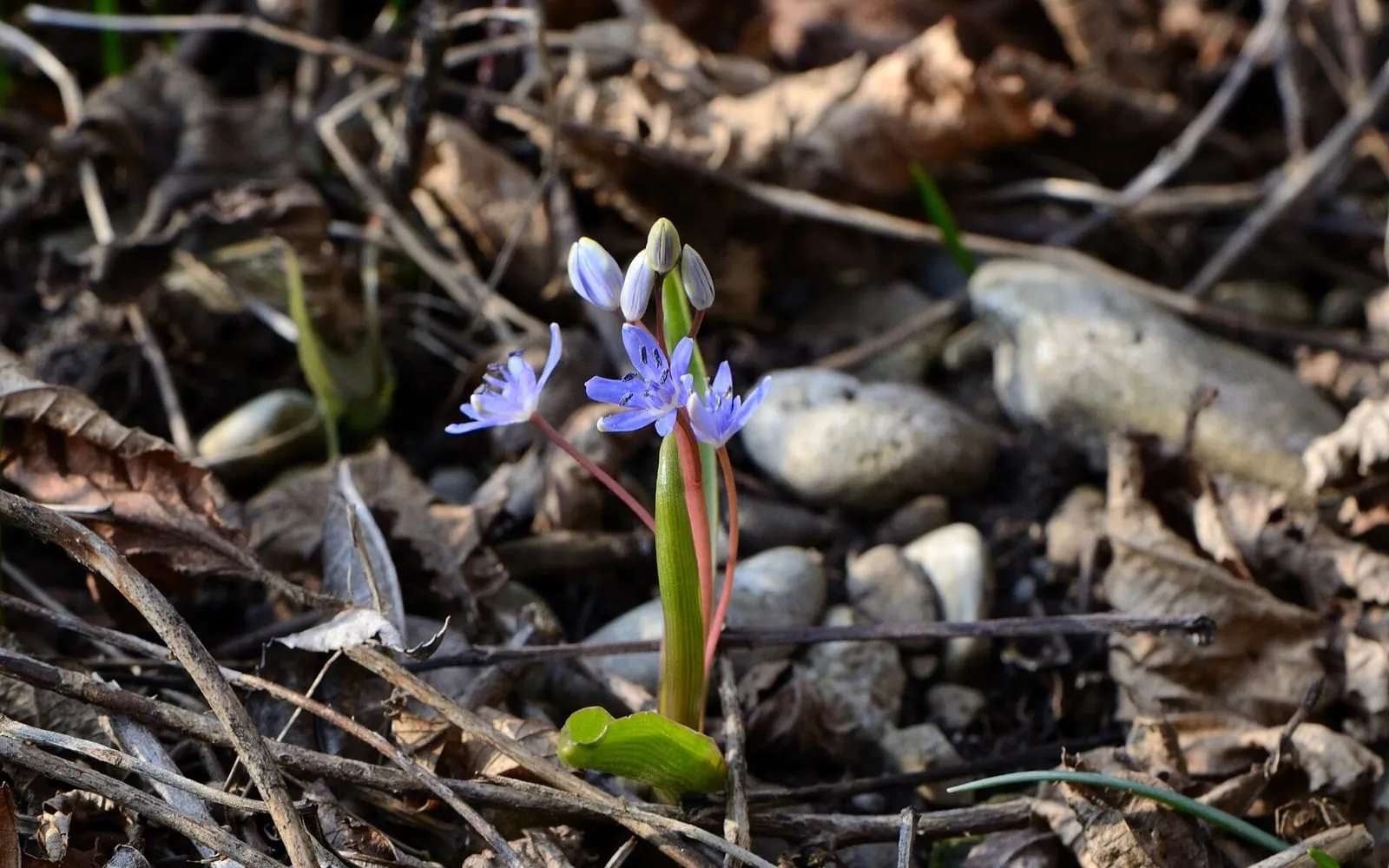
Each bulb usually raises a pair of narrow, channelled green leaves that curve up around the flower stem as it emerges in early spring, the two-leaved habit it shares with its close relative bifolia. The plant is small, only a few inches high in bloom.
The flower stem carries a loose, one-sided raceme of small six-pointed stars in a bright, clear blue, opening from the base upward over a couple of weeks. The colour is a little clearer than the more violet tones of some spring squills, and a self-sown drift in light woodland shade gives strong colour at ground level early in the season.
Where it is from
Scilla vindobonensis is native to East Central Europe and the Western Balkans, from eastern Germany and eastern Austria through Czechia, Slovakia and Hungary to Croatia and Albania, where it grows in deciduous woodland, scrub and damp meadows. The name ties it to the woods around Vienna, part of that broad central European range.
Its behaviour is that of a woodland spring bulb. It grows and flowers early, while the leafless tree canopy still lets light reach the ground and the soil holds winter and spring moisture, then dies back as the canopy closes and summer arrives. It is fully hardy, used to cold central European winters, and it prefers the leaf-rich, moisture-holding soil of a woodland floor to a hot, dry bed.
How it grows
The paired leaves and the flower stem emerge together in early spring. The flowers open over a couple of weeks, and by late spring the foliage yellows as the bulb enters summer dormancy. The display is early and brief, timed to the window before the trees shade the ground.
Plant the small bulbs in autumn, a few centimetres deep, in humus-rich, free-draining soil in dappled shade or a spot that gets spring sun, such as under deciduous trees or in a shady border. It increases by offsets and self-sows freely in leafy ground, spreading into colonies with little help. Lift and divide a crowded clump during dormancy to move it around.
Through the seasons
Spring is the whole display, the paired leaves and bright blue stars appearing together and flowering early, before the tree canopy closes over.
Summer is dormancy, the leaves faded and the bulb resting in the cool, leafy soil until autumn.
Autumn is planting and dividing time, and cooler, damper weather sets the bulb rooting for the year ahead.
Winter passes with the bulb dormant in the woodland soil, the early-spring flowers still to come.
Care difficulty
Easy in the leafy, lightly shaded conditions it likes, needing little once established and naturalising on its own. It is fully hardy and untroubled by cold. The likeliest disappointment comes from planting it in a hot, dry, sunny bed, which suits a Mediterranean squill but leaves this woodland species too dry. A cooler, moister, shadier spot puts that right.
Watering
In suitable woodland-type soil the bulb needs little watering, drawing on the moisture the leafy ground holds through winter and spring. Water only in a dry spring while leaves and flowers are active, keeping the soil evenly moist instead of wet.
Through the summer dormancy it can be left to the weather, since the soil in dappled shade rarely bakes as hard as an open Mediterranean bed. It tolerates a cool, slightly moist rest better than the dry-summer squills do. Standing winter water, though, still rots the bulb, so the ground must drain even while it holds moisture.
Warning signs, diseases and pests
Rot from waterlogged soil is the main risk, showing as a bulb that fails to reappear. Plant it in ground that drains freely even when it holds spring moisture. A bulb rotted at the base cannot be saved.
Slugs and snails graze the soft young leaves in the damp shade the plant enjoys, so protect emerging growth where they are troublesome. Otherwise the plant is little bothered, and a naturalised colony in leafy soil looks after itself without spraying or routine care.
Growing environment
Dappled or light shade suits it best, the sort cast by deciduous trees that let spring light through before they leaf up. It also takes a spot in spring sun so long as the soil stays cool and moist, and it naturalises well in a shady border or light woodland.
The soil should be humus-rich and moisture-holding yet free-draining, improved with leaf mould or garden compost on thin or sandy ground. This is not a plant for a hot, dry, gritty bed. Cool, leafy soil and a little shade matter more than shelter.
Feeding
Feeding is seldom needed in good leafy soil, where an autumn mulch of leaf mould or well-rotted compost keeps a colony thriving, much as a woodland floor feeds itself. A weak, balanced liquid feed in spring can help a planting in poorer ground while the leaves are green.
Stop feeding as the leaves fade, and give nothing over the summer rest. Heavy nitrogen feeds push soft foliage at the expense of the bright spring flowers, so keep any feeding light.
Troubleshooting
What does the name mean? Both the German Wiener Blaustern and the Latin vindobonensis mean Vienna blue star, after Vindobona, the Roman name for the city, near which the plant grows wild.
How is it different from Scilla bifolia? The two are very close and often confused, sharing the two-leaved habit; this one is generally noted for its bright, clear blue flowers within that group.
Why does it flower so early? As a woodland bulb it blooms before the tree canopy closes, using the light and moisture of early spring, then rests through summer.
How do I get more plants? It self-sows and makes offsets freely; lift and divide a clump during dormancy to spread it where you want it.
Is it safe around pets? No. Every part, and the bulb most of all, contains cardiac glycosides that can cause vomiting, drooling and an irregular heartbeat in cats and dogs. Keep the bulbs and foliage away from animals that chew, and call a vet if a pet has eaten any.
Wiener Blaustern problem guides
Not sure what is wrong? See the common houseplant pests guide.