
Houseplant
Spring Squill
Scilla verna
Also known as Scilla verna
How to grow spring squill, Scilla verna, a small squill native to Atlantic sea cliffs that turns short coastal turf violet-blue in April and May.
At a glance
- Difficulty
- Easy
- Water
- While in leaf and flower; dry when dormant
- Light
- Full sun to bright light
- Temperature
- Hardy to about -15 deg C
- Humidity
- Average
- Hardiness
- USDA 6-8, RHS H5, hardy to -15 C
- Type
- Perennial
- Height
- 5-15 cm
- Native to
- western Europe
A bulb from cool Atlantic coasts, growing and flowering in its season then resting as a dormant bulb. It takes hard frost and salt wind, but it dislikes hot summers and wet summer soil. It needs a bright spot, free-draining soil and a dry dormant rest.
Hardiness zones describe winter cold alone. Summer heat, humidity, rainfall and the length of the growing season decide as much, so treat the range as the outer limit rather than as a recommendation.
Toxic if eaten
- Do not eat
- Every part, and the bulb most of all
- Harm from
- Eating it
- Affects
- People, cats and dogs
Scilla verna, the spring squill, is toxic if eaten. Squills (Scilla) are listed as toxic to cats and dogs, and the genus contains cardiac glycosides, which act on the heart in the way digitalis does. Swallowing the bulb or leaves can cause drooling, vomiting, diarrhoea and, in larger amounts, an irregular heartbeat. The bulb holds the most. Few analyses cover this species itself, so it is treated as toxic like its relatives. Keep bulbs and plants away from pets and children, and wash your hands after handling them.
Sources: ASPCA toxic and non-toxic plants, RHS potentially harmful garden plants
About
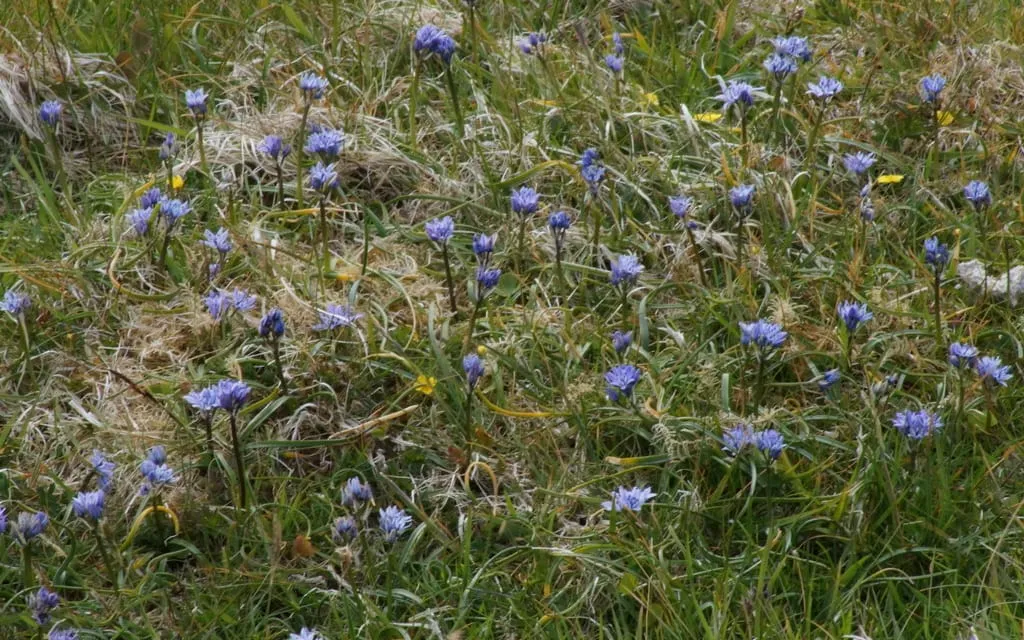
Spring squill is a plant of the sea cliff, a low tuft of grassy leaves and starry blue flowers that carpets short coastal turf along Atlantic shores in April and May. Scilla verna is one of the few squills native to the British Isles, and in flower it turns clifftop grassland violet-blue where little else is yet in bloom.
Everything about it is small and tough. It stands only a few inches high, growing in salt-laden wind and thin, well-drained turf that dries hard in summer. That toughness makes it an easy plant for a sunny, sharply drained spot, a raised bed or an alpine trough, where its neat spring flowers and early dormancy fit a routine of dry summer rest.
Appearance and character
Before the flowers open, each bulb sends up several narrow, grassy leaves that curl and recurve at the tips, a low untidy tuft close to the ground. The flower stem is short and stout, rising only a little above the foliage.
It carries a compact, almost flat-topped cluster of small six-pointed stars in violet-blue to lilac, each flower backed by a small bluish-purple bract that adds to the overall blue cast of the head. Blue anthers deepen the colour further. Individually the flowers are tiny, but a sheet of them across short turf is one of the quiet spectacles of the spring coast.
Where it is from
Scilla verna is native to the Atlantic seaboard of western Europe, from Norway and the Faroes south through Britain and Ireland to western France and the coasts of Iberia. It is a maritime plant, growing in short clifftop turf, coastal grassland and sea-facing heath, almost always within reach of salt wind.
Its life is tied to that exposed, well-drained coastal ground. The leaves and flowers come in spring while the turf is still moist from winter. The bulb feeds, then rests as the thin soil bakes dry through summer. It tolerates wind, salt and sharp drainage, but not rich, heavy or waterlogged ground.
How it grows
The grassy leaves appear in early spring, the short flower stem follows quickly, and the flowers open over a couple of weeks before the whole plant dies back to a small bulb for the summer. It grows during the moist half of the season, then rests when the ground turns dry and hot.
Plant the small bulbs in autumn, a few centimetres deep, in gritty, free-draining soil in full sun, in a raised bed, rock garden or trough where the drainage stays sharp. It increases slowly by offsets and by self-sown seed in open turf, gradually forming a colony. Lift and divide a crowded clump during dormancy, or leave a happy planting to spread on its own.
Through the seasons
Spring is the season that names the plant, the grassy leaves and low blue heads appearing together and flowering through April and May.
Summer is dormancy, the foliage withered and the small bulb resting in the sun-baked turf until autumn moisture returns.
Autumn is the time to plant and to settle established colonies, with cooler damp weather starting fresh roots.
Winter passes with the bulb at rest below the turf, the coming spring’s growth still locked underground.
Care difficulty
Easy given full sun and sharp drainage, the conditions of its native clifftop. It tolerates wind, salt and summer drought, but a rich, damp, shaded border makes the bulb rot or fail to flower. A thin, gritty soil that dries in summer and a bright open position keep it flowering year after year.
Watering
Rely mostly on natural rainfall for a planting in open ground, since the bulb is built for a wet winter and spring followed by a dry summer. Water only in a prolonged spring drought while leaves and flowers are active, and let the surface dry between waterings.
Give no water through the summer dormancy, when the bulb needs the thin soil to bake dry as it would on a clifftop. In a trough or pot, keep the mix lightly moist in spring and dry through summer. Standing wet at any season, but above all in summer, is what rots the small bulb.
Warning signs, diseases and pests
The main threat is rot from wet, heavy soil, especially during the summer rest, and it shows as a bulb that fails to reappear. Sharper drainage and a drier summer prevent it, but a rotted bulb cannot be saved.
Slugs and snails graze the soft young leaves in mild, damp spring weather, so protect emerging tufts with grit in a garden setting. The plant is little troubled otherwise, and its tough coastal constitution keeps most pests and diseases at bay when the drainage suits it.
Growing environment
Full sun and free drainage are the essentials, matching the open, exposed turf of the sea cliff. A raised bed, rock garden, gravel planting or trough all suit it, as does a sunny bank where the soil is thin and stony.
The soil should be gritty and lean instead of rich, and heavy clay must be opened up with plenty of grit before planting, or the bulb grown in a container where drainage can be controlled. Exposure to wind is no problem for this maritime plant; damp shade and heavy ground are what defeat it.
Feeding
Feed little. The bulb comes from thin, poor coastal turf and needs no rich diet, so an established planting in gritty soil can be left unfed. A weak, balanced liquid feed once while the leaves are green in spring is ample for a pot-grown plant.
Do not feed during the summer rest, and avoid high-nitrogen feeds, which push soft leaf growth at the expense of the spring flowers. Fresh, gritty compost carries a newly potted bulb through its first year without extra feeding.
Troubleshooting
Is it a British native? Yes. Scilla verna is one of only two squills native to Britain and Ireland, growing wild in short turf along Atlantic coasts.
Why did it rot away? Wet, heavy soil, most often during the summer dormancy. Grow it in gritty, sharply drained soil in full sun and keep it dry through summer.
How big does it get? Small, only a few inches high in flower, which suits it to a trough, rock garden or the front of a sunny raised bed.
How do I get more plants? Divide a clump during dormancy, or let it set and sow its own seed in open, gritty ground.
Is it safe around pets? No. Squills contain cardiac glycosides and are toxic to cats and dogs, with the bulb the most dangerous part. Keep the bulbs and plants away from pets and children, and call a vet if an animal has eaten any.
Spring Squill problem guides
Not sure what is wrong? See the common houseplant pests guide.