
Outdoor plant
Lady's Slipper Orchid
Cypripedium calceolus
Also known as Yellow lady's slipper
How to grow the Eurasian lady's slipper orchid, Cypripedium calceolus, in a shaded border. Its mycorrhizal dependence, and why nursery-raised stock matters.
At a glance
- Difficulty
- Difficult
- Water
- Consistently moist but never waterlogged soil
- Light
- Dappled shade
- Hardiness
- USDA 4-7, RHS H6, hardy to -25 C
- Type
- Hardy deciduous terrestrial orchid
- Height
- 20-40 cm
- Native to
- Europe, Northern Asia
Fully hardy through cold continental winters, dying back completely each year and relying on the cold itself as a trigger for the following spring's growth. Its real limiting factor in cultivation is not temperature but the specific soil chemistry and, critically, the mycorrhizal fungal partnership it needs to survive, neither of which a hardiness zone can capture.
Hardiness zones describe winter cold alone. Summer heat, humidity, rainfall and the length of the growing season decide as much, so treat the range as the outer limit rather than as a recommendation.
Skin irritant
- Do not eat
- Leaves and stems, on contact
- Harm from
- Handling it
- Affects
- People
Like several other lady's slipper orchids, this species contains compounds in its leaves and stems that can cause a contact dermatitis similar to poison ivy in sensitive individuals, documented among orchid growers and, historically, people who handled wild plants during their harvest for the herbal trade. It has no listing as a food or ingestion hazard, and reactions are limited to skin contact; wearing gloves when handling the foliage is a reasonable precaution.
Source: RHS
About
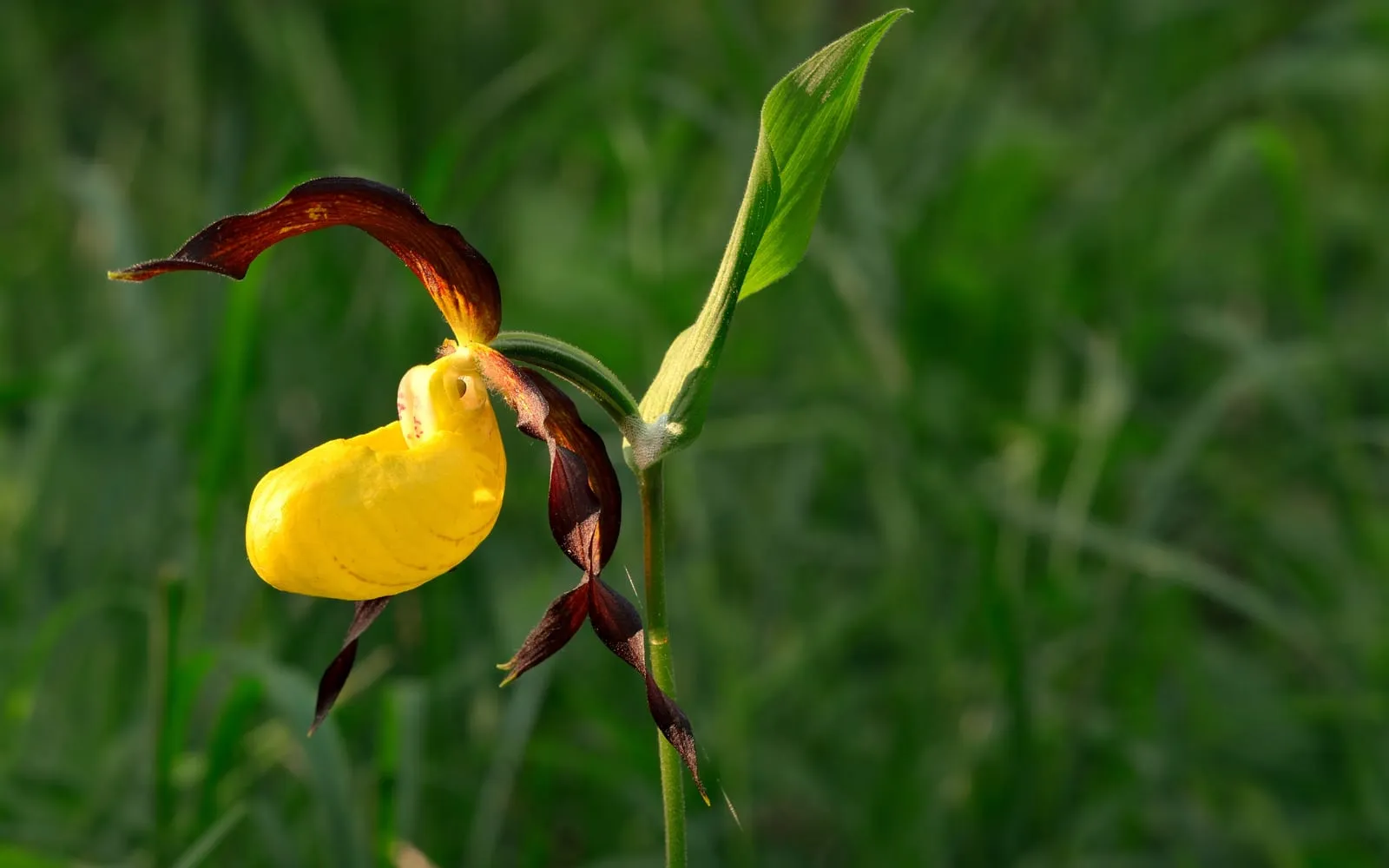
The Eurasian lady’s slipper is one of the most striking and most threatened wild orchids in its native range, named for the large, pouch-shaped yellow lip that gives each flower an unmistakable slipper-like shape, set off by twisted maroon-brown petals above it. It has become vanishingly rare across much of Western Europe through a combination of habitat loss and decades of collection from the wild, and in Britain it survives at only a single closely guarded native site.
Nursery-propagated plants, grown from seed or laboratory-raised tissue rather than dug from wild colonies, are the only responsible source for a garden specimen, and buying from a reputable specialist orchid nursery that can confirm propagated origin matters as much to this species’ survival as any single point of cultivation advice.
Appearance and character
One or a few upright, leafy stems arise each spring from a slow-creeping underground rhizome, each stem holding broad, pleated, strongly veined leaves that clasp the stem in an alternating pattern. A single flower, occasionally two, tops each stem, combining a large, glossy, pouch-shaped yellow lip with narrower, twisted, maroon-brown petals and sepals held above it.
The whole plant dies back completely to its rhizome each autumn, disappearing entirely above ground through winter before re-emerging the following spring, a habit shared with many hardy terrestrial orchids but easy to forget if the plant is new to a garden and its dormant spot is not clearly marked.
Where it is from
Deciduous woodland, particularly over limestone, across a broad swathe of Europe and northern Asia, typically in dappled shade with humus-rich but free-draining, calcium-rich soil.
Like almost all terrestrial orchids, it depends on a specific relationship with mycorrhizal fungi in the soil, which supply nutrients to the plant’s roots and, particularly at the seedling stage, are essential for the orchid’s survival at all. This dependency is a major reason wild-collected plants transplant so poorly and often die within a few seasons even in apparently suitable garden soil that lacks the right fungal partner.
How it grows
The rhizome creeps slowly just below the soil surface, adding new growth points gradually year on year, and an established, undisturbed clump can persist and slowly expand for decades given stable, undisturbed conditions. Growth above ground is entirely seasonal, with stems emerging, flowering and dying back within a single growing season before the plant retreats underground again.
Because the mycorrhizal relationship this species depends on takes time to establish in a new location, a newly planted specimen, even a nursery-propagated one, may take a season or two to settle in and flower reliably, and disturbing an established planting by digging nearby can disrupt the fungal network it relies on.
Through the seasons
Spring new shoots emerge from the rhizome and develop quickly into full leafy stems, with flowers typically opening in late spring.
Summer flowering finishes and the plant continues building reserves in its leaves before beginning to die back later in the season.
Autumn top growth yellows and dies back completely to the rhizome.
Winter the plant is fully dormant below ground, hardy to considerable cold, and needs no protection beyond leaving the dormant site undisturbed.
Care difficulty
Difficult, and the difficulty lies almost entirely in two conditions a garden setting has to replicate. The soil chemistry has to be right, and an established mycorrhizal fungal partnership has to be present in the soil. Getting the light and moisture right is comparatively straightforward; getting the fungal relationship right is what separates a thriving, long-term planting from one that fades within a few seasons regardless of otherwise careful care.
Watering
Keep the soil consistently moist through the growing season without ever letting it become waterlogged, since good drainage matters as much as reliable moisture for healthy roots. Reduce watering once the plant has died back for the season, though the soil should not be allowed to dry out completely even during dormancy.
Warning signs, diseases and pests
Slugs and snails can damage emerging spring shoots, which are soft and vulnerable before they toughen, and protecting new growth at this stage is worthwhile. Fungal leaf spot can develop in poorly ventilated, overly humid conditions, showing as discoloured patches on the leaves, and is reduced by ensuring reasonable air movement around the planting rather than crowding it too closely with other vegetation.
A planting that fails to thrive despite apparently correct light, soil and moisture most often reflects a missing or disrupted mycorrhizal partnership rather than any of the more visible conditions, and this is difficult to diagnose or fix directly; sourcing well-established, nursery-propagated stock from a specialist grower reduces this risk more than any remedial action available once a struggling plant is already in the ground.
Growing environment
Dappled shade, of the kind found beneath deciduous trees, suits it best, avoiding both deep shade and strong direct sun. Humus-rich but free-draining, alkaline to neutral soil gives the best results, closely matching the limestone woodland this species favours in the wild, and established plantings should be left undisturbed as much as possible to protect the fungal network supporting them.
Feeding
No supplemental feeding is recommended. Excess nutrients, particularly phosphorus and nitrogen from typical garden fertilisers, can disrupt the delicate balance of the mycorrhizal relationship this species depends on, so the safest approach is to leave well-prepared, humus-rich soil to provide what the plant needs without additional fertiliser.
Troubleshooting
A newly planted specimen has not flowered in its first season or two. This is common while the mycorrhizal relationship establishes in the new location. Leave the planting undisturbed and be patient; flowering usually follows once the fungal partnership is established.
The plant has declined gradually over a couple of seasons despite seemingly good care. Suspect a disrupted or absent mycorrhizal partnership, particularly if nearby soil has been disturbed or heavily fertilised. There is no direct fix once this has happened; focus on protecting any remaining healthy plants from further disturbance.
Emerging spring shoots have been eaten or damaged. Check for slugs and snails, which target the soft new growth. Protect emerging shoots with a barrier method suited to a sensitive woodland planting.
You are considering buying an inexpensive specimen from an unspecified source. Confirm it is nursery-propagated rather than wild-collected before buying, since wild collection has driven this species to rarity across much of its range and wild-collected plants also transplant and establish far less reliably than propagated stock.