
Houseplant
White-Flowered Marantochloa Prayer Plant
Marantochloa leucantha
Also known as Marantochloa leucantha
How to grow Marantochloa leucantha, a widely used white-flowered prayer-plant relative of tropical Africa, and how to site, water and feed it under cover.
At a glance
- Difficulty
- Easy
- Water
- When the top few centimetres of mix have dried
- Light
- Bright indirect light to light shade
- Temperature
- Warm; keep above about 13 deg C
- Humidity
- Average to high
- Hardiness
- USDA 10-12, RHS H1b, hardy to 13 C
- Type
- Perennial
- Height
- 1-3 m
- Native to
- tropical Africa
A tender tropical foliage plant from tropical Africa, growing in warm, humid, shaded to filtered light. It needs warmth, humidity and bright indirect light, and it cannot take frost or chill. It is safest above about 13 deg C, and cold, wet compost or dry air spoils it.
Hardiness zones describe winter cold alone. Summer heat, humidity, rainfall and the length of the growing season decide as much, so treat the range as the outer limit rather than as a recommendation.
Not known to be toxic
No toxic compound is recorded in Marantochloa leucantha, and the prayer-plant family (the calatheas and their relatives) is listed as non-toxic to cats and dogs by the ASPCA. The RHS does not list it as harmful. A pet or child that chewed a leaf would be unlikely to come to real harm beyond a possible mild stomach upset.
Sources: ASPCA toxic and non-toxic plants, RHS potentially harmful garden plants
The useful everyday plant
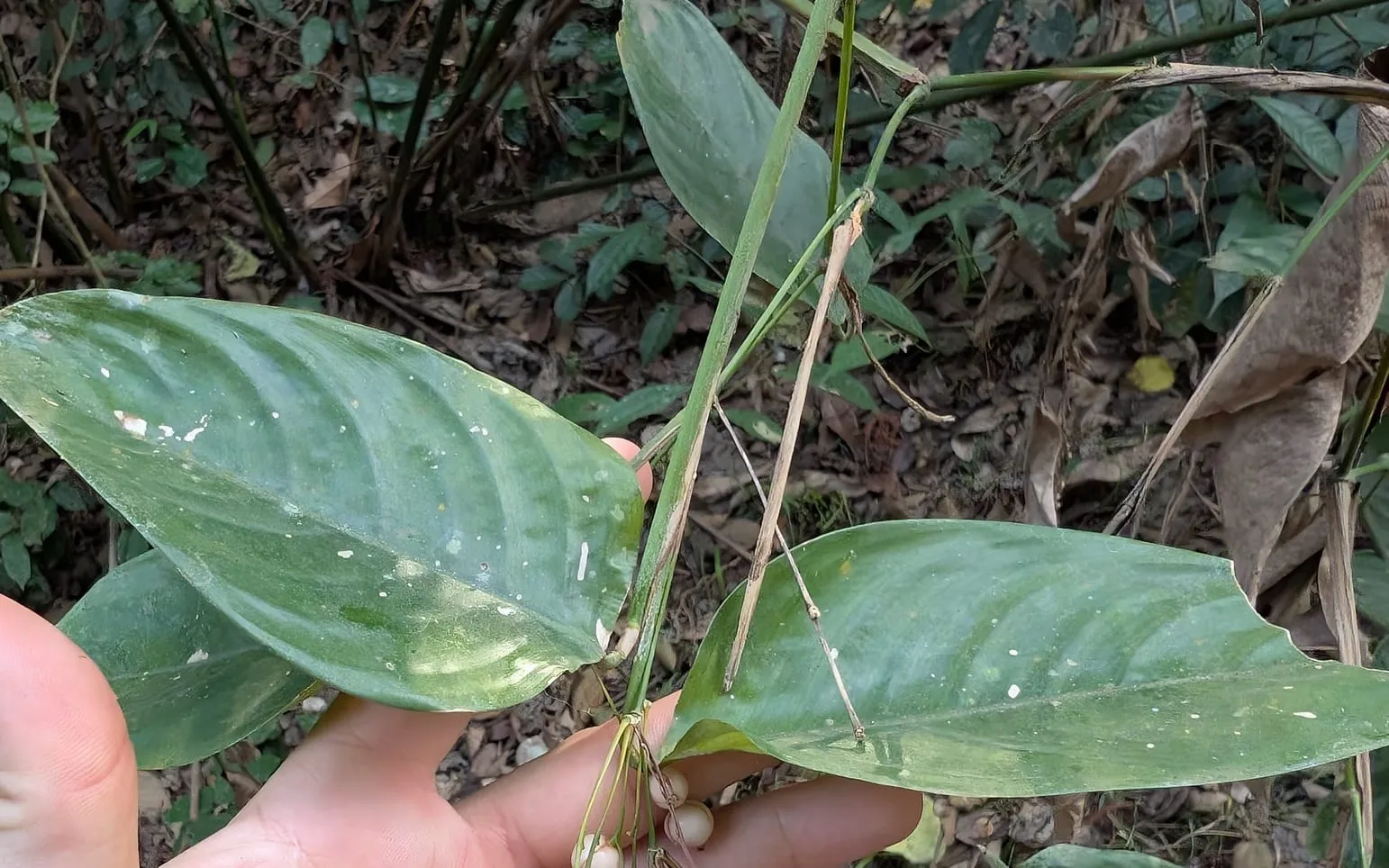
Marantochloa leucantha is the most familiar and widely used member of its genus across tropical Africa, a common understorey herb used far more often than any calathea. It has the prayer-plant family traits of a creeping rhizome, cane-like leafy stems and folding leaves, plus small white flowers that give it its name.
Reading leucantha
The name comes from the Greek leukos, white, and anthos, a flower, marking the pale blossoms as the plant’s distinguishing feature. Several marantochloas look much alike in leaf, so the white flowers and the fruit that follows help identify this one. A collector can key it out by bloom colour as well as by leaf shape.
Flowers, fruit and movement
Small white flowers open in loose branching clusters and are followed by little rounded fruits that ripen through blue to purple, bright against the plain green leaves. Each leaf sits on a stalk ending in the pulvinus, the water-filled hinge that lifts and folds the blade between day and night. The stems rise from a spreading underground rhizome, so a single plant broadens over time into a leafy patch. Birds take the coloured fruit and carry the seed off into new ground.
Where it grows wild
The species ranges widely through the forests of tropical Africa, growing in the shaded understorey, along stream banks and in clearings and regrowth where light filters down. Its native range gives it constant warmth, heavy rain and humid air, with no frost. It tolerates both deep shade and brighter gaps, and often grows in disturbed and secondary forest close to villages and well-used paths.
A plant used in daily life
Of all the marantochloas, this is the one most often used for leaves and stems. The broad leaves are cut in quantity to wrap food for cooking and market, to line and cover surfaces, and to thatch the roofs and walls of shelters. The tough pliable stems are split and woven into mats, baskets and cordage. Parts of the plant are also used in local herbal medicine. Those practical uses, rather than ornament, are why it stays so well known throughout its range.
Growing it under cover
M. leucantha is a tender tropical plant with no frost tolerance, suited to warm zones around USDA 10 to 12. It needs a minimum around 13 deg C and shelter from cold draughts and chilly window glass. Set it in filtered light or light shade, since harsh direct sun scorches and fades the leaves. With warmth and shelter it establishes quickly, and in a bright humid spot it may even produce its white flowers under glass. Because it is a tough working plant in the wild, it tolerates missed care more readily than the fussier patterned prayer plants do.
Room to spread and repotting
Left to itself the rhizome creeps outward each season, so the plant slowly fills the pot. Repot in spring when roots show at the surface or come through the drainage holes, moving up one size into fresh open mix and firming it gently around the clump. A congested plant flowers less freely, so divide a crowded clump before it becomes too tight. For blooms, keep it warm, humid and steadily fed through the growing season, because a well-nourished plant in good light is the one most likely to flower and fruit indoors.
Compost, watering and humidity
Plant it in a free-draining but moisture-retentive mix, peat-free where you can manage it, with bark and grit added for structure. Keep the medium evenly damp during warm active growth, letting the surface dry before you water again, and reduce watering as the weather cools so the rhizome never sits cold in soggy compost. Hard water can leave mineral marks on the leaves, so rain or filtered water is better. Moist air suits it, so stand the pot over damp gravel or cluster it among other plants.
Telling it from its relatives
Out of flower, this plant is easy to muddle with other green marantochloas, since the leaf on its own gives little away. Wait for the bloom if you can. The small white flowers and the blue to purple fruit belong to this species and separate it from its cane-forming cousins. Growers who keep several species side by side often label them by flower colour for that reason. The fruit ripens in stages, so a single plant can show green, blue and purple berries at once, which is a useful confirmation. Where a specimen never flowers under glass, the safest route to a name is comparison with a properly identified plant.
Feeding and propagation
Give a dilute balanced feed every couple of weeks from spring to early autumn, then none through the cool rest. The simplest way to increase it is division in spring, splitting the rhizome into rooted, leafy pieces and growing them on in warmth and humidity. Where the plant flowers and sets fruit, fresh seed is another option, though division is quicker and more reliable.
Troubleshooting
Wilting stems above dark, sour compost mean the rhizome is rotting in cold wet conditions, so dry the mix and raise the temperature. Browned, brittle leaf margins usually follow dry indoor air or salty tap water. In warm dry rooms, watch the leaf undersides for the fine speckling of spider mites and the leaf joints for the white waxy tufts of mealybugs, and treat both by wiping, rinsing and lifting the humidity around the plant.
Quick answers
What do the flowers look like? Small and white, carried in open branching sprays, and followed by fruits that ripen from blue to purple.
Why is it so widely grown near its home? Its leaves wrap and thatch and its stems weave, so it works in daily use instead of as decoration.
How do I get more plants? Divide the rhizome in spring into rooted pieces, or sow fresh seed if the plant fruits under your conditions.
What conditions does it hate? Cold, waterlogged compost and dry air. Keep it warm, humid and shaded from strong sun.
White-Flowered Marantochloa Prayer Plant problem guides
Not sure what is wrong? See the common houseplant pests guide.